
Adelaide Writers’ Week in Crisis: Free Speech, Fear, and the Fight for the “Grey Zone”
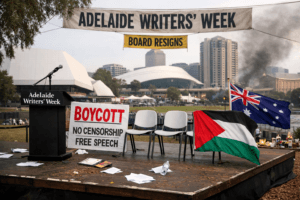
Adelaide Writers’ Week in Crisis: Free Speech, Fear, and the Fight for the “Grey Zone”
The Adelaide Writers’ Week, traditionally a celebration of literary expression and spirited debate, finds itself at the epicenter of a profound national crisis. Following the board’s decision to disinvite Palestinian-Australian author and academic Randa Abdel-Fattah, the festival is experiencing an unprecedented institutional collapse, raising urgent questions about free speech, cultural censorship, and the social fissures exposed in the wake of terrorism.
The controversy stems from a single decision made in a climate of fear. On January 8, 2026, the Adelaide Festival Board announced it had removed Abdel-Fattah from its February lineup. The board stated that while her work had no connection to the December 2025 Bondi Beach massacre—an Islamic State-inspired attack that killed 15 people at a Hanukkah celebration—her inclusion would not be “culturally sensitive” given her past statements.
This reasoning, which Abdel-Fattah denounced as “blatant and shameless anti-Palestinian racism,” has triggered a domino effect of boycotts, resignations, and legal threats, threatening the viability of one of Australia’s premier cultural events.
The Swift Unraveling: Boycotts and Boardroom Exodus
The backlash was immediate and widespread. Within days, what began as a protest snowballed into a mass exodus, decimating the festival’s program.
Table: Scale of the 2026 Adelaide Writers’ Week Boycott
| Category | Impact | Key Examples |
| Participant Withdrawals | Over 70 writers, poets, and artists | Zadie Smith, Percival Everett, Yanis Varoufakis, M. Gessen, Peter Greste, Evelyn Araluen, Chelsea Watego |
| First Nations Solidarity | All First Nations authors slated to speak joined boycott | |
| Sponsorship Loss | The Australia Institute withdrew funding | |
| Organizational Resignations | Peak body Writers SA withdrew from the event | |
| Board Collapse | Chair and three board members resigned | Tracey Whiting (Chair), Daniela Ritorto, Donny Walford, Nick Linke |
The resignations have created a constitutional crisis for the festival. The Adelaide Festival Corporation Act requires a board with a specific gender composition. With the departure of three members, including one of two remaining men, the board may no longer have a legal quorum to make decisions, potentially paralyzing the organization weeks before its scheduled events.
Between “Cultural Sensitivity” and Censorship: Examining the Motives
The board’s vague justification of “cultural sensitivity” has been criticized as a pretext for censorship. Critics argue the decision reflects a growing trend where marginalized voices, particularly those advocating for Palestinian rights, are deemed inherently “unsafe” or destabilizing.
The decision appears linked to pressure from specific groups. The Jewish Community Council of South Australia confirmed it sent a letter requesting Abdel-Fattah’s removal. However, the board’s move has been condemned by other Jewish organizations, such as the progressive Jewish Council of Australia, which called it “deeply concerning to all who value a plural and open society”.
Abdel-Fattah’s legal team has demanded transparency, sending a letter to the board chair requiring her to identify, with specificity, every past statement that informed their decision by January 14. This legal pressure highlights the potential defamatory association drawn between the author—a Palestinian-Muslim woman—and an act of Islamist terrorism.
A Deeper Pattern: The Shrinking “Grey Zone”
This incident is not isolated. It follows the 2025 Bendigo Writers Festival boycott, where Abdel-Fattah was among 50 participants who withdrew after the festival imposed a last-minute code of conduct seen as stifling debate on Palestine.
A powerful framework for understanding this conflict comes from journalist Peter Greste, who withdrew from Adelaide in protest. He references a 2015 Islamic State essay titled “The Extinction of the Grey Zone“. The “grey zone” represents the space where people of different identities coexist, debate, and argue without being forced into polarized camps. Greste argues that by banning voices deemed controversial, cultural institutions do “the work of Islamic State for them,” shrinking the very civic space that extremists seek to destroy.
This tension was present at Adelaide Writers’ Week before. In 2023, the festival faced protests for including Palestinian writers but stood by them, with Jewish director Louise Adler defending the invitations. Conversely, in 2024, the board resisted calls to cancel pro-Israel columnist Thomas Friedman, with the then-chair stating that asking to cancel a writer was an “extremely serious request”. This inconsistency suggests the current decision is less about a principled stand and more a reaction to post-Bondi political pressure.
The Broader Landscape: Art, Academia, and Ambiguous Definitions
The festival controversy mirrors a wider struggle within Australian universities and cultural institutions. Since the war in Gaza began, universities have implemented new policies and committees aimed at addressing antisemitism, which many academics argue are used to suppress pro-Palestine speech.
Initiatives like the Monash Initiative for Rapid Research into Antisemitism (MIRRA), which has government support, have been criticized for fostering a climate where the “ambience” or “vibe” of speech can be deemed antisemitic, moving beyond objective definitions. As one analysis notes, under such subjective frameworks, even a statement like “we support solidarity with Gaza” has been cited as an expression experienced as antisemitic.
This creates a chilling effect, signaling to racialized artists and academics that their participation in public life is conditional and that speaking on certain issues carries professional risk.
A Festival’s Future and a Nation’s Soul
As of January 12, the Adelaide Writers’ Week is a festival in name only. Its program is unpublished, its board is in disarray, its participants have fled, and its reputation is deeply tarnished. The South Australian Premier has expressed concern about the significant economic and reputational damage.
The crisis transcends literature. It is a stress test for Australian multicultural democracy. Can public institutions navigate genuine security concerns after a horrific terror attack without resorting to collective guilt or silencing legitimate political discourse? Does “cultural safety” mean insulating audiences from challenging ideas, or does it require platforms where difficult conversations about justice, race, and violence can occur?
The mass solidarity from writers of diverse backgrounds suggests a cultural sector deeply alarmed by the precedent. As Diversity Arts Australia stated, the decision “reinforces harmful and racist tropes” and makes cultural spaces “less safe, not more”.
The path forward is fraught. Reinstating Abdel-Fattah could be seen as capitulation by some; proceeding without her and the boycotting authors gutters the festival’s purpose. Ultimately, the saga of the 2026 Adelaide Writers’ Week may be remembered not for the books it promoted, but for the painful lesson it provided: when fear dictates curation, the most crucial stories are often the first to be removed from the stage, and the space for shared understanding—the “grey zone”—grows smaller for everyone.
You must be logged in to post a comment.