
Acknowledged Starvation, Undetermined Cause: The Legal Paradox in the Death of a Palestinian Teen
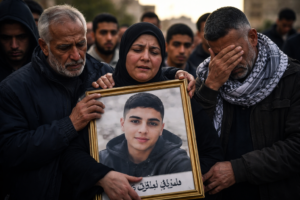
Acknowledged Starvation, Undetermined Cause: The Legal Paradox in the Death of a Palestinian Teen
In the sterile language of a legal ruling, a paradox lies buried. An Israeli judge has acknowledged, without equivocation, that a 17-year-old Palestinian boy held in state custody was “apparently starved.” Yet, in the same breath, the judge ordered the investigation into the teenager’s death closed, arguing that while the starvation was undeniable, its legal connection to the fatality could not be definitively proven.
The case of Walid Ahmad, a 17-year-old from the occupied West Bank town of Silwad, has become a flashpoint in the ongoing international scrutiny of Israel’s detention system. His death in March 2025 marked the first time a Palestinian minor died in Israeli custody since the beginning of the current cycle of violence, according to Palestinian officials. But the newly unsealed court decision, recently published by Haaretz, reveals a legal system grappling—and, critics argue, failing—to reconcile obvious physical evidence with the high legal bar required to hold the state accountable.
The Anatomy of a Closed Case
Walid Ahmad was arrested in September 2024 during a pre-dawn raid at his family home. The accusation, according to his family: throwing stones at soldiers. For six months, he was held in Megiddo prison, a facility in northern Israel. During that time, the healthy teenager described by his relatives withered away.
When Walid collapsed and died in March 2025, an autopsy was conducted. Dr. Daniel Solomon, an Israeli physician who observed the procedure, documented a body ravaged by extreme malnutrition. His report detailed signs of colitis—an inflammation of the colon that leads to chronic diarrhea—as well as scabies, a contagious skin disease often associated with overcrowded and unsanitary conditions.
Crucially, Dr. Solomon noted that starvation was “likely the leading cause” of death. He also pointed to records from the prison’s medical clinic indicating that Walid had been complaining about inadequate food for months.
One would assume that a prisoner dying of malnutrition in a state’s custody, with medical records to support complaints of hunger, would trigger a criminal inquiry. But under Israeli legal procedure, deaths in custody are subject to a unique system of judicial oversight. A judge is appointed to supervise the investigation, with the power to review evidence and determine if a crime occurred.
In December, Judge Ehud Kaplan exercised that power—but not in the way human rights advocates had hoped. In his ruling, Kaplan stated: “The fact that he was apparently starved cannot be hidden and should not be hidden. But I cannot determine based on the findings of the expert report that there is a causal connection between his poor physical condition and his death, and therefore I cannot determine that the death was caused by a crime.”
With that finding, the investigation was declared “exhausted.”
A Question of Causation
To legal observers, the judge’s decision highlights a persistent tension in cases of custodial death: the difficulty of proving intent or direct causation when the victim is the only one who can testify to the conditions they endured.
The ruling essentially separates the condition of starvation from the act of dying. It acknowledges the former as a fact but deems the latter too medically ambiguous to prosecute. Dr. Solomon’s report had introduced colitis as a potential complicating factor—an ailment that can cause severe dehydration and, in weakened individuals, lead to death. Yet, for the judge, the presence of a possible pre-existing or developed medical condition introduced enough “reasonable doubt” to sever the legal chain linking the prison’s food policies to the teenager’s final collapse.
For the family of Walid Ahmad, this distinction is a form of legal sophistry that mocks justice. “What is happening in Israeli prisons is a real tragedy, as there is no value for life,” his father, Khalid Ahmad, told the Associated Press in the weeks following his son’s death. The family is now engaged in a separate, desperate legal battle: petitioning Israeli courts for the release of Walid’s body, which remains held by Israeli authorities months after his death.
The Broader Context: A System Under Strain
The case does not exist in a vacuum. It emerges from a period of unprecedented strain on Israel’s detention infrastructure following the Hamas attacks of October 7, 2023, and the subsequent war in Gaza.
Rights groups, including B’Tselem and the Public Committee Against Torture in Israel (PCATI), have documented a dramatic deterioration in conditions across Israeli military and civilian prison facilities. Detainees—including those from Gaza held under administrative detention and West Bank residents arrested for alleged security offenses—have reported systematic beatings, severe overcrowding, and the withholding of food and water.
Walid Ahmad’s case has specifically highlighted the vulnerability of minors. According to official figures cited by B’Tselem, as of late September, the Israeli Prison Service held approximately 350 Palestinian minors on “security” grounds, with an additional 110 held for being in Israel illegally. These children and teenagers are subject to military court systems where conviction rates are exceptionally high, and where rights groups say due process is often lacking.
Firas Al-Jabrini, Walid’s lawyer during his detention, revealed that Israeli authorities denied all requests to visit his client in the months leading up to his death. The denial of family visits is a common tactic in “security” cases, but it also serves to obscure the conditions inside from external oversight.
A Legal Shield or a Sword?
Israel’s Prison Service maintains that it operates within the bounds of the law, asserting that all prisoners are granted basic rights. However, the decision by Judge Kaplan to keep the majority of his ruling sealed—with only a few sentences released after Haaretz successfully petitioned to lift a gag order—has fueled accusations of opacity.
The use of gag orders in cases involving detainees is a frequent source of friction between the judiciary and the press. While authorities argue such orders are necessary for security reasons or to protect ongoing investigations, critics contend they are often used to shield the state from embarrassing revelations regarding the treatment of prisoners.
In this instance, the lifting of the gag order has done little to clarify the circumstances of Walid’s death, but it has exposed the mechanics of a system that can acknowledge wrongdoing—starvation—without assigning responsibility for the result of that wrongdoing.
For Palestinian officials and human rights organizations, the ruling sets a dangerous precedent. If a detainee can be starved to the point of physical collapse, yet the death is ruled “undetermined” because of intervening medical factors exacerbated by that starvation, the standard of accountability becomes nearly impossible to meet.
The Human Cost
Beyond the legal arguments and geopolitical tensions lies the simple, unadorned tragedy of a life cut short. Walid Ahmad was a teenager from Silwad, a town north of Ramallah known for its olive groves and its history of resistance to occupation. By his family’s account, he was not a hardened militant but a boy caught up in the frequent nightly confrontations that have defined life in the West Bank for generations.
He was arrested when he was 16. He died at 17. In between, he was allegedly left to starve, suffering from scabies and gastrointestinal illness in a cell far from home, with no access to his lawyer and no ability to communicate his condition to the outside world.
His father’s plea for the return of his son’s body is a grim reminder that for the families of Palestinian detainees, the struggle rarely ends with death. The withholding of bodies has been used by Israel as a bargaining chip or a punitive measure for decades, a practice that the International Committee of the Red Cross (ICRC) has repeatedly stated must adhere to the principle of dignity and the right of families to bury their dead.
As the region remains embroiled in escalating conflict, the case of Walid Ahmad serves as a stark illustration of what rights groups call “lawfare”—the use of legal procedures to legitimize outcomes that, on their face, appear to contravene the most basic standards of custodial care.
Judge Kaplan concluded that the investigation was exhausted. But for the Ahmad family, and for the hundreds of Palestinian minors currently held in Israeli prisons, the question of whether justice was served remains as painfully open as the question of how a teenager can be starved in state custody without anyone being held accountable.
You must be logged in to post a comment.