
A Winter Ghost in Spring: Delhi Wakes to Rare March Fog on Eid Morning
In late March 2026, Delhi-NCR experienced an unusual weather anomaly as dense fog shrouded the city on Eid morning, following heavy rains that had delivered the coldest March day since 2020, with temperatures plunging to 21.7°C. The downpour also dramatically improved air quality, pushing the AQI into the “satisfactory” category for the first time in nearly five months, offering a brief respite from the capital’s chronic pollution. Meteorologists attributed the rare fog to saturated ground from the rainfall and a sharp overnight temperature drop, driven by an active western disturbance. The unseasonal chill, combined with the fog, added a serene but disorienting backdrop to Eid prayers, while underscoring deeper concerns about climate instability and Delhi’s geographical vulnerability to low-ventilation weather regimes compared to coastal cities like Bengaluru and Chennai.
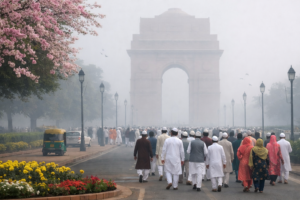
A Winter Ghost in Spring: Delhi Wakes to Rare March Fog on Eid Morning
For a city accustomed to the harsh, dry heat of late March, the morning of March 21, 2026, felt like a temporal anomaly. As worshippers began to make their way to mosques across the National Capital Region to mark Eid, they were greeted not by the usual promise of a warm spring sun, but by a thick, disorienting blanket of dense fog. It was a scene borrowed from December, yet it unfolded on the cusp of summer, leaving residents shivering in a chill that defied the calendar.
Just a day earlier, Delhi-NCR had witnessed a meteorological phenomenon of a different kind. Persistent showers had lashed the capital, not only washing away the accumulated grime of winter but also pulling the temperature down to an unseasonal low. The maximum temperature on Friday settled at a startling 21.7 degrees Celsius, making it the coldest March day since 2020. The city, famous for its scorching summers, was suddenly wrapped in the clammy embrace of a weather system more typical of February.
But it was Saturday’s fog that truly captured the city’s imagination—and its unease. The minimum temperature dipped to 13 degrees Celsius, three and a half degrees below normal, as a chilly wind swept through the streets of Delhi, Noida, and Ghaziabad. The India Meteorological Department (IMD) forecast a maximum of 27 degrees Celsius, but the morning air had a distinct bite, a stark reminder that the atmosphere does not always abide by the neat boundaries of seasons.
The Science Behind the Anomaly
For meteorologists, the rare March fog was a logical, albeit striking, consequence of the preceding rainfall. The heavy showers on Friday saturated the ground, loading the earth with moisture. As the skies cleared overnight under the influence of an active western disturbance, the mercury plummeted. When warm, moist air near the surface met the cooler temperatures, condensation occurred, forming the dense fog that shrouded the city.
Akhil Shrivastava of the India Meteorological Department explained that a large-scale thunderstorm activity was currently being witnessed across India, with conditions likely to remain cloudy. The IMD also predicted more rainfall on Saturday evening, with very light rain expected to return on Monday, driven by the lingering influence of the western disturbance.
This wasn’t merely a weather event; it was a visible clash of systems. The western disturbance—a storm system originating in the Mediterranean region—had pushed deep into northern India, disrupting the typical spring warming trend. While such disturbances are common in winter, their intensity and persistence in late March is becoming a notable pattern, raising questions about shifting climatic rhythms in the subcontinent.
A Breath of Fresh Air
Amidst the inconvenience of the fog and the unseasonal cold, there was a silver lining that Delhiites could literally breathe. The same persistent showers that caused the temperature to plunge also performed a miracle of sorts: they scrubbed the city’s notoriously toxic air clean.
For nearly five months—161 days to be precise—Delhi’s Air Quality Index (AQI) had languished in the “poor,” “very poor,” and “severe” categories, a toxic haze that has become the capital’s unwanted identity. On Friday, following the rain, the AQI fell to 99, pushing it into the “satisfactory” category for the first time since October 9, 2025.
It was a moment of respite that highlighted the tragic irony of Delhi’s environmental crisis. A heavy downpour, a force of nature that causes traffic jams and waterlogging, is now one of the only reliable mechanisms to break the city’s months-long cycle of air pollution. The sight of clear blue skies and distant horizons, so rare in the winter months, returned briefly, offering a glimpse of what life could be like with sustained environmental action.
The Fog and the Faithful
For many in Delhi, the fog of March 21, 2026, will be remembered not just for its meteorological rarity, but for its cultural context. It coincided with Eid, a festival usually associated with new clothes, festive feasts, and the gentle warmth of spring. Yet, this year, worshippers braved the chill and low visibility to gather at mosques.
The visuals were striking. Men in crisp kurtas and topis, their breath visible in the cold morning air, walking through a ghostly, silent landscape where familiar landmarks were reduced to silhouettes. The fog muffled sounds, creating a serene, introspective atmosphere that contrasted with the usual bustling energy of a festival morning. It added a layer of spiritual poignancy, a moment where the unpredictability of the natural world invited a pause, a moment of reflection before the festivities began.
Delhi’s Geography vs. Its Urban Sprawl
The news report also offered a telling comparison that cuts to the heart of India’s urban planning challenges. It noted that a large share of days in Delhi and Patna fall under “low-ventilation weather regimes.” In contrast, cities like Bengaluru and Chennai have recorded lower and more stable PM2.5 levels.
This isn’t merely a matter of luck or location; it is a story of geography versus development. Delhi’s landlocked location, far from the moderating influence of the sea, makes it susceptible to extreme weather and the trapping of pollutants. The city acts like a basin, where emissions from vehicles, industries, and construction get trapped under a blanket of cool air during winter, leading to the infamous “airpocalypse.”
Bengaluru and Chennai, blessed with coastal locations and higher average wind speeds, benefit from natural ventilation. However, the report’s subtext suggests that while Chennai and Bengaluru have a geographical head start, Delhi’s struggle is compounded by decades of unplanned urbanization. The solution, therefore, isn’t just about controlling emissions, but also about understanding urban design—creating “ventilation corridors,” preserving green spaces, and building in a way that doesn’t trap pollutants.
The Bigger Picture: Climate Instability
The events of this March week—from record-cold days to rare fog and the brief return of clean air—are a microcosm of a larger global trend: climate instability. The traditional, predictable rhythms of Indian seasons are becoming increasingly erratic.
A cold day in March is not inherently alarming. But a “coldest March day in six years,” combined with heavy rainfall and fog, signals a departure from historical norms. These fluctuations have real-world impacts. They affect the rabi (winter) harvest, particularly wheat, which requires warm temperatures to ripen. They increase the prevalence of vector-borne diseases like malaria and dengue, which thrive in the stagnant water left behind by unseasonal rain. For the urban poor, particularly those living in slums or on the streets, a sudden cold spell in late March is not a novelty; it is a health crisis.
The “satisfactory” air quality, while a relief, also serves as a stark indictment. It shows that the solution to Delhi’s air pollution is not technologically out of reach. The same effect could be achieved not by rain, but by sustained political will, by a complete overhaul of industrial fuel standards, by a permanent curb on stubble burning, and by a massive investment in public transport. The rain gave Delhi a glimpse of a livable city, but it was a fleeting gift, not a solution.
A City’s Resilience
As the sun eventually rose on Saturday, the fog began to lift, revealing a city waking up to a day that felt both strange and familiar. The temporary weather office advisories would expire, the roads would clog again, and the air, though clean for the moment, would soon face the relentless pressure of millions of vehicles and construction sites.
The story of Delhi’s rare March fog is not just a weather update. It is a story about the resilience of a city that endures the extremes of scorching summers, choking winters, and increasingly unpredictable transitional seasons. It’s about worshippers who will make their way to prayer regardless of the mercury reading, and about a populace that has learned to celebrate the brief return of blue skies as a victory.
It is also a reminder of our vulnerability. In an era of climate change, the surest prediction is uncertainty. The cold, foggy Eid morning of 2026 will likely be remembered as an anomaly, a footnote in the city’s weather history. But for those who lived through it—who felt the unseasonal chill on their skin and breathed the crisp, clean air—it was a powerful reminder of the delicate balance of the world we inhabit, and how quickly, with a change in the wind, it can all shift.
As the IMD forecasts more rainfall and the potential for thunderstorms, one thing is clear: Delhi’s spring of 2026 will not be easily forgotten. It has been a season of disruption, but also a season of clarity—both meteorological and existential—forcing a city to look at its own vulnerabilities and its fleeting moments of respite.
You must be logged in to post a comment.