
A Two-Tiered Justice: How Israel’s New Death Penalty Law Exposes the Fault Lines of Occupation
Israel’s new death penalty law, passed by the Knesset, applies only to Palestinians in the occupied West Bank convicted of terror-related killings—while exempting Jewish extremists for identical crimes—prompting the UN’s human rights chief to warn that its discriminatory application would constitute a war crime. The legislation, which allows executions within 90 days without unanimity from judges, has drawn sharp international rebuke: the EU called it a “clear step backwards,” Spain’s prime minister labeled it “a step closer to apartheid,” and even Germany expressed grave concern. Human rights groups argue the law entrenches a two‑tiered system of justice and meets the definition of apartheid, while domestic challenges have been filed with Israel’s Supreme Court to overturn it.
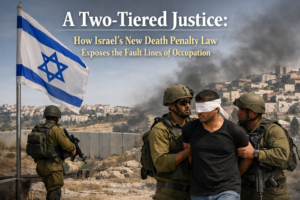
A Two-Tiered Justice: How Israel’s New Death Penalty Law Exposes the Fault Lines of Occupation
In the harsh light of a Jerusalem afternoon on Monday, the Israeli Knesset passed legislation that fundamentally alters the calculus of justice in the occupied territories—and in doing so, may have crossed a threshold that even some of Israel’s staunchest allies can no longer ignore.
The new law, which establishes the death penalty as the default punishment for Palestinians convicted of deadly attacks deemed terrorism by military courts, applies exclusively to residents of the occupied West Bank. Jewish extremists accused of identical crimes face no such consequence. The distinction is not incidental to the law—it is the law.
When Volker Türk, the UN High Commissioner for Human Rights, called the legislation “patently inconsistent with Israel’s international law obligations” and warned that its application would constitute a war crime, he was articulating what human rights advocates have long documented: the formal codification of a two-tiered legal system in which justice is not blind but sharply discriminating.
The Architecture of Discrimination
To understand what has just happened in Israel’s parliament, one must first understand what the law actually does—and what it does not do.
The legislation applies specifically to Palestinians in the Israeli-occupied West Bank who are tried in military courts. Under its provisions, judges may impose death sentences without a request from prosecutors, without requiring unanimity among the bench, and with a simple majority vote sufficient to send a person to the gallows. Those sentenced would be held in isolation, denied visitors, and permitted legal consultations only by video link. Executions would follow within ninety days.
This is not the law that applies to Israeli citizens. It is not the law that would apply to Jewish settlers who commit violent attacks against Palestinians—attacks that have surged in recent years with the expansion of settlements and the growing impunity afforded to settler militias.
The national security minister, Itamar Ben-Gvir, has made his enthusiasm for the measure unmistakable, repeatedly appearing with a noose-shaped lapel pin—a symbol of the executions his office championed through the Knesset. The Israeli public broadcaster KAN reported that executions would be carried out by hanging, a method long abandoned in most of the democratic world.
A History of Abandonment
Israel has maintained a formal death penalty for certain crimes since its founding, but it has been used only once in the country’s history—the 1962 execution of Nazi war criminal Adolf Eichmann. That exceptional case, carried out against one of the architects of the Holocaust, has long been understood as the outer limit of Israeli capital punishment, a response to crimes so monstrous that ordinary legal frameworks could not contain them.
The new legislation shatters that understanding. It transforms the death penalty from a theoretical possibility into an operational reality, stripping away the procedural safeguards that made executions rare even when they were legally permissible.
For Palestinians living under occupation, the message is clear: the protections that have historically restrained Israeli state violence against its own citizens do not extend to you.
The International Response
The reaction from the international community has been unusually swift and unified for a subject that often divides Western capitals.
The European Union’s spokesperson Anouar El Anouni expressed concern over “the discriminatory nature of the law,” calling it “a clear step backwards.” The statement was notable not only for its content but for its timing—the EU does not typically issue immediate condemnations of Israeli legislation.
Spain’s Prime Minister Pedro Sánchez went further, using the loaded term “apartheid” to describe the legal architecture the law represents. “Same crime, different punishment,” Sánchez wrote on X. “That is not justice. It is a step closer to apartheid.”
Even Germany, whose historical obligations have made it one of Israel’s most reliable defenders in European forums, expressed unease. Government spokesperson Stefan Kornelius noted that “such a law would likely apply exclusively to Palestinians in the Palestinian territories,” adding that “the rejection of the death penalty is a fundamental principle of German policy.”
For Germany to distance itself from an Israeli government policy—even cautiously, even diplomatically—represents a significant moment. It suggests that the cumulative weight of occupation policies, settlement expansion, and now explicit legal discrimination has begun to strain relationships that were once considered unbreakable.
The Apartheid Framework
The word “apartheid” appears repeatedly in critiques of the new law, and not only from political leaders. Human rights organizations that have spent decades documenting conditions in the occupied territories have increasingly adopted the term to describe a system they say meets the international legal definition.
Adam Coogle, deputy Middle East director of Human Rights Watch, offered a measured but damning assessment: “Israeli officials argue that imposing the death penalty is about security, but in reality it entrenches discrimination and a two-tiered system of justice, both hallmarks of apartheid.”
Oxfam’s Shaista Aziz connected the law to broader patterns of violence, noting that “Israel holds more than 9,000 Palestinians in its jails—many unlawfully and subject to inhumane conditions, starvation and torture as state policy.”
The apartheid framing is significant because it moves the conversation beyond isolated policy critiques to a structural analysis. If Israel’s legal system operates on two separate tracks—one for Jews, one for Palestinians—then no single law can be understood in isolation. Each new piece of legislation becomes another brick in a wall of institutionalized discrimination.
The Domestic Challenge
Not everyone in Israel supports the law. Within hours of its passage, several Israeli human rights groups, joined by three members of parliament, filed petitions to the Supreme Court seeking to overturn it.
The Association for Civil Rights in Israel argued that the law creates “two parallel tracks, both designed to apply to Palestinians” and should be struck down on constitutional grounds. The organization’s challenge reflects a tension that has long existed within Israeli society: between democratic principles and the demands of occupation, between equal protection under law and the reality of governing another people without granting them political rights.
These domestic legal challenges face uncertain prospects. Israel’s Supreme Court has shown increasing reluctance to intervene in matters it considers political rather than legal, and the current government has made clear its intention to reshape the judiciary in ways that would limit its ability to strike down legislation.
Beyond the Legal Arguments
For all the technical legal analysis the law invites—questions about international humanitarian law, about the Geneva Conventions, about the jurisdiction of military courts—there is a simpler human truth at its core.
The law declares that some lives are worth less than others. It codifies a hierarchy of human value based on national identity. It says that when a Palestinian kills an Israeli, the response may be death, but when an Israeli kills a Palestinian—in the West Bank, in Gaza, in circumstances that range from military operations to settler vigilantism—the response is something else entirely.
This is not a subtle distinction. It is not hidden in the fine print of legal texts or buried in the procedural details of military court administration. It is the explicit purpose of the legislation, openly discussed by its proponents, symbolized by the noose on Ben-Gvir’s lapel.
What Comes Next
The law faces immediate challenges, both in Israeli courts and in international forums. The International Criminal Court has already opened investigations into alleged crimes committed in the occupied territories, and the formal codification of a discriminatory death penalty regime is likely to become part of that prosecution’s evidentiary record.
But the deeper significance of the legislation may be what it reveals about the trajectory of Israeli politics. A country that once took pride in its Supreme Court’s willingness to strike down government policies, that once saw itself as a beacon of democratic governance in an undemocratic region, has now passed a law that makes explicit what was once implicit: that the rights enjoyed by Israeli citizens do not extend to Palestinians living under Israeli control.
The international response suggests that this is not a development the world is prepared to accept quietly. The language of war crimes, of apartheid, of fundamental violations of international law—these are not terms deployed lightly. They carry weight, legal and moral, and their application to Israeli policy represents a shift in how the country is perceived by its traditional allies.
For Palestinians in the occupied territories, the law is another reminder of what life under occupation means: a legal system that applies to you but does not represent you, courts that judge you but owe you no accountability, punishments that escalate without any corresponding expansion of rights.
For Israelis who oppose the law, it represents something else: evidence that their country is moving in directions they cannot support, that the occupation is corrupting the democratic institutions they once believed would contain it.
The noose that Ben-Gvir wears on his lapel is a symbol. But it also functions as a kind of mirror, reflecting back an image of what Israeli governance has become. The question now is whether enough Israelis, enough allies, enough people of conscience in the international community, will look into that mirror and recognize what they see.
You must be logged in to post a comment.