
A Torpedo in the Dark: The Sinking of the IRIS Dena and the War That Reached India’s Shoreline
A US submarine torpedoed and sank the Iranian warship IRIS Dena in the Indian Ocean off Sri Lanka’s southern coast on March 4, 2026, killing 87 of the 130 sailors on board just weeks after the vessel had participated as a diplomatic guest in India’s International Fleet Review and Exercise Milan in Visakhapatnam. The attack, which occurred in international waters while active hostilities were underway between the US and Iran, has created a profound diplomatic dilemma for India as it attempts to balance its defence partnership with Washington against its longstanding ties with Tehran, while strategic analysts argue the sinking represents both a human tragedy and a pointed message about America’s willingness to project power in what India considers its maritime neighbourhood, effectively challenging New Delhi’s carefully cultivated image as the Indian Ocean’s “preferred security partner.”
A Torpedo in the Dark: The Sinking of the IRIS Dena and the War That Reached India’s Shoreline
The photograph, posted on a cheerful February morning, showed a grey frigate gliding into Visakhapatnam harbour under a cloudless sky. Sailors in immaculate white uniforms lined the deck. The Indian Navy’s social media team had chosen the perfect caption: “Welcome!” with hashtags celebrating friendship and united oceans. The Iranian warship IRIS Dena had arrived as a guest, a diplomatic visitor to one of India’s most ambitious naval gatherings.
Less than three weeks later, that same vessel lay 3,000 metres beneath the Indian Ocean, its hull torn apart by a US Navy torpedo. Of the 130 Iranian sailors on board, only 32 survived. The rest—87 young men, many of whom had marched in a parade along India’s eastern coast just days earlier—were gone before the sun rose over Sri Lanka’s southern tip on 4 March 2026.
The Last Port of Call
Vice Admiral Arun Kumar Singh (retired) still remembers watching the Iranian contingent during the International Fleet Review. He had been invited to the event, part of Exercise Milan—a multilateral naval exercise designed to showcase India’s emergence as the Indian Ocean’s “preferred security partner.” Seventy-four countries had sent delegations. Eighteen warships had sailed into Visakhapatnam. Among them was the Dena, a Moudge-class frigate commissioned in 2021 and assigned to Iran’s Southern Fleet, which normally patrols the Strait of Hormuz and the Gulf of Oman.
“I saw the boys marching in front of me,” Singh recalls, his voice carrying the weight of hindsight. “All young people. Perhaps ten metres away. I feel very sad now, thinking about it.”
The parade along the Visakhapatnam seafront had been a scene of deliberate symbolism—nations gathered in maritime fellowship, their differences set aside for the duration of the exercises. The Iranian sailors had smiled for photographs. They had exchanged pleasantries with their Indian hosts. They had represented their country at a moment when Iran’s navy was increasingly isolated on the world stage.
On 21 February, the assembled ships sailed out for the sea phase of Exercise Milan, scheduled to run until 25 February. The Dena participated in drills, its crew demonstrating the capabilities of a vessel that Tehran had touted as a symbol of its indigenous naval ambitions. What happened after the exercises concluded remains unclear. The ship may have returned to port briefly or peeled away immediately. Either way, by early March, it was steaming through waters off Galle, Sri Lanka—roughly two to three days’ sailing from India’s east coast.
What the Dena was doing during those seven days, no one has officially explained.
The Morning the Sea Caught Fire
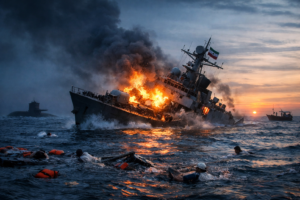
At approximately 5:30 a.m. on 4 March, the Indian Ocean approximately 20 nautical miles west of Galle erupted.
A Mark-48 torpedo—a heavyweight weapon carrying roughly 650 pounds of high explosive—slammed into the Dena’s hull. Designed to snap warships in two, the torpedo did its work with terrible efficiency. Video footage released later by the Pentagon suggests the attacking submarine, whose identity remains classified, had fired from perhaps three or four kilometres away, remaining invisible beneath the surface throughout.
The Dena sank in under three minutes.
“It’s a miracle they managed to send an SOS,” Singh says, his voice reflecting the professional admiration of a former submarine commander for a crew that managed one final act of communication as their ship disintegrated around them.
The distress signal reached the Sri Lanka Maritime Rescue Coordination Centre in Colombo in the early morning darkness. What followed was a chaotic regional response: Sri Lanka’s navy launched rescue operations first, pulling 32 survivors from the water. India deployed a long-range maritime patrol aircraft to support the search and kept another aircraft with air-droppable life rafts on standby. A naval vessel already operating in the vicinity reached the area by late afternoon. Another ship sailed from the southern Indian port city of Kochi to join the effort, continuing to comb the waters for survivors and debris in the days that followed.
But for most of the Dena’s crew, rescue came too late. By the time the sun fully rose over Galle, 87 sailors were dead.
The Fishermen Who Saw It First
In the fishing villages along Sri Lanka’s southern coast, the morning of 4 March began like any other. Boats had put out before dawn, their crews hoping for a good catch. Then the horizon lit up.
“We heard a sound like thunder from clear sky,” recalls Priyantha Kumara, a fisherman from a village near Galle who asked that his specific location not be published. “Then we saw smoke. By the time we turned our boats toward it, there was nothing to see except debris floating on the water.”
Sri Lankan fishermen would spend the next 48 hours pulling bodies from the sea. At the Galle National Hospital, Iranian embassy officials stood vigil as injured sailors were brought ashore. The scene outside the hospital—an Iranian diplomat in a dark suit, standing before a colonial-era building, his face etched with exhaustion and grief—became one of the defining images of the tragedy.
For the survivors, the questions began immediately. Why had they been targeted so far from any recognised combat zone? Had their vessel been tracked since leaving Indian waters? How long had the American submarine stalked them before firing?
US Defence Secretary Pete Hegseth offered a stark explanation: the vessel “thought it was safe in international waters” but instead “died a quiet death.” The phrasing, almost literary in its brutality, captured the operational reality of modern naval warfare—a reality in which ships can vanish beneath the waves without warning, their crews given no chance to fight back.
The Strategic Reckoning
In New Delhi, the sinking landed with the force of a diplomatic shockwave. India had spent years cultivating relationships with both Washington and Tehran, balancing deepening defence ties with the United States against longstanding political and economic connections with Iran. The Milan exercise had been intended to demonstrate India’s growing maritime leadership. Instead, it had resulted in one of its invited guests being destroyed in what analysts began calling India’s “maritime backyard.”
“This is more than a battlefield episode,” wrote strategic affairs expert Brahma Chellaney on X. “By sinking a vessel returning from an Indian-hosted multilateral exercise, Washington effectively turned India’s maritime neighbourhood into a war zone, raising uncomfortable questions about India’s authority in its own backyard.”
The critique cut deep. For years, India had positioned itself as the Indian Ocean’s preferred security partner—a stable, reliable presence in waters increasingly contested by major powers. The Milan exercise, with its 74 participating countries and 18 visiting warships, had been intended to showcase precisely that role. Now a visiting vessel lay at the bottom of those waters, destroyed by India’s most important strategic partner.
Vice Admiral Singh, watching the debate unfold from retirement, offers a more measured assessment. “When a shooting war is on, any ship of a belligerent country becomes fair game,” he notes. The United States and Iran had been engaged in active hostilities since 28 February, with claims that 17 Iranian naval vessels had already been destroyed. In that context, the Dena’s presence in international waters made it a legitimate military target.
But legitimacy, in international law, does not always align with diplomatic wisdom. And for India, the timing could hardly have been worse.
The Question of Responsibility
Under the Second Geneva Convention, nations at war are required to take “all possible measures” to rescue wounded or shipwrecked sailors after a naval attack. In practice, this obligation applies only when rescue can be attempted without endangering the attacking vessel. Submarines, Singh explains, almost never surface after an attack.
“Submarines don’t surface,” he says flatly. “If you surface and give up your position, someone else can sink you.” The attacking American submarine, wherever it lurked in the hours after the torpedo struck, would have remained submerged and silent, listening to the chaos above through its sonar while contributing nothing to the rescue effort.
The speed of the Dena’s sinking compounded the tragedy. A ship breaking up in under three minutes leaves little opportunity for evacuation, for lifeboats, for the organised abandon-ship procedures that navies practice endlessly. The crew that managed to send a distress signal before the water closed over them had accomplished something remarkable—but not remarkable enough to save their shipmates.
For India’s diplomatic establishment, the immediate challenge was crafting a response that acknowledged the tragedy without alienating either Washington or Tehran. External Affairs Minister S. Jaishankar spoke by telephone with his Iranian counterpart, Abbas Araghchi. He also posted a photograph of a meeting with Iran’s Deputy Foreign Minister at a foreign policy summit in Delhi—a visual signal of continuing engagement.
But the carefully worded statements avoided direct criticism of the American strike. Prime Minister Narendra Modi called broadly for “dialogue and diplomacy” to resolve conflicts, without addressing the sinking directly. The balancing act, always delicate, had become nearly impossible.
The Human Cost of Geopolitics
At the Galle National Hospital, the injured sailors told stories that would never make it into official statements. They spoke of comrades lost, of the terror of a torpedo striking without warning, of swimming through fuel-slicked water toward distant lights. One survivor, his burns still being treated, reportedly asked repeatedly about a friend who had been standing beside him when the explosion came. No one had the heart to tell him what they already knew.
In Iran, the sinking became a rallying cry. Foreign Minister Araghchi described it as “an atrocity at sea” and stressed repeatedly that the frigate had been “a guest of India’s Navy”—a phrase calculated to maximise Tehran’s diplomatic advantage. The implication was clear: India bore some responsibility, if not legal then at least moral, for what had happened to its invited guest after it left Indian waters.
Kanwal Sibal, a veteran diplomat, articulated this view directly. “The Iranian ship would not have been where it was had India not invited it to the Milan exercise,” he wrote on X. “A word of condolence at the loss of lives of those who were our invitees would be in order.”
India has not yet offered such a word, at least not publicly. Whether it will remains an open question—one that speaks to the broader challenge of maintaining relationships with powers that are actively at war with each other.
The Warning Beneath the Waves
For military historian Srinath Raghavan, the Dena’s sinking carries lessons that extend far beyond the immediate diplomatic awkwardness. “First, the spreading geography of this war,” he notes. “Second, India’s limited ability to manage its fallout.”
The war between the United States, Israel, and Iran, which had previously been contained largely to the Middle East, had suddenly reached waters just off Sri Lanka—waters that India has long considered part of its strategic neighbourhood. A US submarine had fired on a vessel that had recently been India’s guest, in an area where Indian naval assets operate routinely. The message, Raghavan suggests, was unmistakable.
“Indeed, the US Navy has fired a shot across the bow aimed at all regional players, including India.”
The question now is how India responds. Will it accelerate its military modernisation, seeking to ensure that no foreign power can operate with impunity in its maritime neighbourhood? Will it double down on its balancing act, maintaining ties with both Washington and Tehran while hoping the contradictions don’t become unsustainable? Or will it be forced, eventually, to choose sides?
The 87 dead sailors aboard the Dena did not live to see those questions answered. They died in international waters, far from their homes, in a war that had nothing to do with them personally but everything to do with the strategic position their vessel occupied. They died because a submarine commander somewhere in the depths received an order and carried it out with professional efficiency.
And they died because, in the end, the laws of war are written by the powerful. The Second Geneva Convention requires rescue efforts after naval attacks—but only when rescue can be attempted without endangering the attacker. The attacking submarine, hidden and silent, faced no such danger. The survivors in the water, and the bodies floating beside them, were someone else’s problem.
The Debris Field
Days after the sinking, Indian and Sri Lankan vessels continued to search the waters off Galle. They found debris, oil slicks, and the occasional piece of wreckage that might once have belonged to a young sailor’s personal effects. What they did not find—what they will never find—is an explanation that makes sense of the tragedy.
The war between America and Iran continues. More ships will sink, more sailors will die, more families will receive the news that their loved ones are not coming home. The IRIS Dena, a relatively new vessel commissioned in 2021, will become a footnote in that larger conflict—a statistic, a data point, a reminder of the costs that accumulate when great powers collide.
But for those who saw the Iranian sailors marching along the Visakhapatnam seafront, smiling in their white uniforms on a sunny February morning, the Dena will always be more than that. It will be the ship that came as a guest and left as a casualty. It will be the reminder that in war, there are no safe harbours—only moments of illusory peace before the torpedo strikes.
Vice Admiral Singh, who watched those young men parade past him just weeks before their deaths, puts it simply: “I feel very sad.” In that sadness, stripped of strategic analysis and diplomatic calculation, lies the only truth that ultimately matters. Eighty-seven sailors are dead. They came to India as friends. They left as victims of a war that was never theirs.
The sea off Galle has returned to its usual rhythms. The fishing boats put out before dawn. The sun rises over the water. But somewhere beneath the surface, in the darkness where light never reaches, the wreck of the Dena lies silent—a tomb for 87 men, and a question mark over the future of the Indian Ocean.
You must be logged in to post a comment.