
A Sacred Symbol in a Secular Conflict: The Fall of a Vishnu Statue and the Weight of History
In late December 2025, the dismantling of a recently erected Hindu deity statue on the disputed Thailand-Cambodia border by Thai military engineers escalated a localized territorial conflict into a matter of international cultural diplomacy, prompting India to formally voice concern. Citing the act as “disrespectful” to a “shared civilizational heritage,” India urged both nations to resolve their dispute through dialogue, emphasizing the protection of cultural sentiments. Thailand defended the action as a necessary security measure to remove an unauthorized “landmark” erected to support a Cambodian claim, stressing it was not an affront to religion. The incident underscores how ancient symbols become pawns in modern sovereignty disputes, revealing the tension between preserving a region’s common historical bonds and the pragmatic, often confrontational, tactics of border defense.
A Sacred Symbol in a Secular Conflict: The Fall of a Vishnu Statue and the Weight of History
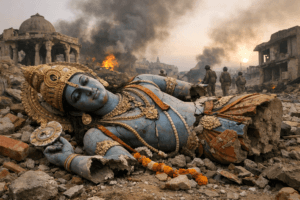
A crane operated by Thai Army engineers moves in, its mechanical arm a stark contrast against the serene stone face of a Hindu deity. In moments, a statue of Lord Vishnu, recently erected on a disputed stretch of land known as Chong An Ma Pass, is dismantled[reference:0]. This brief, brutal act in late December 2025 ignited more than just another skirmish in the long-running Thailand-Cambodia border conflict. It triggered a diplomatic intervention from New Delhi, exposing the deep fault lines where modern territorial disputes collide with ancient civilizational bonds[reference:1].
The incident is a microcosm of a complex struggle. The Thai military stated the statue was a “landmark” erected by Cambodian soldiers to fortify an “unlawful claim” over what they assert is Thai soil, and its removal was “routine area management”[reference:2]. Cambodia countered, with a government spokesman claiming the statue was “inside our territory” and condemning its destruction[reference:3]. Caught in the middle was not just a piece of stone, but a symbol revered by millions.
India’s response was swift and pointed. The Ministry of External Affairs spokesperson, Randhir Jaiswal, called the demolition “disrespectful,” an act that “hurt the sentiments of followers around the world”[reference:4]. His statement carried a profound historical weight, reminding both nations that “Hindu and Buddhist deities are deeply revered and worshipped by people across the region, as part of our shared civilizational heritage”[reference:5]. This was not merely a protest; it was an invocation of a common past that long predates the modern border lines drawn on maps.
The Weight of the Past: Civilizational Heritage as a Diplomatic Tool
India’s statement is a powerful reminder of its role as the cradle of a cultural wave that shaped Southeast Asia. For centuries, concepts of kingship, art, architecture, and religion flowed from the Indian subcontinent to the kingdoms of Sukhothai, Angkor, and beyond. The revered Ramakien (the Thai version of the Ramayana) and the magnificent bas-reliefs of Angkor Wat are enduring testaments to this shared heritage. In this context, a statue of Vishnu is never just a statue; it is a node in a vast cultural network.
By framing its concern around this “shared civilizational heritage,” India employs a sophisticated form of cultural diplomacy. It elevates the issue from a bilateral territorial quarrel to a matter of preserving a legacy that belongs to the entire region. This stance allows New Delhi to position itself not as a meddling third party, but as a legitimate stakeholder in the region’s cultural well-being, a role that resonates deeply both domestically and among the global Hindu diaspora.
The Pragmatics of the Present: Sovereignty and Symbolic Warfare
Thailand’s clarification, issued after India’s expression of concern, reveals the pragmatic, security-focused perspective of a state in a territorial dispute. Thai authorities stressed that the demolished structure was not a “registered religious site” but a “later addition” installed recently[reference:6]. Their actions, they asserted, were “solely for the purpose of area management and security… to confirm control of the area, minimize the risk of misunderstandings, and prevent the use of symbols that could lead to further tension”[reference:7].
This rationale highlights a cold, modern reality: in conflict zones, cultural and religious symbols can be weaponized. Erecting a shrine or a statue can be a tactic to cement a territorial claim, a form of “symbolic warfare” that invests a piece of land with cultural and spiritual significance for one side. The removal of such symbols then becomes a necessary military and political act to negate that claim. From this viewpoint, the Thai army was not attacking Hinduism but dismantling a perceived tool of Cambodian encroachment.
A Conflict with Deep Roots: More Than a Statue
The clash over the Vishnu statue is a flare-up in a border dispute that has simmered for decades, centered around the ancient Preah Vihear temple and surrounding areas. The conflict reignited violently in 2025, with reports of significant casualties and displacement[reference:8]. Both sides have accused each other of damaging cultural sites, with Cambodia claiming Thailand has attacked border temples[reference:9].
This history adds layers of bitterness and suspicion. When Cambodia condemns the statue’s destruction and Thailand cites security needs, both are speaking from a deep well of mutual grievance. The statue, in this environment, was doomed to be seen not as an object of veneration, but as a pawn in a much larger and deadlier game.
The Path Forward: Between Dialogue and Destruction
India’s central message, repeated in its statement, is a call to “return to dialogue and diplomacy” to restore peace and avoid damage to heritage[reference:10]. This is the crucial fork in the road. One path leads to a further escalation where cultural heritage becomes collateral damage, eroding the very shared history that binds the region. The other path requires a difficult but essential separation: to de-weaponize cultural symbols and find mechanisms to protect them even amidst sovereignty disputes.
The international community, through bodies like UNESCO, has long advocated for the protection of cultural property during conflict. The 1954 Hague Convention expressly obligates parties to safeguard cultural heritage. While the Vishnu statue may not have been a centuries-old monument, the principle remains. Respecting shared heritage, even—or especially—in times of tension, is a hallmark of civilized statecraft.
The dismantled statue at Chong An Ma Pass is a silent witness to a fraught present. Its fate underscores a urgent lesson: in Southeast Asia, the past is never truly past. It lives in stone, in story, and in faith. As Thailand, Cambodia, and influential neighbors like India navigate this crisis, the challenge is to find a future where security is not pursued at the expense of a common heritage that has, for millennia, defined the soul of the region. The true test will be whether diplomacy can rebuild what a crane tore down.
You must be logged in to post a comment.