
A Plea of Guilty, A World of Consequences: Inside the Foiled Plot That Exposed India’s Secret Campaign on American Soil
Indian man Nikhil Gupta pleaded guilty in a New York courtroom to murder-for-hire and related charges for his role in a foiled plot to assassinate Sikh separatist Gurpatwant Singh Pannun, a case that U.S. prosecutors allege was directed by Indian government agents as part of a broader campaign to eliminate Khalistani activists in North America—a campaign they say also targeted Hardeep Singh Nijjar, the Canadian Sikh leader who was fatally shot in British Columbia in June 2023, with Gupta receiving a video of Nijjar’s body just hours after the killing and sharing it with an undercover operative posing as a hitman.
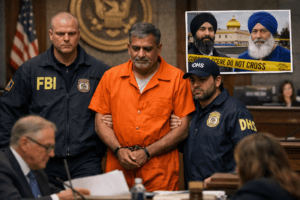
A Plea of Guilty, A World of Consequences: Inside the Foiled Plot That Exposed India’s Secret Campaign on American Soil
The fluorescent lights of the Manhattan federal courtroom cast their usual sterile glow on Friday morning, but for Nikhil Gupta, they illuminated the end of a long and winding road from Delhi street criminal to international conspiracy defendant. When the 54-year-old Indian national uttered his guilty plea to charges of murder-for-hire, he wasn’t just admitting to his own crimes—he was confirming what prosecutors have alleged for months: that the Indian government dispatched agents to kill its critics on foreign soil, and that one of those targets was a Canadian citizen gunned down outside a Sikh temple in British Columbia.
The plea entered in the Southern District of New York marks a significant turning point in a case that has sent shockwaves through diplomatic relations between three nations, exposed the long arm of India’s foreign intelligence services, and raised profound questions about how far sovereign nations will go to silence dissidents living abroad. For the first time, a defendant directly connected to these alleged state-sponsored operations has formally admitted guilt in an American court.
The Man at the Center of the Storm
Nikhil Gupta cuts an unlikely figure for someone at the center of an international conspiracy. Described by prosecutors as an international narcotics and weapons trafficker, Gupta operated in the shadowy spaces between legitimate commerce and outright criminality long before he allegedly became entangled with Indian intelligence. His journey from those shadowy enterprises to a Brooklyn detention center offers a window into how state security apparatuses sometimes recruit from the criminal classes to do their dirtiest work.
According to court documents and statements from prosecutors, Gupta’s motivation for participating in the murder plot was deeply personal and transactional. He was facing criminal prosecutions in India, and an agent of the Research and Analysis Wing—India’s foreign intelligence service—allegedly dangled the prospect of making those charges disappear. In exchange, Gupta would use his criminal connections to broker a deal: $100,000 to eliminate Gurpatwant Singh Pannun, a Sikh separatist and outspoken critic of the Indian government who had the audacity to live openly in New York City.
The arrangement speaks to a troubling pattern that has emerged in the Justice Department’s investigation: the outsourcing of political assassinations to criminal intermediaries who can provide deniability while delivering results. It’s a model that intelligence agencies have used for decades, but the Gupta case suggests India may have embraced it with particular enthusiasm in its campaign against Khalistani activists.
The Hitman Who Wasn’t
What Gupta didn’t know as he coordinated the plot from Indian soil in the spring of 2023 was that his carefully constructed plan had a fatal flaw. The hitman he believed he was hiring to kill Pannun was actually a confidential source working with the U.S. Drug Enforcement Administration. Every conversation, every negotiation, every detail of the murder-for-hire scheme was being recorded and documented by federal agents.
The indictment paints a picture of Gupta growing increasingly comfortable with his undercover handler as the plot progressed. On June 9, 2023, working in coordination with his Indian government handler Vikash Yadav, Gupta arranged for an associate to deliver $15,000 in cash to the undercover officer as an advance payment. It was the moment that sealed his fate—the point at which conspiracy crossed into overt act, giving prosecutors the evidence they needed.
Three weeks later, Gupta was arrested in the Czech Republic, unaware that American authorities had been tracking his movements and communications. He would spend nearly a year fighting extradition before being brought to Brooklyn in June 2024, where he initially pleaded not guilty. His change of plea on Friday suggests either a recognition of the overwhelming evidence against him or a strategic calculation about sentencing—or perhaps both.
The Video That Changed Everything
Among the most chilling details in the indictment against Gupta is the video evidence that prosecutors say links his plot to the murder of Hardeep Singh Nijjar in British Columbia. Just hours after Nijjar was shot dead outside the Guru Nanak Sikh Gurdwara in Surrey on June 18, 2023, Gupta received a video of the slain activist’s body. He promptly shared it with the undercover officer posing as his hitman, explaining that Nijjar “was also the target” and that “we have so many targets.”
That single exchange, preserved in electronic communications, connects the New York plot to the Canadian murder in ways that Indian officials have desperately tried to deny. It suggests a coordinated campaign, not isolated rogue actors—a systematic effort to eliminate leaders of the Khalistan movement wherever they could be found.
For Canadian investigators still working to build their case against the four Indian nationals charged in Nijjar’s killing, the Gupta plea provides powerful corroboration. It confirms what they have long suspected: that Nijjar’s murder was not an isolated act of violence but part of a broader strategy targeting Sikh separatists in North America.
The Rogue Agent Defense Meets Reality
Since the allegations first emerged, Indian officials have consistently maintained that any involvement in these plots was the work of rogue operatives acting without authorization. Vikash Yadav, the Indian government agent who allegedly recruited Gupta and sent him the video of Nijjar’s body, has been dismissed by New Delhi as an individual who exceeded his mandate.
But Gupta’s guilty plea makes that defense increasingly difficult to sustain. The evidence presented by U.S. prosecutors describes a coordinated effort involving multiple individuals, significant financial resources, and the kind of operational security that suggests institutional backing rather than freelance vigilantism. The advance payment of $15,000—money that had to come from somewhere—and the promise to make Gupta’s criminal cases disappear both point to capabilities that ordinary criminals don’t possess.
Yadav himself is believed to be in India, where he faces separate criminal prosecution for his role in an alleged kidnapping. Whether Indian authorities will ever allow him to be questioned by American or Canadian investigators remains an open question, but the political pressure to do so will only intensify following Gupta’s admission of guilt.
The Target Who Survived
Gurpatwant Singh Pannun, the Sikh lawyer and activist who was the intended victim of the foiled plot, has spent the months since its discovery living with the knowledge that his government allegedly wanted him dead. From his home in New York, he has watched the case unfold with a mixture of relief and righteous anger.
Speaking after Gupta’s plea, Pannun characterized the defendant as merely a “foot soldier” in a larger operation orchestrated by the Indian state. His demand that American officials prosecute those who directed the campaign reflects a broader frustration among Sikh activists who feel that the masterminds remain beyond reach while their alleged agents face justice.
Pannun’s survival is due entirely to the accident of the DEA’s confidential source. Had Gupta connected with a genuine hitman instead of a government informant, the lawyer might well have shared Nijjar’s fate. That proximity to death has given his words a particular weight, and his insistence on holding the Indian government accountable resonates with Sikh communities across North America who now wonder whether they too are targets.
Diplomatic Fallout and Fractured Relations
The political consequences of these revelations have been most acutely felt in Canada, where Prime Minister Justin Trudeau’s October 2023 announcement that Canada had “clear and compelling evidence” of Indian government involvement in Nijjar’s killing triggered a diplomatic crisis that continues to simmer.
Ottawa expelled six Indian diplomats in October 2024, a decision explicitly tied to the Nijjar investigation. New Delhi responded with predictable outrage, denying any involvement and accusing Canada of harboring terrorists and extremists. The exchange of diplomatic expulsions represented the lowest point in Canada-India relations in decades, and the rupture shows few signs of healing.
For Canadian officials, Gupta’s plea validates the position they’ve maintained despite Indian denials. The connection between the New York plot and Nijjar’s murder, established through the video evidence and Gupta’s communications, undercuts the rogue agent narrative and suggests a pattern of state-sponsored violence against Sikh separatists that extends across international borders.
The RCMP and Global Affairs Canada have so far declined to comment on the Gupta plea, likely mindful of the ongoing investigation and the sensitive diplomatic implications. But behind the scenes, investigators are surely reassessing their evidence in light of the American case, looking for connections that might strengthen their prosecution of the four men charged in Nijjar’s killing.
The Khalistan Movement: A Decades-Old Conflict
To understand why the Indian government would allegedly authorize assassinations on foreign soil, one must understand the Khalistan movement and the threat it represents to Indian sovereignty. The demand for an independent Sikh state in the Punjab region dates back to India’s independence in 1947, but it reached its most violent expression in the 1980s and 1990s, when Sikh militants fought Indian security forces in a conflict that claimed tens of thousands of lives.
The movement was effectively crushed in India by the mid-1990s, but it found new life in the Sikh diaspora, particularly in Canada, the United Kingdom, and the United States. For the Indian government, these overseas activists represent a persistent irritant—organizing referendums, lobbying foreign politicians, and keeping alive a separatist dream that New Delhi considers permanently extinguished.
Hardeep Singh Nijjar was among the most prominent of these diaspora activists. As the president of the Surrey-based Guru Nanak Sikh Gurdwara and a leader in the Khalistan movement, he had been designated a terrorist by India in 2020, a designation Canada did not share. His killing outside the temple where he worshiped sent shockwaves through the Sikh community and raised immediate suspicions of Indian involvement.
What Happens Next
Nikhil Gupta now faces up to 40 years in federal prison when he is sentenced, a term that would effectively ensure he spends the rest of his life behind bars. His cooperation with prosecutors—if any—remains unknown, but his guilty plea opens the door to potential testimony against others involved in the conspiracy, including Vikash Yadav should he ever be brought to American justice.
For the Southern District of New York, the case represents a significant victory in its efforts to combat transnational crime and hold accountable those who would use American soil as a stage for political violence. The statement from FBI Assistant Director James C. Barnacle, Jr. emphasized the gravity of the offense: plotting to assassinate an American citizen at the direction of a foreign government employee.
The broader investigation into Indian government involvement in plots against Sikh activists continues on multiple fronts. American prosecutors have made clear that Gupta is not the end of the story but rather a single node in a larger network. Whether they can reach higher up the chain of command—perhaps to the Indian officials who allegedly directed the campaign—remains to be seen.
A Cautionary Tale
As Gupta adjusts to life in the Metropolitan Detention Center in Brooklyn, awaiting a sentence that will likely consume the remainder of his years, his case stands as a cautionary tale about the dangers of mixing criminal enterprise with state-sponsored violence. A man who began as a narcotics and weapons trafficker in India will end his days in an American prison, his fate sealed by a video he probably wishes he had never received.
But his story is also about something larger—the willingness of sovereign nations to reach across borders and silence their critics by any means necessary. The Khalistan movement may have faded as a military threat in India, but its symbolic power in the diaspora remains potent enough that some in New Delhi apparently consider assassination a reasonable response.
For Sikh communities in Canada, the United States, and beyond, the Gupta plea offers both validation and warning. Validation that their concerns about Indian government surveillance and targeting were not paranoid fantasies. Warning that the long arm of their adversaries can reach into the streets of New York and Surrey alike.
And for the families of Hardeep Singh Nijjar, watching from British Columbia as the case unfolds, there is at least this much: the man who allegedly helped plan his killing has now admitted his role in open court. The admission comes too late to bring back a husband, father, and community leader, but it adds one more brick to the wall of evidence that may someday hold someone truly accountable for the shooting outside the temple.
The courtroom in Manhattan has fallen silent now, the lawyers have gathered their papers, and Nikhil Gupta has been led back to his cell. But the questions his case raises about sovereignty, dissent, and the rule of law will echo through diplomatic channels and community centers for years to come. In pleading guilty, Gupta may have hoped to find some measure of resolution. Instead, he has only deepened the mystery of how far governments will go to silence those who oppose them—and how much we are willing to accept before we say enough.
You must be logged in to post a comment.