
A Plea for Peace: An Israeli Singer’s Call to Boycott Eurovision Reveals the Contest’s Political Divide
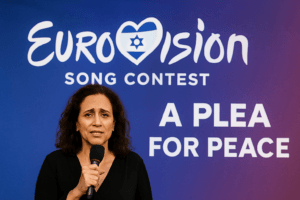
A Plea for Peace: An Israeli Singer’s Call to Boycott Eurovision Reveals the Contest’s Political Divide
The Eurovision Song Contest has long tried to present itself as a glittering, apolitical spectacle “United by Music.” Yet, its 70th-anniversary edition is now at the epicenter of a geopolitical storm. The European Broadcasting Union’s (EBU) recent decision to allow Israel to compete in the 2026 contest has not brought calm but triggered an unprecedented wave of formal boycotts from several member nations.
Amid this official discord, a powerful and distinct voice has emerged from within Israel itself. Achinoam Nini, the acclaimed singer known internationally as Noa who represented Israel at Eurovision in 2009, has made a profound public plea. She has urged her own country to voluntarily withdraw from the competition, framing it not as a concession to political pressure but as “a gesture of solidarity” for the suffering on both sides of the Israeli-Palestinian conflict.
The Voice Behind the Plea: Who Is Achinoam Nini?
To understand the weight of Nini’s statement, one must understand her unique position. She is no ordinary artist. Born in Israel to a family of Yemenite Jewish origin and raised in New York City, her identity and career are built on bridging divides. Recognized by the World Economic Forum as “Israel’s most prominent cultural advocate of dialogue and co-existence,” her work has long championed peace.
Her 2009 Eurovision entry was a living testament to this mission. Performing “There Must Be Another Way” alongside Arab-Israeli singer Mira Awad, the song featured lyrics in English, Hebrew, and Arabic. In a recent interview, reflecting on that performance, she said the goal was to show that “if we can truly empathize with each other’s sorrow, if we can cry together, then we can also reach the next level”. This history makes her current call for a voluntary withdrawal a poignant evolution of her lifelong philosophy, arguing that true solidarity sometimes requires painful sacrifice.
A History of Controversy: Israel and Eurovision
The current crisis is not an isolated incident but the latest chapter in a long and complicated history. Israel debuted at the contest in 1973, just one year after the Munich Olympics massacre, setting a precedent for its participation being viewed through a political lens. Its very first win in 1978 led Jordanian TV to cut its broadcast and announce the runner-up as the winner.
In recent years, the tension has intensified. The 2018 Israeli victory and subsequent hosting duties in 2019 sparked large boycott campaigns. The Icelandic band Hatari famously held up Palestinian flag scarves during the live broadcast in a defiant protest. The 2024 contest in Malmö and the 2025 contest in Basel were both overshadowed by large pro-Palestinian demonstrations, illustrating how the conflict has moved from the periphery to the center of the fan experience.
The controversy has also seeped into the contest’s content. Israel’s 2024 entry, initially titled October Rain, faced demands from the EBU for lyric changes due to perceived political references to the October 7 attacks. It was eventually renamed Hurricane. More recently, allegations surfaced that Israel artificially boosted its public vote in the 2025 contest through state-linked promotional campaigns, directly leading to the new voting rules the EBU just adopted.
The Stakes of the 2026 Boycott
The table below summarizes the key positions and actions taken by the broadcasters and institutions central to the current controversy.
| Country/Institution | Position on Israel’s Participation | Key Actions & Statements |
| European Broadcasting Union (EBU) | Allowed Israel to compete for 2026. | Adopted new anti-vote-manipulation rules. Avoided a direct vote on Israel’s participation, stating all compliant members are eligible. |
| Spain (RTVE) | Boycotting the 2026 contest. | Called Israel’s participation “incompatible with core values,” and will not broadcast the event. A leading member of the financially critical “Big Five”. |
| Ireland (RTÉ) | Boycotting the 2026 contest. | Stated participation is “unconscionable” given the loss of life in Gaza. |
| Netherlands (AVROTROS) | Boycotting the 2026 contest. | Said participation “is no longer compatible with the responsibility we bear as a public broadcaster”. |
| Slovenia (RTVSLO) | Boycotting the 2026 contest. | Argued the situation is “incompatible with the values it upholds,” such as peace and equality. |
| Germany (ARD) | Supports Israel’s participation. | Threatened to leave if Israel was excluded, welcomed the EBU’s decision. |
| Nordic Broadcasters (Norway, Sweden, etc.) | Support the EBU’s compromise. | Issued a joint statement backing the new voting rules but called for ongoing dialogue on contest credibility. |
The Heart of the Debate: Art, Politics, and Double Standards
The boycott and Nini’s plea force a fundamental question: Can—or should—a cultural event like Eurovision be separated from global politics? The EBU’s official rules strictly forbid political content in songs and performances, aiming to keep the contest neutral. However, as Eurovision expert Donal Mulligan notes, the idea it is “above politics” is “slightly fantastical”.
This perception of a double standard is the boycotters’ core grievance. In 2022, following Russia’s full-scale invasion of Ukraine, the EBU moved swiftly to exclude the Russian broadcaster, stating its participation would bring the contest into “disrepute”. Several of the boycotting nations now ask why the same principle does not apply to Israel, given the International Court of Justice has considered allegations of genocide in Gaza and the overwhelming civilian casualty count.
The EBU and supporting nations like Germany draw a technical distinction: Eurovision is a contest between public broadcasters, not governments. They argue that as long as the Israeli broadcaster KAN operates independently and meets EBU membership criteria, it cannot be excluded. Critics, including Spain’s culture minister, counter that this amounts to allowing music “to be used as a tool to whitewash crimes against humanity”.
The Road to Vienna: An Uncertain Future
The 70th-anniversary contest in Vienna was meant to be a grand celebration. Instead, it risks being defined by absence and protest. The withdrawal of four nations, including the major financial contributor Spain, will directly strain the event’s budget and alter its competitive landscape. More boycotts may follow; Iceland’s broadcaster is meeting to decide its position.
Nini’s suggested path—a voluntary, principled withdrawal—presents a different vision. It reframes the action not as an exclusion imposed by others, but as a conscious, moral choice born from empathy. “This is not the time to celebrate with glitter and feathers,” she argues, proposing that Israel should sit out “as a gesture of solidarity” and return to celebrate “real peace and justice”.
Whether this call will be heeded is uncertain. Israeli President Isaac Herzog has praised the EBU’s decision, framing Israel’s participation as a “victory over those who seek to silence Israel”. The stage is set for a contest where the drama in the stands and in the meeting rooms of European broadcasters may overshadow the performances on stage. Eurovision finds itself at a crossroads, its slogan “United by Music” clashing painfully with the reality of a deeply divided world. The plea from one of its own former stars highlights that the most resonant performance in Vienna next year may be the one that chooses not to happen at all.
You must be logged in to post a comment.