
A Night of Conscience Over Celebration: How Swedes Chose Solidarity With Gaza as the World Welcomed 2026
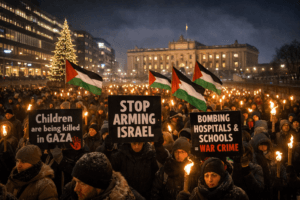
A Night of Conscience Over Celebration: How Swedes Chose Solidarity With Gaza as the World Welcomed 2026
As the clock ticked toward midnight on December 31, 2025, the global narrative was familiar: fireworks, champagne toasts, and resolutions for a brighter future. Yet, in the heart of Stockholm, under a canopy of freezing Scandinavian darkness, a different kind of gathering was taking shape. Hundreds of Swedes made a conscious, poignant choice: to cancel their New Year’s celebrations and instead gather in solemn vigil for Gaza. This protest, more than a demonstration, became a powerful symbol of where moral conscience sits in the hierarchy of tradition and festivity.
The Deliberate Choice: Mourning Over Merriment
The call to assemble at Segels Torg Square, disseminated by a coalition of Swedish civil society organizations, was not merely an invitation to protest; it was a call for collective moral reckoning. Attendees didn’t just attend a rally; they actively canceled plans, foregoing a deeply ingrained social ritual. This act of personal sacrifice is the first layer of insight. It signifies a shift from passive sympathy to active solidarity, where the urgency of a distant humanitarian catastrophe eclipses the comfort of local tradition.
In biting cold, they stood not with party hats, but with banners that spoke of stark, uncomfortable truths: “Children are being killed in Gaza,” “Schools and hospitals are being bombed.” These placards were not generic slogans; they were direct, unflinching references to the reports from international bodies and NGOs. The demonstrators weaponized the very language of international law and human rights, holding it up against the backdrop of a world seemingly eager to move into a new year and leave difficult headlines behind.
The Torchlight March: A Funeral Procession for the New Year’s Spirit
The imagery was potent and deliberately somber. Waving Palestinian flags and carrying torches, the crowd later marched toward the Swedish Parliament. This was not a raucous, angry march, but a procession reminiscent of a vigil. The torches, traditionally symbols of hope and enlightenment, here served as funeral pyres for the “normal” New Year and for the tens of thousands lost. The destination—the Parliament—was carefully chosen, anchoring the protest’s emotional core to a concrete political demand: an immediate end to Sweden’s arms sales and indirect support to Israel.
The organizers’ statement, read aloud in the square, framed their actions not as political posturing, but as an ethical necessity for entering a new temporal chapter. “We refuse to begin a new year by turning a blind eye to injustice,” it declared. This phrase cuts to the heart of the human insight here: the concept of a “clean slate” that New Year’s promises feels fraudulent, even complicit, when ongoing violence is ignored. For these protesters, 2026 could not begin with a lie of omission.
Contextualizing the Protest: Sweden’s Complicated Stance
To understand the significance of this rally, one must look at Sweden’s nuanced position. In 2014, Sweden became the first EU member state in Western Europe to officially recognize the State of Palestine, a move that drew both praise and criticism. However, like many Western nations, it maintains complex economic and defense ties. The protesters’ specific demand to halt arms sales touches a nerve in Sweden’s policy of exporting defense materials, scrutinizing the gap between diplomatic rhetoric and material complicity.
The rally, therefore, was as much about holding Sweden’s own government to account as it was about showing solidarity with Palestinians. It challenged the notion that a country’s progressive foreign policy gestures are enough if they are undermined by its trade practices. This internal critique adds a layer of sophistication to the protest, moving it beyond simple international condemnation to a domestic call for coherence and integrity.
The Deeper Human Insight: The Redefinition of “Community” and “Time”
This event offers two profound insights into contemporary social movements.
First, it redefines community. The community gathered in Segels Torg was not one of shared ethnicity, religion, or even direct experience. It was a community forged through shared ethical conviction. In an age of digital activism and often performative solidarity, the physical gathering in extreme cold represents a tangible, costly commitment. It builds community through shared sacrifice, however small—a cancelled party, a endured frost—making the bond and the message stronger.
Second, it challenges our perception of time. New Year’s is a globally synchronized milestone, a collective agreement to reset. The protesters rejected this imposed rhythm. They declared that for them, time could not progress normally while what they term a “genocide” continues. They entered 2026 not with cheers, but with a demand for an immediate ceasefire, essentially arguing that the new year cannot truly begin until certain atrocities end. This is a powerful form of temporal protest, insisting that moral calendars must override Gregorian ones.
A Global Echo, Not an Isolated Event
While this article focuses on Stockholm, the report notes parallel actions, most notably the massive gathering of over half a million on Istanbul’s Galata Bridge. This is crucial. It frames the Swedish protest not as an outlier, but as part of a burgeoning global pattern where public solidarity with Palestine is becoming a litmus test for civil society’s conscience, transcending national and cultural boundaries. From Sweden to Turkey, citizens are leveraging symbolic dates and creating new traditions of vigilance.
Conclusion: The Unignorable Whisper in the Global Shout of Celebration
The hundreds in Stockholm who chose Segels Torg over champagne toasts delivered a message far louder than their numbers might suggest. They demonstrated that in an interconnected world, the luxury of uncomplicated celebration is increasingly reserved for the privileged and the willfully ignorant. Their vigil was a stark, torchlit reminder that for millions in Gaza and their supporters worldwide, there will be no “happy new year” until there is justice, accountability, and a lasting peace.
Their action reframes solidarity from a passive state of mind to an active, disruptive force. It proves that the most powerful protest sometimes isn’t about shouting louder than everyone else, but about choosing a profound and deliberate silence—a mournful, purposeful quiet—amidst the global roar of celebration. As 2026 unfolds, the echo from that cold Swedish square lingers as a question to us all: what, and who, are we willing to cancel our plans for?
You must be logged in to post a comment.