
A New Dawn for Trade and Geopolitics: Decoding the Landmark EU-India Free Trade Agreement
After two decades of stalled negotiations, the European Union and India have successfully concluded talks on a landmark Free Trade Agreement, set to be formally announced at a summit on January 27, 2026. This “balanced, forward-looking deal,” reached through pragmatic compromises on longstanding issues like auto tariffs and agricultural access, marks a significant geopolitical realignment, aiming to deepen ties between the world’s largest democracies. Beyond commerce, the comprehensive partnership includes anticipated agreements on security, defence, and mobility, representing a joint strategic move to diversify economic dependencies and collaboratively shape a new, rules-based global order amidst a fragmenting international landscape, even as both sides navigate differences on issues like relations with Russia.
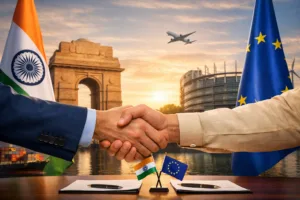
A New Dawn for Trade and Geopolitics: Decoding the Landmark EU-India Free Trade Agreement
After two decades of false starts, contentious debates, and prolonged stalemates, a new chapter in global economic diplomacy is being written in New Delhi. The official conclusion of negotiations for the European Union-India Free Trade Agreement (FTA) marks not just a commercial breakthrough, but a profound geopolitical realignment. Announced on the eve of a high-stakes summit, this “balanced, forward-looking deal” signals a conscious, strategic coupling of the world’s largest democracy and its most ambitious single-market bloc. This isn’t merely about tariffs and quotas; it’s a statement of intent to, as European Commission President Ursula von der Leyen declared, jointly “shape a new global order.”
The Long and Winding Road: From 2007 to 2026
To appreciate the magnitude of this moment, one must revisit the rocky path that led here. Launched in 2007, the talks were almost immediately hamstrung by a clash of economic cultures and sensitivities. Europe, protective of its agricultural sector and stringent on geographical indications (like Champagne or Feta), faced off against an India cautious about opening its market to a flood of dairy and automobile imports, and fiercely protective of its generic pharmaceuticals sector. Environmental standards, data security, and immigration for professionals became further sticking points. The talks entered a deep freeze in 2014, a period reflecting mutual frustration and shifting global priorities.
The relaunch in 2022 was born of a starkly changed world. The economic upheaval of the pandemic, China’s increasingly assertive posture, and the geopolitical shockwaves from Russia’s invasion of Ukraine forced a recalculation in both Brussels and Delhi. The EU, seeking to de-risk its economic dependencies and strengthen ties with like-minded democracies, found a willing partner in a India pursuing its own “Atmanirbhar Bharat” (self-reliant India) vision while diversifying trade partnerships. The pragmatism that defined the final stretch—reportedly agreeing to set aside irreconcilable issues for future discussion—proved key. This mature approach moved the dialogue from an all-or-nothing pursuit to a practical, milestone-driven negotiation.
The Core of the Deal: Strategic Compromises and Digital Futures
While the final legal text awaits “scrubbing,” key contours have emerged, revealing a tapestry of strategic compromises:
- Automobiles & Engineering: India’s agreement to slash tariffs on EU cars from 70-100% to a reported 40% is a major win for European manufacturers. In return, India gains greater access for its skilled professionals (in IT, engineering, and healthcare) and labour-intensive sectors like textiles, apparel, and agricultural products. This addresses a long-standing Indian demand for easier mobility, a cornerstone of its services-driven export strategy.
- The Digital & Green Transition: This FTA is arguably the first of its generation to be negotiated with the digital economy and climate imperatives as central pillars, not afterthoughts. Expect robust chapters on data flows, e-commerce norms, and collaboration on green technologies. For the EU, aligning with India’s vast market and tech talent is crucial for its digital sovereignty goals. For India, access to European green tech and investment is vital for its renewable energy and sustainability targets.
- Strategic Autonomy vs. Rules-Based Order: The most fascinating subtext was visible on Republic Day itself. As EU leaders watched a parade showcasing Russian-made military hardware—systems under EU sanctions—the dissonance was palpable. Yet, it was diplomatically sidestepped. EU Council President Antonio Costa focused instead on shared maritime security goals in the Indo-Pacific. This moment encapsulates the deal’s essence: it is not an alliance based on uniform worldviews, but a partnership of convergent interests between two poles of strategic autonomy. India will not abandon its defence ties with Russia, and the EU will not drop its sanctions, but both have decided that their shared economic and democratic future is too significant to be held hostage by a single divergence.
Beyond Trade: The Architecture of a Broader Partnership
The FTA is the centerpiece, but it is nested within a suite of agreements that transform the EU-India relationship from a transactional dialogue to a comprehensive strategic partnership. The anticipated Security and Defence Partnership and Mobility Agreement are particularly significant.
- Defence & Security: Upgraded cooperation in maritime security (critical in the Indian Ocean), cyber defence, counter-terrorism, and joint military exercises points to a hardening of the strategic core. In a region shadowed by an increasingly unpredictable China, a stronger EU-India security understanding contributes to a multi-polar balance of power.
- Talent & Trust: A Mobility Agreement, facilitating the movement of students, researchers, and professionals, builds the human bridges that sustain long-term partnerships. It softens the edges of globalisation backlash in Europe while recognising India’s human capital as a key export.
The Geopolitical Calculus: Shaping the New Global Order
President von der Leyen’s phrase is not mere rhetoric. The EU-India FTA is a core element of a broader geopolitical architecture emerging in response to a fragmenting world. For the EU, India represents a democratic, fast-growing counterweight to China and a stabilising force in Asia. It is part of a concerted EU push into the Indo-Pacific, following enhanced engagements with Japan, South Korea, and ASEAN.
For India, the EU is a massive, high-tech market and a source of critical investment and technology, reducing its economic reliance on any single region. It also bolsters India’s credibility as a leading global power and trusted rule-maker, not just a rule-taker. Together, they offer an alternative model of engagement: one based on democratic values, rules-based trade, and strategic pragmatism, contrasting with the coercive economics or transactional blocs seen elsewhere.
The Road Ahead: Ratification and Realisation
The journey is not over. The concluded negotiations now face the arduous process of legal verification, translation into two dozen languages, ratification by the European Parliament, and approval by all 27 EU member states—a process that can take years, as seen with other EU FTAs. Domestic constituencies, from European farmers to Indian small manufacturers, will scrutinise the fine print.
However, the political momentum is undeniable. With bilateral trade already exceeding $136 billion, this deal has the potential to be one of the world’s most significant bilateral economic agreements. It establishes a framework for the 21st-century challenges of digital trade, supply chain resilience, and green innovation.
The image of EU leaders standing on Kartavya Path during India’s Republic Day was powerfully symbolic. It represented a respect for sovereignty and a celebration of democratic spirit. The EU-India FTA is the tangible outcome of that respect—a complex, nuanced, and forward-looking pact. It acknowledges that in an era of global fractures, building bridges of trade and trust between diverse democracies is not just good economics; it is an essential act of shaping a more stable, prosperous, and multipolar world order. The talks have concluded, but the real work of building this shared future is just beginning.
You must be logged in to post a comment.