
A New Dawn for India’s Women Workers? Decoding the Rights and Realities of the 2020 Labour Codes
The new Labour Codes of 2020, while not yet implemented, represent a significant potential shift for women workers in India by moving from a framework of restrictive protection to one of empowered inclusion; key provisions grant women the right to work night shifts with mandated safety measures like secure transport, substantially increase paid maternity leave to 26 weeks, and aim to extend social security benefits like pension and insurance to the vast unorganized sector where women are disproportionately employed.
However, the success of these progressive reforms hinges entirely on effective implementation, which faces challenges including the need for consistent state-level rules, the financial burden on small businesses, and the necessity of a profound cultural shift in workplaces and society to ensure these legislative rights translate into safe, equitable, and tangible realities for women.
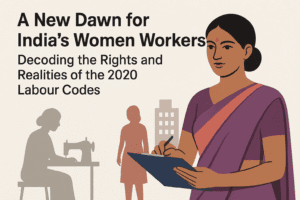
A New Dawn for India’s Women Workers? Decoding the Rights and Realities of the 2020 Labour Codes
For decades, the landscape of India’s labour laws has been a complex, overlapping web of archaic statutes, often failing to protect its most vulnerable workforce—women. The historic passage of the four new Labour Codes in 2019-2020 promises a tectonic shift, aiming to consolidate, simplify, and, most critically, modernize the regulatory framework for a new era. While their implementation is pending, the codes represent a profound philosophical pivot, placing the empowerment, safety, and economic inclusion of women workers at the heart of India’s formalization agenda.
This analysis moves beyond the legislative text to explore the potential transformative impact of these codes on women, the historical context they seek to redress, and the formidable implementation challenges that lie ahead.
The Historical Legacy: From Invisible Labor to Recognized Contributors
To appreciate the significance of the new codes, one must first understand the historical backdrop. India’s journey with labour welfare began under colonial rule, with early reforms like the Factories Act of 1881 focusing primarily on limiting women’s working hours and prohibiting night shifts—policies framed in a protective, often paternalistic light.
Post-independence, landmark acts like the Maternity Benefit Act (1961), the Factories Act (1948), and the Equal Remuneration Act (1976) were progressive for their time. They legally mandated equal pay and provided basic maternity benefits. However, their application was fragmented and riddled with gaps. A vast majority of women, toiling in the unorganized sector—as farm labour, domestic help, or in small-scale manufacturing—remained outside their purview. Their work was often invisible, underpaid, and devoid of social security.
The new Labour Codes, therefore, are not merely an administrative consolidation but a necessary evolution. They attempt to bridge the chasm between the organized sector’s privileges and the unorganized sector’s precarious reality, with a specific focus on gender parity.
Key Provisions Empowering Women in the New Labour Codes
The four codes—on Wages, Social Security, Occupational Safety & Health, and Industrial Relations—introduce several paradigm shifts for women workers.
- The Right to Night Work: A Double-Edged Sword
Perhaps the most debated reform is the explicit provision allowing women to work night shifts (between 7 PM and 6 AM) in all establishments. Previously restricted in factories and mines, this was a significant barrier to women’s employment in many industries.
- The Opportunity: This move recognizes women’s autonomy and their right to choose their working hours, opening doors to higher-paying shifts and roles in sectors like IT, BPO, manufacturing, and healthcare that operate round-the-clock. It is a critical step towards true workplace equality.
- The Imperative for Safeguards: The code wisely ties this right to the employer’s duty to ensure safety. This isn’t a mere suggestion; it mandates concrete measures:
- Safe Transportation: Providing secure, monitored transport from workplace to residence.
- Enhanced Security: Implementing adequate security protocols within the premises.
- Consent is Key: A woman cannot be compelled to work nights against her will.
The success of this provision hinges entirely on enforcement. The legislature’s liberal intent will be tested on the ground. Is the Indian shop floor, and society at large, ready to ensure these safeguards are not just on paper but in practice?
- A Landmark Leap in Maternity Benefits
The Social Security Code subsumes and significantly amplifies the Maternity Benefit Act. It retains and extends the paid maternity leave from the already improved 12 weeks to 26 weeks. This places India among the most progressive nations in terms of statutory maternity leave.
- Beyond the Organized Sector: The true revolution lies in the code’s attempt to extend this benefit to all establishments, potentially bringing millions of women in the unorganized sector under its ambit through mechanisms like the e-Shram portal and other proposed social security schemes.
- Adoption Leave: In a welcome move, the code also provides for 12 weeks of paid leave for mothers adopting a child below three months, promoting a more inclusive definition of motherhood.
This enhanced benefit is not just a welfare measure; it’s an economic imperative. It helps retain female talent, improves infant health outcomes, and acknowledges the biological and social role of motherhood without penalizing women’s careers.
- Bridging the Gender Gap: From Non-Discrimination to Active Inclusion
The constitutional mandate of Article 14 (Equality before Law) and Article 15(3) (empowering the state to make special provisions for women) finds a stronger voice in the codes.
- Equal Pay for Equal Work: The principle, enshrined in the Constitution and the earlier Equal Remuneration Act, is reinforced. In a growing gig economy, this will be crucial to ensure women freelancers and platform workers are not subject to a gender pay gap.
- A Focus on the Unorganized Sector: By creating a framework for universal social security—including health insurance, pension, and gratuity—the codes aim to provide a safety net for all workers, regardless of gender. For women, who are disproportionately represented in informal work, this is a potential game-changer, offering financial resilience and dignity in old age.
The Constitutional Backbone: Legislating Equality
The Labour Codes draw their legitimacy from the foundational principles of the Indian Constitution. Article 39(a), a Directive Principle of State Policy, mandates that the state shall direct its policy towards securing that citizens, men and women equally, have the right to an adequate means of livelihood. The codes operationalize this directive.
Furthermore, by enabling night work with safety, the state exercises its power under Article 15(3) to make “special provision” for women, moving from restrictive protection to progressive empowerment. The entire legislative exercise is an attempt to make the abstract ideal of “equality before law” a tangible reality for millions of women workers.
The Road Ahead: From Legislative Promise to Lived Reality
Despite the progressive framework, the path to implementation is strewn with challenges.
- The Rule-Making Conundrum: The central government has framed the broad law, but the crucial details—the specific safety standards for night shifts, the exact mechanism for extending social security to the unorganized sector—will be defined by state-level rules. This creates a risk of a fragmented and uneven implementation landscape across India.
- The Compliance Burden on MSMEs: For small and medium enterprises, the cost of providing safe transport, enhanced security, and extended maternity leave could be significant. There is a risk that this may inadvertently deter the hiring of women, counteracting the code’s very purpose. The government may need to consider fiscal incentives to offset these costs.
- Cultural and Mindset Shifts: A law can grant rights, but it cannot instantly change deep-seated societal attitudes. Ensuring that women feel safe and are not stigmatized for working night shifts requires sustained awareness campaigns and a shift in organizational culture.
- Strengthening the POSH Framework: The effectiveness of the night work provision is inextricably linked to the robust implementation of the Prevention of Sexual Harassment (PoSH) Act at the workplace. A safe environment is a prerequisite for women to exercise their new rights confidently.
Conclusion: A Cautious Optimism
The new Labour Codes of 2020 mark a definitive break from the past. They represent a vision where a woman worker is not a liability to be managed but an asset to be empowered. By legally endorsing night shifts, enhancing maternity benefits, and promising universal social security, the codes have laid a powerful foundation for a more inclusive and equitable workforce.
However, a law is only as good as its execution. The true test of this reform will not be in the statute books but in the factories, fields, and offices of India. It will be measured by whether a woman feels secure taking the night shift transport, whether a mother in the unorganized sector actually receives her maternity benefit, and whether the gender pay gap truly narrows.
The legislative intent is clear and commendable. The onus is now on the government to create watertight rules, on employers to build genuinely inclusive workplaces, and on society at large to embrace this change. If implemented with sincerity and vision, these codes could indeed herald a new dawn for India’s women workers, transforming them from vulnerable participants into secure, equal partners in the nation’s economic growth.
You must be logged in to post a comment.