
A Lost Generation: How the Threat to West Bank’s Kalandia Centre Symbolizes a Battle Over Palestinian Futures
The potential imminent closure of the Kalandia Training Centre in the West Bank, as warned by UNRWA, threatens to strip 350 young Palestinian men of vital vocational education in trades like plumbing and vehicle maintenance, with no immediate alternative available. This action is part of a broader campaign by Israeli authorities, who have recently demolished other UNRWA facilities and passed laws banning the agency’s operations, citing alleged links to Hamas—a charge UNRWA denies. The move highlights the severe politicization of humanitarian aid and education in the conflict, directly jeopardizing the economic prospects and right to education of Palestinian refugees, which UNRWA officials argue demands urgent international attention to prevent further erosion of critical civilian infrastructure.
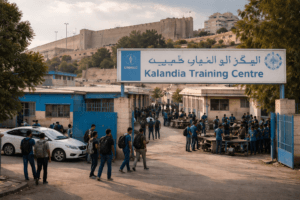
A Lost Generation: How the Threat to West Bank’s Kalandia Centre Symbolizes a Battle Over Palestinian Futures
The potential closure of a vocational training centre in the West Bank represents more than just a bureaucratic land dispute; it threatens to extinguish the fragile hopes of hundreds of young Palestinians striving for economic independence in an environment of profound instability. The Kalandia Training Centre, a UNRWA-run institution teaching vital trades like plumbing and vehicle maintenance to 350 young men, now faces imminent closure as the land it occupies is at risk of expropriation by Israeli authorities. This standoff is not an isolated incident but a critical flashpoint in a broader, systematic campaign that pits the right to education against geopolitical strategy, with the future of an entire generation hanging in the balance.
The Centre and Its Crucial Mission
For over seven decades, the Kalandia Training Centre has stood as a beacon of practical opportunity in East Jerusalem. As UNRWA’s oldest vocational training centre, it has equipped generations of Palestine refugees with the technical skills necessary to build livelihoods. In a region where unemployment is chronically high and economic prospects are severely constrained, centres like Kalandia offer a rare pathway to self-sufficiency. Students learn trades such as plumbing, electrical work, and vehicle maintenance—skills that are not only employable but essential for community infrastructure and development.
The centre’s 350 students arrive from across the West Bank, representing a cross-section of Palestinian youth seeking an alternative to dead-end jobs or political despair. Jonathan Fowler, UNRWA’s spokesperson, starkly outlined the consequences of closure: “If the centre were to be forcibly closed… there is no educational alternative for these students. So you’re depriving a large cohort of Palestine Refugees of economic opportunities”. This potential loss transcends individual disappointment; it represents a direct attack on the right to education and the economic resilience of entire communities.
Part of a Broader Pattern of Pressure
The threat to Kalandia is not an anomaly but rather the latest escalation in a series of Israeli actions against UNRWA’s operations. The agency’s chief, Philippe Lazzarini, has characterized these actions as a coordinated campaign, including:
- The demolition of structures inside UNRWA’s East Jerusalem compound in January 2026.
- A raid on a UNRWA medical clinic earlier in January 2026.
- Plans to cut power and water to other UNRWA facilities in the near future.
This pressure is institutionalized. In October 2024, the Israeli parliament passed a law banning UNRWA from operating within Israel and prohibiting Israeli officials from having contact with the agency. The current threat to Kalandia stems from a recently passed amendment to these anti-UNRWA laws, which could enable the expropriation of the land the centre sits on.
Israel’s position is rooted in long-standing accusations that UNRWA is biased and maintains links to militant groups like Hamas, charges the agency denies. The controversy intensified after October 7, 2023, when Israeli intelligence alleged that at least 12 UNRWA employees were involved in the Hamas-led terror attacks. These allegations led the United States and several other major donors to temporarily suspend funding in January 2024.
UNRWA: An Agency at the Heart of the Controversy
To understand the significance of Kalandia’s plight, one must understand the unique and contentious role of UNRWA itself. Established in 1949 to aid Palestinians displaced during the war surrounding Israel’s founding, UNRWA has grown into a quasi-state service provider for millions. Its uniqueness is a core source of controversy.
| Aspect | UNRWA | UNHCR (Standard UN Refugee Agency) |
| Mandate | Serves Palestinian refugees only. | Serves all other refugee groups globally. |
| Refugee Definition | Grants refugee status to descendants of original refugees. | Does not automatically grant status to descendants. |
| Scope | Provides education, healthcare, and social services directly. | Focuses on legal protection and coordination of aid. |
This separate, generational system has expanded the refugee count from an estimated 750,000 in 1949 to over 5.9 million today. Critics, including Israel, argue this perpetuates the conflict by solidifying a unique Palestinian refugee identity and, through alleged failings in its educational materials and staff vetting, sometimes fostering resentment. A 2024 independent review (the Colonna report) acknowledged problems with neutrality and the need for stronger safeguards, which UNRWA has committed to implementing.
However, for its defenders—including over 100 refugee and human rights organizations—UNRWA is an irreplaceable lifeline. They argue that in the face of humanitarian catastrophe, particularly in Gaza, “there is currently no alternative actor able to provide the wide range of services UNRWA provides”. Cutting its funding, they state, is a “moral and strategic failure” that amounts to collective punishment of Palestinian civilians.
Education as a Battleground
The targeting of the Kalandia Training Centre illuminates how education has become a primary battleground. For Palestinians, education is more than a personal benefit; it is a form of resilience and nation-building in the absence of statehood. Vocational training, in particular, is viewed as a tool for developing the practical foundations of a future economy, reducing dependency on aid, and fostering a sense of agency among youth.
Israel’s actions, framed as a necessary security measure against an allegedly compromised agency, are perceived by Palestinians and many in the international community as an assault on this developmental capacity. The move sends a chilling message: that the structures supporting Palestinian social and economic advancement are themselves vulnerable. This creates a devastating paradox: while the international community often emphasizes building Palestinian institutions for a future two-state solution, those very institutions face systematic erosion.
The impact is intergenerational. When a young man training to be an electrician sees his college shuttered, it reinforces a narrative of denied opportunity and external control. It risks alienating a generation from the path of constructive development, with unpredictable consequences for regional stability.
The Stakes and the Path Forward
The imminent decision regarding the Kalandia Training Centre carries profound symbolic and practical weight. Its closure would:
- Immediately strip 350 young men of their chosen path to a skilled trade.
- Further dismantle the educational infrastructure available to Palestinian refugees in the West Bank.
- Deepen the crisis of legitimacy for international interventions, demonstrating how humanitarian spaces are shrinking under geopolitical conflict.
- Set a precedent for the seizure of other UNRWA properties under the 2024 Israeli law.
The international community faces a stark test. As UNRWA’s spokesperson implored, “The international community needs to wake up”. The response will reveal much about the world’s commitment to Palestinian welfare beyond emergency aid. Will donor nations, many of which have restored funding after the 2024 suspensions, actively diplomatically intervene to protect humanitarian and educational assets? Can pressure be applied to find a solution that addresses legitimate security concerns without obliterating vital civilian institutions?
The story of the Kalandia Centre is a microcosm of the entire Israeli-Palestinian conflict. It is about land, security, history, and legitimacy. But most palpably, it is about the futures of hundreds of ordinary young men who simply want to learn a trade, earn a living, and build a life. In threatening their classrooms, the conflict reaches beyond politics and into the most fundamental human aspirations for dignity and self-reliance. The preservation of such spaces of hope is not merely a humanitarian footnote; it is a essential condition for any future peace.
You must be logged in to post a comment.