
A Lifeline with Strings Attached: Gaza’s Rafah Crossing Reopens Amid Deepening Despair
Amid a catastrophic humanitarian crisis in Gaza described by the UN as a “human-made abyss,” Israel’s announced reopening of the Rafah crossing to allow residents to exit for Egypt is a tightly controlled measure that raises fears of permanent displacement, while inside the territory, life is blighted by acute shortages as UN officials report that large stocks of aid—including food, medicine, and winter shelter—remain blocked by Israeli restrictions, leaving nearly 1.5 million people facing extreme impoverishment, a collapsed health system, contaminated water, and where 9,400 children suffer acute malnutrition, all within an economy that has shrunk 87% with reconstruction costs estimated at over $70 billion.
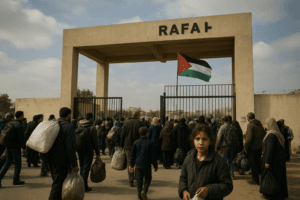
A Lifeline with Strings Attached: Gaza’s Rafah Crossing Reopens Amid Deepening Despair
For the over two million Palestinians in Gaza, news that Israel would reopen the Rafah border crossing arrived with a painful mix of hope and profound anxiety. Announced as a gesture of progress on a fragile ceasefire, the reopening is, in practice, a tightly controlled and one-way valve: it permits exit only, requiring Israeli and Egyptian security approval, with no guarantee of return. This move, unfolding against what the United Nations describes as a “human-made abyss,” illuminates the cruel paradox of Gaza’s existence—the appearance of relief overshadowed by the reality of a catastrophic humanitarian collapse that grows more desperate by the day.
The Rafah Crossing: A Gate of Contested Hope
The Rafah crossing is not just another checkpoint; it is Gaza’s sole gateway to the world that doesn’t pass through Israel. Before the war, it was a bustling artery for people and goods. Since Israel seized control of the Gaza side in May 2024, it has been mostly sealed, opening only occasionally for medical evacuations.
Israel’s announcement that the crossing would open “exclusively for the exit of residents” immediately raised international alarm. Observers, including Al Jazeera’s correspondent in Gaza City, warned this was less about freedom of movement and more about “accelerating the process of depopulating the Gaza Strip”. The fear of permanent displacement is not abstract; it has been promoted by far-right ministers in Israel’s government and is vehemently opposed by Egypt, which fears a mass refugee influx into the Sinai Peninsula.
Egypt’s stance is clear: any opening must be two-way, allowing both exit and entry, in line with the current ceasefire plan. This positions Egypt as a critical barrier against a policy of displacement, but it also creates a stalemate. For sick and wounded Gazans, the political impasse is a matter of life and death. The World Health Organization estimates over 16,500 people urgently need medical evacuation. Yet, since the ceasefire began, only 235 patients—almost all children—have been evacuated via crossings with Israel.
The Anatomy of Catastrophe: Life Inside the “Human-Made Abyss”
Beyond the politics of the crossing lies the grim reality of daily survival. The UN has stated that rebuilding Gaza could cost over $70 billion over decades, but for now, the focus is on preventing total societal collapse. The situation can be quantified in staggering terms, as detailed in the table below, which summarizes the multi-dimensional crisis.
Table: Key Metrics of Gaza’s Humanitarian Crisis
| Category | Key Statistic | Source / Context |
| Food Security | 81% of households report poor food consumption; famine thresholds reached in Gaza City. | IPC Global Initiative alert, July 2025. |
| Child Malnutrition | 9,400+ children suffering acute malnutrition; 96 children died from malnutrition since start of August 2025. | UNRWA and Gaza Ministry of Health data. |
| Economic Collapse | Economy shrank 87% in 2023-2024; GDP per capita at $161. | UN trade and development agency report. |
| Population Displaced | 1.9 million people—around 90% of the population—forced from their homes. | UNRWA report, August 2025. |
| Casualties | At least 70,117 Palestinians killed, 170,999 wounded since October 2023. | Gaza Health Ministry figures. |
The statistics only tell part of the story. The lived experience is one of relentless degradation:
- The Collapse of Food Systems: The Integrated Food Security Phase Classification (IPC) has warned that famine is not a future risk but a present reality in parts of Gaza. In July 2025, 94% of young children suffered severe food poverty. The humanitarian system, designed to be a lifeline, is failing at the point of delivery: in one month, over 90% of food aid brought into Gaza was offloaded by desperate, hungry crowds or looted by armed gangs before reaching warehouses.
- A Health System in Ruins: With hospitals decimated, medical supplies out of stock, and fuel for generators rationed, the health system cannot cope. The wound of war is compounded by the sickness of deprivation. Malnutrition weakens immune systems, making common illnesses deadly, especially for children and the elderly.
- Shelter from the Storm That Doesn’t Exist: Winter rains have turned displacement camps into quagmires. Adnan Abu Hasna, a UNRWA media adviser, describes tents as “worn out” and offering little protection from wind and rain. Hundreds of thousands of new tents and tarpaulins sit in warehouses, blocked from entry for over six months. A UN rapid assessment in late November found over 3,000 people in flooded shelters.
- The Scarcity of Basics: Access to clean water remains a dire challenge, with 96% of households reporting water insecurity. The price of wheat flour has skyrocketed by up to 15,000% compared to pre-war levels, placing even the most basic staple out of reach for most.
The Blockade Within the Blockade: Why Aid Isn’t Flowing
A persistent and critical question is why, under a ceasefire, does such profound deprivation continue? The answer lies in a complex web of political, logistical, and security barriers.
UNRWA, the UN agency with the largest operational footprint in Gaza, has been systematically crippled. Israel has barred it from operating after making unproven allegations against some staff members, leading to a suspension of funding from its largest historical donor, the United States. UNRWA Commissioner-General Philippe Lazzarini states the agency has had “not a single truck” of aid permitted into Gaza for over 150 days. He warns that without funding, the agency may be unable to pay salaries, collapsing the last organized pillar of support for millions.
Even when aid is cleared to enter, the journey is perilous. The UN reports a constant struggle with “insecurity along convoy routes, driven by the absence of public order and safety”. Armed looting is rampant, and deadly incidents occur near Israeli checkpoints. Furthermore, Israel maintains a dense bureaucracy of inspections and denials for specific items. For instance, the entry of high-performance tents for learning spaces and materials to repair sewage networks is routinely blocked.
The Path Ahead: More Than a Crossing
The debate over the Rafah crossing is a microcosm of the larger struggle over Gaza’s future. For Israel, it may be a pressure valve and a bargaining chip in hostage negotiations. For Egypt and the UN, it is a test of sovereignty and the principle of voluntary, safe return. For Gaza’s residents, it represents a torturous choice: remain in an uninhabitable landscape of ruin and hunger, or risk a one-way journey into an uncertain exile.
Humanitarian workers stress that opening crossings, while vital, is only the first step. What follows must be a sustained, protected, and scaled-up flow of aid that meets the colossal need. As one UN report starkly concluded, military operations have “significantly undermined every pillar of survival” for 2.3 million people. Rebuilding those pillars—food, water, health, shelter, and hope—will require more than a single open gate. It will require a fundamental shift from managing a crisis to ending one, a commitment that so far remains lost in the gap between announcements of progress and the daily, grinding reality of life in the abyss.
You must be logged in to post a comment.