
A Life Worth Ending: How the Harish Rana Judgment Transformed India’s Right to Die with Dignity
The article examines how the Supreme Court of India’s landmark 2026 judgment in Harish Rana v. Union of India transformed passive euthanasia from a theoretical constitutional right into an accessible reality for families, moving beyond the earlier Aruna Shanbaug framework by establishing practical procedures for withdrawing life support from patients in permanent vegetative states who cannot express their wishes. It traces the evolution of euthanasia jurisprudence from its Greek philosophical origins through international legal consensus, explaining the critical distinctions between active and passive euthanasia and between voluntary and non-voluntary situations.
The piece emphasizes the human dimension behind the legal abstractions—families trapped for years visiting loved ones who will never recover, the emotional complexity of deciding to let go, and the constitutional principle that dignity in death is inseparable from dignity in life. While celebrating the judgment’s creation of oversight mechanisms involving hospital ethics committees and independent medical experts to prevent abuse, the article acknowledges unresolved questions about evidence of patient wishes and the ongoing debate about whether the distinction between passive and active euthanasia remains ethically sustainable as medical technology continues advancing.
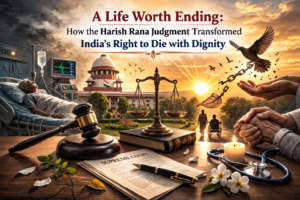
A Life Worth Ending: How the Harish Rana Judgment Transformed India’s Right to Die with Dignity
The Long Wait for Release
For twelve years, Harish Rana existed in a twilight state between life and death. His body lay on a hospital bed in Delhi, kept alive by machines while his consciousness remained trapped in what doctors called a permanent vegetative state. His parents grew old beside him. His siblings built families of their own. The world moved on, but for Harish, time stopped on an ordinary day in 2014 when a catastrophic brain injury erased everything that made him who he was.
When the Supreme Court of India finally delivered its judgment in March 2026, allowing his family to withdraw life support, it wasn’t merely a legal victory. It was an acknowledgment that sometimes, love means letting go.
The Harish Rana case has done something remarkable in India’s legal landscape. It has transformed the concept of dignified death from a philosophical abstraction discussed in law journals into a tangible reality for families trapped in impossible situations. Unlike the landmark Aruna Shanbaug case that preceded it, this judgment didn’t just establish guidelines—it created a pathway.
The Faces Behind the Headlines
To understand why this judgment matters, one must first understand what families like the Ranas endure. Harish was thirty-two when the court finally ruled. He had spent more than a third of his life neither truly alive nor permitted to die. His mother, now in her late sixties, had last seen her son’s eyes open with recognition when he was a young man just beginning his career.
The emotional toll on such families defies easy description. They visit hospital rooms year after year, watching flesh diminish and hope curdle into something more complicated. They become experts in medical terminology they never wanted to learn. They navigate hospital bureaucracies while grieving someone who still breathes before them.
What the Supreme Court recognized in 2026 was that these families needed more than sympathy. They needed agency. They needed the legal framework to make decisions that modern medicine had made possible but the law had not yet caught up with.
From Greek Origins to Indian Realities
The word euthanasia comes from the Greek “eu” (good) and “thanatos” (death)—literally, a good death. Francis Bacon employed the term in the seventeenth century to describe what he believed should be a physician’s duty: easing the passage from life when suffering became unbearable.
But what constitutes a “good death” varies enormously across cultures, religions, and individual beliefs. In India, with its rich tapestry of philosophical traditions, the concept carries particular weight. Hindu philosophy has long contemplated the nature of suffering and the appropriate response to terminal illness. Jain traditions emphasize the importance of conscious departure from life. These indigenous frameworks for understanding death have existed for millennia, long before modern medicine created the ethical dilemmas we face today.
The Harish Rana judgment doesn’t import Western notions of autonomy wholesale into Indian jurisprudence. Instead, it synthesizes global legal principles with India’s specific cultural and constitutional context.
The Global Consensus That Shaped Indian Law
The Supreme Court didn’t arrive at its conclusion in isolation. The judgment draws upon decades of jurisprudence from courts across the democratic world, creating a tapestry of legal thought that now finds expression in Indian law.
When the House of Lords decided the fate of Tony Bland in 1993—a young man crushed in the Hillsborough disaster who had lain in a persistent vegetative state for nearly four years—they established principles that would echo through subsequent cases globally. Bland’s doctors sought permission to withdraw life support, including the artificial nutrition and hydration that kept his body functioning. The Lords’ decision that such withdrawal could be lawful provided a foundation for courts in Ireland, Scotland, Canada, Australia, and New Zealand to build upon.
What united these disparate decisions across different legal systems was a remarkable consensus. Courts consistently recognized that the right to refuse medical treatment extended even to those who could no longer exercise it themselves, provided proper safeguards existed. They acknowledged that continuing treatment wasn’t always in a patient’s best interests. They accepted that quality of life mattered as much as its mere continuation.
The Harish Rana judgment plants Indian law firmly within this international consensus while adapting it to local conditions.
The Distinction That Matters
Euthanasia isn’t a single concept but a spectrum of practices with profound ethical differences. Active euthanasia—the direct administration of lethal substances—remains illegal in India and most of the world. The physician’s hand that deliberately ends life crosses a line that few jurisdictions have been willing to permit.
Passive euthanasia, which the Harish Rana case addresses, operates differently. Here, death results not from action but from omission—the withdrawal or withholding of treatments that merely prolong the dying process. A ventilator is removed. A feeding tube is not replaced. Nature, as the courts often phrase it, is allowed to take its course.
This distinction matters enormously both ethically and legally. When a physician withdraws life support, they aren’t killing the patient. They’re acknowledging that medicine has reached its limits and that continued intervention serves only to extend suffering rather than sustain meaningful life.
The Question of Consent
Within passive euthanasia, further distinctions arise. Voluntary passive euthanasia involves patients who have clearly expressed their wishes while competent—through living wills, advance directives, or conversations with family members. When a terminally ill cancer patient decides she’s had enough of chemotherapy and wishes to die at home without further intervention, the law generally respects her choice.
Non-voluntary passive euthanasia, which the Supreme Court addressed in both Aruna Shanbaug and Harish Rana, involves patients who cannot express their wishes. They lie in persistent vegetative states, their higher brain functions permanently destroyed. They cannot tell us what they would want. Family members and doctors must make that determination on their behalf, guided by whatever evidence exists of the patient’s values and beliefs.
The Aruna Shanbaug case highlighted the profound difficulties this creates. Shanbaug lay for forty-two years after a brutal assault destroyed her brain. The nurses who cared for her opposed ending her life. The court ultimately denied the petition to withdraw her life support, but in doing so, established the first framework for considering such cases.
What Changed in Twelve Years
Between Aruna Shanbaug’s case and Harish Rana’s, India’s understanding of end-of-life care evolved significantly. The 2018 Common Cause judgment recognized advance directives—living wills that allow competent adults to specify their wishes should they become incompetent later. This created a mechanism for voluntary passive euthanasia that hadn’t previously existed.
But advance directives, however valuable, couldn’t address every situation. Most people don’t create them. Young people like Harish Rana, struck down suddenly by accident or illness, never had the opportunity to contemplate their own mortality and document their wishes.
The 2026 judgment fills this gap. It establishes procedures for families and doctors to make decisions for patients without advance directives, creating a pathway that balances compassion with safeguards against abuse. A committee structure now exists, involving hospital ethics boards, independent medical experts, and judicial oversight for contentious cases.
The Human Element
What the legal language obscures, however, is the human reality these procedures address. Families don’t arrive at decisions to withdraw life support lightly. They spend years wrestling with guilt, hope, religious teaching, and the opinions of relatives who may disagree passionately about what should be done.
I’ve spoken with families in similar situations—not the Ranas specifically, but others who have faced the same impossible choice. One woman described visiting her husband in the hospital every day for three years, watching his body curl into itself, his muscles atrophy, his face become unrecognizable. “I kept thinking he would wake up,” she told me. “The doctors said he wouldn’t, but I believed in miracles. Eventually, I realized that keeping him like this wasn’t hoping for a miracle. It was refusing to accept that miracles sometimes don’t come.”
Another family described the moment they decided to withdraw life support from their twenty-three-year-old daughter after a car accident. “She had just graduated from university. She had her whole life ahead of her. But the life she had ahead of her wasn’t the one she would have wanted—not like this, not trapped in a body that didn’t work anymore, unable to speak or move or think. We knew because she’d told us once, years before, that she would never want to be kept alive on machines. She was just a teenager then, talking about something she saw on television. But we remembered.”
These conversations—ordinary moments that become extraordinary in retrospect—are what the law must honor. The Harish Rana judgment creates mechanisms for those memories to carry legal weight.
The Safeguards That Matter
Critics of euthanasia, whether active or passive, raise legitimate concerns about abuse. Families with inheritance at stake might pressure doctors to end lives prematurely. Cash-strapped hospitals might encourage withdrawal of expensive life support. Biases against disabled persons might color judgments about what constitutes a life worth living.
The Harish Rana framework addresses these concerns through multiple layers of oversight. No single person can authorize withdrawal of life support. Families must petition hospital ethics committees, which include medical professionals, legal experts, and community representatives. Independent neurologists must confirm the irreversibility of the patient’s condition. For disputed cases, courts retain ultimate authority.
These safeguards aren’t perfect—no system designed by humans can be—but they represent a serious attempt to balance compassion with protection. They acknowledge that most families act from love, not greed, while recognizing that love alone cannot guarantee appropriate decisions.
The Unanswered Questions
For all its comprehensiveness, the Harish Rana judgment leaves certain questions unresolved. What constitutes adequate evidence of a patient’s wishes when no formal advance directive exists? A casual conversation years before may carry different weight than a written document, but how much different? And who decides?
The judgment also doesn’t address active euthanasia, leaving India within the global mainstream of countries that permit passive but not active measures. Whether this distinction remains sustainable over time is uncertain. Critics argue that withdrawing life support while prohibiting lethal injection creates arbitrary distinctions—that death by dehydration through tube removal may actually involve more suffering than a peaceful injection, if suffering is what we’re trying to prevent.
Proponents of the distinction respond that the physician’s role differs fundamentally in these scenarios. Withdrawing treatment acknowledges the limits of medicine. Administering lethal substances transforms the physician from healer into agent of death, however compassionate the motive.
This debate will continue in India as it continues everywhere. The Harish Rana judgment doesn’t resolve it but provides a foundation for future conversations.
Living with the Decision
For the Rana family, the Supreme Court’s judgment ended one kind of ordeal and began another. Having fought for years for the right to let Harish go, they now faced the reality of actually doing so. The machines would be switched off. The routines of a dozen years would end. They would finally grieve the son and brother they had lost long ago but never been permitted to bury.
Their experience reflects a broader truth about end-of-life decisions. The legal framework matters enormously, but it cannot eliminate the emotional complexity of these situations. Families who choose withdrawal don’t stop loving the person whose life support they remove. They love them enough to accept what medical technology cannot fix.
The Constitutional Foundation
Beneath the specific procedures and safeguards lies a constitutional principle that the Supreme Court has steadily elaborated over decades: the right to life with dignity includes the right to die with dignity when life can no longer be lived meaningfully.
Article 21 of India’s Constitution guarantees that no person shall be deprived of life except according to procedure established by law. For years, this was interpreted as a protection of life against arbitrary state action. But gradually, courts have recognized that dignity is inseparable from life—that the constitutional guarantee isn’t merely about biological existence but about the quality of that existence.
The Harish Rana judgment extends this logic to its conclusion. If dignity requires certain minimum conditions for living, it also requires that we not be forced to continue living when those conditions cannot be met. The state’s obligation to protect life doesn’t require forcing citizens to endure meaningless suffering.
Looking Forward
India now joins the growing list of countries with clear legal frameworks for passive euthanasia. The journey from Aruna Shanbaug’s 2011 case to Harish Rana’s 2026 judgment reflects broader social changes—increasing acceptance of patient autonomy, growing recognition that medical technology creates dilemmas it cannot resolve, and deeper conversation about what makes life worth living.
The next frontier may involve advance directives, which remain underutilized despite their legal recognition since 2018. Public education about living wills could help more Indians document their wishes before crisis strikes, sparing families the anguish of guessing what their loved ones would have wanted.
Medical education must also evolve. Doctors trained to preserve life at all costs need support in recognizing when that preservation becomes harmful rather than helpful. End-of-life care should be part of medical curricula, not an afterthought learned through painful experience.
A Good Death
The Greek roots of “euthanasia” remind us that the concept of a good death is ancient, predating the medical technologies that make its achievement complicated. Every culture has rituals and beliefs about how life should end. Every family has memories of grandparents who died at home, surrounded by loved ones, after illness ran its natural course.
Modern medicine changed this pattern, extending life in ways previous generations couldn’t imagine. But extension isn’t always benefit. When machines breathe for those who will never breathe again, when nutrition flows through tubes into bodies whose owners will never taste food, when months stretch into years without any possibility of recovery—at what point does preserving life become prolonging death?
The Harish Rana judgment doesn’t answer this question for everyone. It creates space for families and doctors to answer it case by case, with safeguards against abuse and mechanisms for resolving disputes. It acknowledges that law cannot eliminate the tragedy of young lives cut short, but can prevent that tragedy from being compounded by decades of meaningless existence.
For Harish Rana, for his family, and for the countless Indians who will face similar situations in years to come, this represents something precious: the right to choose, when choice remains possible, and the dignity of being released when it does not.
The machines can finally fall silent. The long waiting can end. And somewhere in that silence, perhaps, a good death becomes possible after years of something that was neither life nor death but a terrible suspension between them.
You must be logged in to post a comment.