
A Life Snuffed Out By Prejudice: The Murder of Anjel Chakma and the Enduring Scourge of Racial Profiling in India
Beyond the headlines: How a racial slur led to murder in Dehradun. Dive into the systemic issues and join the conversation for a more inclusive India.
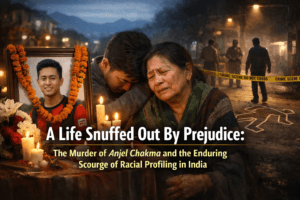
A Life Snuffed Out By Prejudice: The Murder of Anjel Chakma and the Enduring Scourge of Racial Profiling in India
The bustling university town of Dehradun, nestled in the Himalayan foothills, markets itself as India’s “school capital,” a melting pot of aspirations where students from every corner of the nation converge. For 24-year-old Anjel Chakma from Tripura, it was to be the launchpad for a dream. A final-year MBA student, a placed professional, a football enthusiast, and the son of a BSF head constable—his narrative was one of striving and imminent success. On December 26, 2025, that narrative was brutally rewritten, not by fate, but by a knife wielded in a haze of racist vitriol. His death, following a 17-day struggle after a stabbing, is more than a crime statistic; it is a searing indictment of the persistent “othering” faced by India’s own citizens from its Northeastern states.
The Anatomy of a Hate Crime
On the evening of December 9, Anjel was out with his younger brother Michael. An altercation with a group of six men, including two juveniles, quickly degenerated from a random argument into a targeted racial attack. The slurs were sickeningly familiar to any Northeastern Indian in mainland cities: “Chinese” and “momo.” These are not just words; they are dismissive reductions of complex identities, reducing a rich tapestry of cultures to stereotypical, foreign caricatures. “Momo,” a beloved culinary staple across the Himalayas, has been weaponized into a pejorative.
Reports indicate Anjel did what countless have done before him: he asserted his Indianness, telling his assailants he was from Tripura. This plea for basic recognition of his citizenship was met with further violence. As the brothers tried to leave, the attack escalated. Michael was hit on the head. Anjel, in a final act of fraternal protection, intervened. He was stabbed. The ordinariness of the setting—a Dehradun street—and the sheer banality of the hateful taunts make the tragedy even more chilling.
A Promise Unfulfilled: The Human Cost
To understand the profound loss, one must look past the headlines. Anjel Chakma was the embodiment of middle-class aspiration. Hailing from Unakoti in Tripura, his family took an education loan to fund his MBA. He had already secured a placement with a French multinational in the sporting goods sector—a point of immense pride. His university dean remembers an active, bright student who excelled in football. His Vice-Chancellor recalls visiting him in the hospital, where Anjel, ever the diligent student, was worried about missing his exams, reassuring everyone with a mention of his “high bone density.”
This detail is heartbreaking. It speaks to a young man’s belief in his own resilience, in a future he was meticulously building. His father, posted in conflict-prone Manipur with the BSF, now mourns a son he hoped would navigate a life of opportunity, not prejudice. His mother, Gourimita, now fears sending her surviving son, Michael, back to Uttarakhand. The attack didn’t just claim a life; it shattered a family’s faith and severed a pipeline of hope that education was supposed to guarantee.
Systemic Failures: Delay and Disregard
The family’s anguish is compounded by alleged systemic apathy. The attack occurred on December 9. A complaint was filed on December 10, but the FIR was registered only on December 12, with arrests made on December 14. Anjel’s father has stated that police initially refused to register a report, only acting under pressure from student unions and senior officers. This delay is not a procedural footnote; it is often the first barrier to justice for victims of hate crimes, where immediate, decisive action is crucial. It reinforces a dangerous perception that such violence is not a serious priority.
One accused, Yagya Raj Awasthi, remains absconding, a police reward on his head. While Uttarakhand CM Pushkar Singh Dhami has called the incident “unacceptable” and promised strict action, and Tripura CM Manik Saha has received assurances, these responses follow a grim, predictable pattern: condemnation after the fact, promises of justice after a life is lost.
Beyond Condemnation: The “Chinese” Stereotype and Its Violent Echoes
The racist taunt used against Anjel—“Chinese”—is the core of this malignancy. For decades, the distinct phenotypic features of many communities from India’s Northeast have made them targets for misidentification and harassment in their own country. They are perceived as perpetual foreigners, their Indian identity constantly questioned. This is not mere ignorance; it is a profound failure of the national imagination and education system to integrate the Northeast’s history, cultures, and peoples into the mainstream narrative of India.
Meghalaya Chief Minister Conrad Sangma, condemning the attack, pointedly stated, “People from the North East are as Indian as every citizen of this country.” The fact that a sitting CM still needs to assert this fundamental truth in 2025 is a damning commentary. His new ‘One Northeast’ party, referenced in the report, itself emerges from a political landscape shaped by this very sense of alienation from the mainland.
The university V-C, Dr. Shankar Ramamoorthy, identified the crux of the issue: “The taunt was that he was Chinese. This local sentiment has to be changed, and it requires a policy-level intervention.” Campus sensitization is essential, but it is a reactive, localized measure. The “sentiment” he speaks of is a nationwide deficit of empathy and knowledge.
Dehradun’s Wake-Up Call and a Nation’s Reckoning
Dehradun, as an educational hub, sits at a critical juncture. It has a moral and practical responsibility to safeguard the thousands of Anjel Chakmas who choose it for their studies. The Vice-Chancellor’s pledge to sensitize the campus is a necessary start, but it must be part of a broader, sustained city-wide campaign involving local administration, police, businesses, and civil society.
However, to confine this problem to Dehradun would be a mistake. Similar attacks have scarred cities like Delhi, Bengaluru, and Pune. This is a pan-Indian crisis of identity and belonging. It demands:
- Legal Recognition: Explicit classification of such attacks as “racially motivated” or “hate crimes” in FIRs and legal charges, attracting enhanced penalties.
- Police Reformation: Mandatory, intensive sensitivity training for police forces across states on dealing with communities from the Northeast, ensuring zero tolerance for delay or dismissiveness.
- Curriculum Integration: A non-negotiable inclusion of the history, geography, and cultural contributions of Northeastern states in school curricula nationwide to build familiarity from a young age.
- Media Representation: A conscious move beyond stereotypical portrayals in popular media to normalized, diverse representation of Northeastern individuals in all professional and social roles.
Anjel Chakma’ story is not an isolated incident. It is the extreme, lethal endpoint of a spectrum of discrimination that ranges from casual name-calling and intrusive questioning to physical violence and sexual harassment. His dream was to graduate and start work at a French MNC. Instead, his legacy must become a catalyst for a deeper, more honest national conversation. He was a football enthusiast, but the goal post he ultimately confronted was one of basic human dignity and the right to simply be who he was—an Indian from Tripura. His death must be the wake-up call that finally ends the corrosive practice of judging a fellow citizen’s nationality by the shape of their eyes. True justice for Anjel will be measured not only in court verdicts but in the eradication of the hatred that killed him.
You must be logged in to post a comment.