
A Frozen Ceasefire: How Political Deadlock in Gaza Leaves a Population in Perpetual Winter
The U.S.-brokered ceasefire in Gaza has stalled indefinitely, leaving a desperate humanitarian crisis frozen in political limbo. While the initial agreement halted the worst violence, the process has broken down over irreconcilable core issues: Israel refuses to consider a pathway to Palestinian statehood or allow a unified Palestinian authority, Hamas will not disarm without sovereignty, and no country is willing to contribute to the proposed international force tasked with the dangerous mission of peace enforcement and dismantling Hamas. As both Israeli and Palestinian leaderships prioritize their own political survival over compromise, the result is a prolonged and precarious occupation of much of Gaza, where civilians endure a deadly winter in tents, reliant on inadequate aid, with the temporary calm offering no hope for a permanent political solution or a return to normal life.
A Frozen Ceasefire: How Political Deadlock in Gaza Leaves a Population in Perpetual Winter
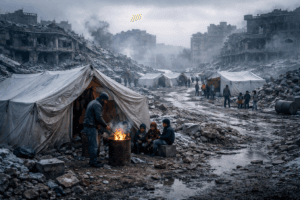
Beneath a sky the color of slate, Mohamed Hassouna arranges his family’s few possessions inside a tent pitched on a foundation of pulverized concrete. The wind, sharp and cold, whips through the ruins of his former neighborhood near Gaza City. “Israel needs to let us live,” he says, a simple plea echoing amidst a landscape of profound destruction. “They can be a country and we can be a country.” His words, captured by a videographer, are not just a personal lament but the core grievance at the heart of a ceasefire agreement that is now chillingly inert. The promise of peace, brokered with great fanfare, has stalled, leaving over two million Palestinians trapped not only in physical rubble but in a political deep freeze, with winter’s bite a cruel metaphor for a diplomatic process gone cold.
The October 10th ceasefire agreement, a 20-point plan brokered by U.S. President Donald Trump and endorsed by the UN Security Council, was hailed as a potential turning point. It successfully halted the most intense bombardments and secured the release of hostages. Yet, months later, the transition to its crucial subsequent phases—the stabilization of Gaza and a pathway to a political solution—has completely bogged down. Both Israeli and Hamas leadership are accused of “dragging their feet,” each for their own survival, while the international community, tasked with implementing the plan, watches with apparent reluctance. The result is a dangerous limbo where short-term calm masks a long-term crisis, and the people of Gaza pay the price.
The Core Obstacles: A Triptych of Failure
The ceasefire’s collapse into stalemate rests on three interlocking obstacles, each a decades-old wound that the agreement papered over but could not heal.
- The Phantom Stabilization Force: The linchpin of the plan’s first phase was the creation of an International Stabilization Force (ISF). This was not envisioned as a traditional peacekeeping mission but as a peace-enforcing one, with the daunting mandate to provide security, monitor the ceasefire, and—most critically—ensure the dismantling of Hamas’s military infrastructure. As analyst H.A. Hellyer of the Royal United Services Institute notes, “If you have a mandate… that includes the disarming of Hamas, then nobody is going to join it.” Nations like Turkey, Indonesia, or Pakistan may have been willing, but they face Israeli vetoes or their own principled refusal to act as an occupation force without a clear transition to Palestinian sovereignty. The U.S. administration’s confidence that nations will step up rings hollow against the public silence of potential contributors.
- The Disarmament Dilemma: This directly feeds into the second obstacle: Hamas’s refusal to fully disarm. The group, significantly weakened but not eradicated, insists disarmament is only possible within the context of a sovereign Palestinian state. For Israel, complete demilitarization is a non-negotiable security imperative. This creates an impossible chicken-and-egg scenario. Furthermore, Israel’s reported strategy of arming rival factions in Gaza, as analysts suggest, intentionally sows chaos to prevent a unified Palestinian authority from emerging and to make any enforced disarmament a bloody, chaotic undertaking. As former Israeli Major General Yitzhak Brik starkly stated, “disarming Hamas will not happen because there is no one who can enforce it.”
- The Ghost of Statehood: Ultimately, the entire process stumbles over the issue the agreement most glossed over: Palestinian statehood. The document relegates it to a vague future possibility, “a credible pathway” only after redevelopment. This is a far cry from the definitive two-state solution endorsed by countless UN resolutions. For Hamas and many Palestinians, statehood is the ultimate goal, the reason for any interim compromise. For Israeli Prime Minister Benjamin Netanyahu, it is anathema. Accepting the Palestinian Authority’s return to Gaza as a temporary measure—a compromise suggested by European and Arab states—is rejected by Netanyahu, who analysts believe seeks to keep Palestinian territories divided to indefinitely postpone statehood talks. As former Palestinian Authority advisor Manal Zeidan observes, Hamas is now primarily “aiming for their survival” and a political role, but their condition for transformation remains sovereignty.
The Human Cost of Political Calculus
Away from the negotiation tables, this deadlock manifests in a grim daily reality. While the famine conditions have slightly abated, the UN reports food security remains critical and accuses Israel of persistently blocking essential shelter and medical supplies—charges Israel denies. The winter storms have turned camps into quagmires, with hypothermia claiming lives. For residents like Zakaria Shabat, 55, the ceasefire is an illusion: “The ceasefire is just talk—there is no real ceasefire.” Deadly Israeli strikes continue, including recent attacks on shelters, underscoring the fragile and violated nature of the calm.
Israel’s military now occupies over half of Gaza. With each day of stalemate, these lines risk becoming permanent, a de facto annexation that buries the prospect of a contiguous Palestinian state. Ahmed Al-Kibriti, 36, living in a tent, sees it clearly: “This is not a force for stability, it’s a force of occupation.”
The Path Forward: Reluctant Players and a Fading Deal
The White House is attempting a year-end diplomatic push, with key meetings scheduled in Miami and a potential Trump-Netanyahu summit after Christmas. However, the leverage appears diminished. Hamas has largely fulfilled its initial hostage-return obligations (with one soldier’s body remaining), removing immediate crisis pressure. Netanyahu faces political pressures from a right-wing coalition fundamentally opposed to any concessions. And President Trump, the deal’s architect, seems unable or unwilling to force the painful compromises required, particularly on Israel.
Arab states, as former Jordanian Foreign Minister Marwan Muasher notes, are in a bind. They see the Trump plan as “the only game in town.” Their support is not born of enthusiasm but of desperate pragmatism—it stopped the bleeding, and disengaging might make things worse. Their investment is in permanently ending the war, but they lack the means to break the logjam.
The tragic irony is that the ceasefire, designed as a bridge to peace, has become a holding cell. It saved countless lives in the short term but institutionalized a unsustainable status quo. For the Mohamed Hassounas of Gaza, the promise of “a country” feels more distant than ever, buried under the political muck as surely as his home is buried under concrete. The international community’s feet-dragging on the ISF mirrors the leaders’ intransigence, a collective failure of will. As the winter deepens, so does the chilling realization: without a courageous, urgent, and externally enforced push to address the core political issue of statehood, this frozen ceasefire will thaw not into peace, but into the inevitable heat of another war. The donkey carts may still trudge down Gaza’s muddy roads, but the path to a real future remains utterly blocked.
You must be logged in to post a comment.