
A Diplomatic Reset, An Unanswered Fear: Canada’s Reckoning with India
The Canadian government has declared that Indian foreign interference, including transnational repression and violence against Canadians, has ceased—a dramatic reversal from just months earlier when Ottawa expelled six Indian diplomats over allegations linking New Delhi to the 2023 murder of Sikh activist Hardeep Singh Nijjar and a broader campaign of intimidation targeting the Sikh diaspora. Prime Minister Mark Carney’s upcoming business-focused trip to India, aimed at securing new markets amid U.S. protectionism, appears to hinge on this diplomatic reset, but the about-face has drawn sharp criticism from Sikh community leaders who report ongoing harassment and credible death threats, as well as skepticism from former national security officials who find it implausible that decades-long interference patterns have simply vanished without explanation, raising concerns that economic interests are being prioritized over community safety and that intelligence may be politicized to serve diplomatic convenience.
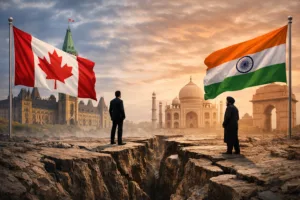
A Diplomatic Reset, An Unanswered Fear: Canada’s Reckoning with India
The timing, as with most things in diplomacy, was deliberate. On a Wednesday afternoon in late February, with the remnants of winter still clinging to Ottawa, a senior Canadian government official sat down with journalists for a background briefing. The topic was Prime Minister Mark Carney’s upcoming trip to India—a business-focused mission designed to pry open new markets as the United States retreats into protectionism.
But the official said something that stopped the room cold.
The Government of Canada, he told reporters, no longer believes India is meddling in this country. No foreign interference. No transnational repression. No violence. It had simply stopped.
Sixteen months after Canadian diplomats were expelled amid accusations that Indian agents were running a campaign of intimidation and murder on Canadian soil, Ottawa was declaring the matter resolved. The official offered no explanation for how this conclusion had been reached. No intelligence assessment was cited. No investigation results were shared. Just a statement of fact, delivered with the quiet certainty of someone turning a page.
“If we believed that the government of India was actively interfering in the Canadian democratic process, we probably would not be taking this trip,” the official said.
It was the kind of line designed to sound reasonable while obscuring a more uncomfortable question: What, exactly, had changed?
The Human Cost of Diplomatic Pivot
Balpreet Singh was in his office when news of the briefing began circulating through community channels. As legal counsel for the World Sikh Organization, he has spent years documenting what he describes as a sustained campaign of harassment, intimidation, and violence directed at Sikh Canadians by agents of the Indian government.
The government’s statement, he says, does not match what he hears from community members every single day.
“We are seeing individuals being harassed by Indian officials and families being intimidated,” Singh told The Globe and Mail. “I can say with complete conviction that the claim by the government official is utterly false.”
He offered a specific example: a prominent Sikh activist in Vancouver who was recently warned by police of a credible threat to his life. The warning came through official channels, delivered by law enforcement officers who had gathered enough intelligence to take it seriously. The activist now lives with the knowledge that someone—whether a foreign agent or a local operative acting on their behalf—may be planning to kill him.
For Singh, the government’s statement represents something deeply troubling: a willingness to subordinate community safety to economic interests. “Clearly for this government, Canadian sovereignty and the rule of law and even human lives are secondary to economic interests,” he said.
It is a damning accusation, and one that cuts to the heart of what foreign interference actually means. For policymakers in Ottawa, it is a matter of diplomatic cables and intelligence assessments, of national security advisories and carefully worded statements. For the Sikh community in Canada, it is something far more immediate: a father checking under his car before starting the engine. A community leader varying his route home each night. A family in Surrey wondering if the knock on the door will ever come.
The Diplomatic Earthquake
To understand what makes the government’s statement so striking, it helps to recall just how bad things had gotten between Canada and India.
In September 2023, Prime Minister Justin Trudeau stood in the House of Commons and delivered bombshell news: Canadian intelligence agencies were actively pursuing “credible allegations” linking agents of the Indian government to the murder of Hardeep Singh Nijjar, a Sikh activist gunned down outside a gurdwara in Surrey, British Columbia.
The killing itself had occurred four months earlier, on June 18, 2023. Nijjar, 45, had just closed the doors of the Guru Nanak Sikh Gurdwara when two masked men approached his truck and opened fire. He died at the scene, leaving behind a wife and children, and a community already on edge about threats from abroad.
Trudeau’s public accusation sent shockwaves through the diplomatic establishment. India vehemently denied involvement, calling the allegations “absurd” and politically motivated. But the damage was done. Diplomatic ties froze. India suspended visa services for Canadians. Trade negotiations stalled. When Canada expelled six Indian diplomats in 2024—including the country’s high commissioner—New Delhi responded in kind.
By then, the RCMP had designated the expelled diplomats “persons of interest” in an investigation probing what the force described as a campaign of violence, extortion, and intimidation directed at the Sikh diaspora by agents of Prime Minister Narendra Modi’s government. The allegations were sprawling: murders, extortion schemes, threats against community leaders, and a systematic effort to silence critics abroad.
A public inquiry report released in January 2025 added another layer, flagging India as the “second most active country engaging in electoral foreign interference in Canada” after China. The finding suggested that India’s reach extended beyond the Sikh community into the very fabric of Canadian democracy.
Against this backdrop, the Carney government’s assertion that everything has stopped seems, to many observers, almost surreal.
The Skeptics
Jody Thomas served as national security adviser under Justin Trudeau. She was in the room when some of the most sensitive intelligence about Indian interference was discussed. She knows the details that never made it into public briefings.
Now retired, Thomas no longer has access to current government intelligence. But she finds the official line difficult to reconcile with everything she learned in office.
“I find it hard to believe that things have resolved themselves to the point described,” Thomas said. “It would be lovely to know that all of the threats and the interference have ended. That would be a really positive thing.” She paused. “But it would surprise me.”
Thomas’s skepticism is rooted in history. The pattern of Indian interference in Canada did not begin with Nijjar’s murder, nor will it end with a change in government. It stretches back decades, to the 1980s, when Sikh militancy in Punjab led New Delhi to view the diaspora with deep suspicion. Indian intelligence agencies have long maintained networks in Canada, cultivating sources, monitoring activists, and occasionally—according to multiple investigations—taking more direct action against those deemed threats to the Indian state.
Stephanie Carvin, a former national security analyst and now a professor at Carleton University, puts it bluntly: “India has been engaged in foreign interference in Canada since the 1980s. It did not stop this week because of a few official exchanges.”
For Carvin, the government’s statement raises troubling questions about how intelligence is being used—or misused—to serve political ends. She points to the Public Inquiry on Foreign Interference, which issued its final report in 2025. Among its warnings was a caution against the politicization of intelligence, a danger the inquiry said could stem “either from ignorance of the threat or blind opportunism—neither of which is good.”
“I’m seeing that warning realized in real time,” Carvin said. “It is concerning to see foreign interference being downplayed in this way by a senior Canadian official. It seems to be bordering on the politicization of intelligence.”
The Channel
The government official who briefed reporters cited one concrete mechanism for the apparent change: a high-level communication channel on security matters, established between Canadian and Indian national security advisers. This channel, the official suggested, allows both countries to address problems before they escalate, creating a diplomatic off-ramp for what might otherwise become full-blown crises.
It is the kind of bureaucratic solution that sounds perfectly reasonable in a background briefing. Two sovereign nations, each with legitimate security concerns, establishing a line of communication to resolve differences. What could be wrong with that?
The problem, critics say, is that it assumes good faith on both sides. It assumes that when Canada raises concerns about threats to its citizens, India will take those concerns seriously and act to address them. It assumes that the channel works both ways.
But what if the channel is simply a way for Canada to signal that it is no longer willing to press the issue? What if raising concerns in private, without any public accountability, allows India to offer assurances while continuing activities that fall short of whatever threshold triggers Canadian action?
The official did not explain how the government had determined that Indian interference had ceased. No intelligence was shared. No investigation results were cited. Just a statement of confidence, offered to journalists on condition of anonymity.
The Prime Minister’s Calculus
Mark Carney is not a politician by training. He came to public life as a central banker, a technocrat comfortable with data and systems, less comfortable with the messy unpredictability of democratic politics. His approach to foreign policy reflects this background: pragmatic, business-focused, oriented toward measurable outcomes.
The India trip, which begins Friday, is classic Carney. He will visit Mumbai and New Delhi, meeting with business leaders and investors, pitching Canada as a stable, reliable partner in an increasingly unstable world. He will not visit Punjab, the heartland of the Sikh diaspora and the region most relevant to the foreign interference allegations. The message is clear: this is about trade, not community politics.
The calculation is understandable. With the United States retreating from global leadership under Donald Trump’s second term, Canada needs new markets. India, with its 1.4 billion people and rapidly growing economy, represents an enormous opportunity. Trade talks that stalled under Trudeau could restart under Carney. Investment that flowed elsewhere could be redirected toward Canada.
But the calculation also carries risks. By declaring the foreign interference issue resolved, Carney is effectively telling the Sikh community that their concerns are no longer a priority for the Canadian government. He is signaling to India that there will be no further consequences for past actions. He is asking Canadians to trust that a diplomatic channel, established behind closed doors, provides sufficient protection for those who remain targets of foreign interest.
The Prime Minister’s Office, asked for comment, offered a carefully worded statement that neither confirmed nor contradicted the official’s remarks. “The safety and security of Canadians will always be our government’s top priority,” said Audrey Champoux, deputy director of communications. She noted that an “ongoing law enforcement dialogue” would continue to guide re-engagement with India.
It was the kind of statement designed to say everything and nothing at once.
What “Resolved” Actually Means
There is, of course, another possibility: that the government actually believes what it said.
Perhaps the intelligence community has concluded that India, chastened by the diplomatic fallout and the public attention, has indeed pulled back. Perhaps the high-level channel has produced concrete results, with Indian authorities taking action against operatives who overstepped. Perhaps the threat has diminished to the point where it no longer meets the threshold for public concern.
This is the version of events the official presented. It is neat, tidy, and diplomatically convenient. It allows Carney to visit India without the shadow of the Nijjar murder hanging over every photo op. It permits trade talks to proceed without the awkwardness of Canadian officials demanding accountability from their Indian counterparts. It resets a relationship that had become, from Ottawa’s perspective, unproductively adversarial.
But even if the government’s assessment is accurate—even if Indian interference has truly ceased—the statement raises uncomfortable questions about how such determinations are made and communicated. Intelligence assessments are rarely this absolute. Threats do not simply stop; they evolve, adapt, and re-emerge in different forms. Declaring victory carries the risk of complacency, of lowering guard precisely when vigilance is most needed.
And for those who have lived with the reality of foreign interference—who have altered their lives, their routines, their relationships in response to threats—the government’s certainty feels like gaslighting.
The Community’s Reality
The World Sikh Organization’s Singh returns again and again to the lived experience of community members. The activist warned by police of a credible threat. The families who receive calls from unknown numbers, voices on the other end speaking in Punjabi, mentioning relatives back in India by name. The gatherings where participants scan parking lots before entering, noting vehicles that seem out of place.
This is the reality that the government’s statement does not capture. It is a reality of low-grade but persistent intimidation, of threats that never quite rise to the level of a major investigation, of fear that becomes normalized, part of the background noise of daily life.
“When the government says this activity has stopped, they are not speaking to anyone in our community,” Singh said. “They are not asking us what we see, what we hear, what we know.”
He paused, choosing his next words carefully. “I don’t know what intelligence they are basing this on. But I know what our community is experiencing. And those two things do not match.”
The Geopolitical Context
It is impossible to separate this moment from the broader geopolitical context in which it occurs. The United States, under Trump, has become an unreliable partner, threatening tariffs, withdrawing from international agreements, and questioning alliances that have underpinned global stability for decades. For Canada, this creates enormous pressure to diversify relationships, to find new partners who offer stability and predictability.
India, in this context, looks increasingly attractive. It is a democracy, however imperfect. It is a growing economy with a massive market. It shares with Canada a concern about Chinese expansionism. It offers an alternative to dependence on the United States.
But India is also a country where democratic backsliding is well documented, where religious minorities face increasing persecution, where the government has shown little tolerance for dissent at home or abroad. The same Narendra Modi whom Carney will meet in New Delhi has spent years cultivating a reputation as a strong leader who brooks no opposition. His government’s approach to the Sikh diaspora has been consistent: critics abroad are enemies at home, and enemies must be dealt with.
The diplomatic reset Carney seeks requires setting aside these concerns, or at least subordinating them to other priorities. It requires accepting that the relationship with India is more important than accountability for past actions. It requires a certain amount of forgetting.
The Unanswered Question
The official who briefed reporters offered one final thought, buried in the middle of his remarks. Asked about allegations that Indian agents continue to engage in extortion and threats of violence in Canada, he responded with confidence: Ottawa believes this is no longer happening.
The basis for this belief remains unclear. No investigation has been closed. No public report has been issued. No charges have been laid that might signal a resolution. Just a statement, offered in a background briefing, that a problem of years’ standing has simply evaporated.
For the Sikh community in Canada, this is not a resolution. It is a dismissal. It is the government looking at a problem that has caused real harm to real people and deciding, without explanation, that it is time to move on.
Balpreet Singh put it this way: “The Carney government has failed to hold India accountable or to create any safeguards.” His voice carried the weariness of someone who has made this argument before, who has watched governments come and go while community concerns remain unaddressed. “They have chosen economic interests over Canadian lives.”
It is a harsh judgment. But it reflects the chasm between how the government sees this issue and how it is experienced by those most affected. For Ottawa, the Nijjar murder and its aftermath are a diplomatic problem to be managed, an obstacle to trade and investment that must be cleared. For the Sikh community, they are an ongoing reality, a threat that has not disappeared simply because the government has decided to stop talking about it.
As Carney boards his plane for India, carrying with him the hopes of Canadian businesses seeking new markets and new opportunities, that chasm remains unbridged. The government has declared the matter resolved. The community continues to live with its consequences.
You must be logged in to post a comment.