
A Descent Into Tragedy: The Perilous Road to a Pilgrim’s Prayer
A bus carrying Indian pilgrims home from the revered Manakamana Temple in Nepal slipped off a treacherous mountain curve on March 14, plunging 150 meters into a ravine and killing seven devotees while injuring nine others, including the Nepali driver and his assistant. The tragedy highlights the perilous intersection of unwavering faith and unforgiving Himalayan geography, where narrow, poorly maintained roads and aging vehicles create a systemic crisis—turning a journey of spiritual hope and whispered wishes to a wish-fulfilling goddess into a devastating descent that leaves families in India mourning and underscores the chronic risks millions face when navigating Nepal’s mountainous terrain in pursuit of divine blessings.
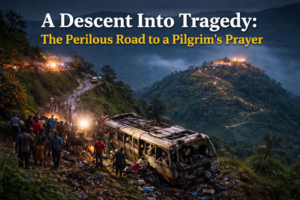
A Descent Into Tragedy: The Perilous Road to a Pilgrim’s Prayer
A bus carrying Indian pilgrims home from a revered mountaintop shrine crashes in Nepal, killing seven and highlighting the stark contrast between spiritual faith and physical reality in the Himalayas.
The air in the Manakamana Temple is thick with the scent of marigolds, burning ghee, and fervent prayer. For centuries, pilgrims have made the arduous journey to this sacred clifftop, believing that the Hindu goddess Bhagwati, an incarnation of Parvati, has the power to grant their deepest wishes. For the 16 people on board a bus on the night of March 14, 2026, their own wishes—for prosperity, for health, for a son, for a happy family—had just been whispered to the goddess. But the journey home, a descent from the spiritual heights back to the physical world, would end in devastating tragedy.
A bus carrying Indian pilgrims slipped off a treacherous curve and plunged 150 meters (500 feet) down a mountainside in central Nepal. By the time the wreckage came to a rest in a dark ravine near Shahid Lakhan village, seven of the devotees had lost their lives. Their pilgrimage, a journey of hope, had become their final one.
This is not just a story of an accident; it is a story about the intersection of unwavering faith and unforgiving geography, a tragedy that reveals the profound risks millions undertake in the name of devotion.
The Lure of the Wish-Fulfilling Goddess
To understand the journey, one must first understand the destination. The Manakamana Temple is not just another holy site in Nepal; it is a powerhouse of faith, particularly for Hindus from both Nepal and the neighbouring Indian states of Bihar and Uttar Pradesh. Perched at an altitude of 1,300 meters (4,265 feet) on a ridge in the Gorkha district, its name itself reveals its power: “Manakamana” translates to “the heart’s wish.”
The temple’s origin is steeped in legend. It is believed that in the 17th century, a king and queen discovered that their queen possessed divine powers. When the king accidentally discovered her true divine form, she prophesied her own demise and resurrection, instructing that a temple be built in her honour at that very spot. The idol worshipped today is said to have manifested on its own, a Swayambhu (self-existent) form of the goddess.
For the millions who visit, the goddess Bhagwati is the ultimate arbiter of fate. Devotees believe that if you make the pilgrimage with a pure heart and offer prayers and animal sacrifices (traditionally chickens, goats, or pigeons), the goddess will look upon you favourably and your wish will be granted. This promise of divine intervention for life’s most intractable problems—infertility, chronic illness, business failures, family disputes—draws a constant stream of the desperate and the hopeful.
For the 14 Indian pilgrims on the bus, the journey was likely the culmination of years of planning and saving. Crossing the border from India, they would have joined a throng of other devotees, their faces a mixture of exhaustion and excitement. Many would have chosen to take the thrilling, five-minute cable car ride from the highway below, soaring over dense forests and rushing rivers to the temple complex. But others, perhaps due to cost or a desire for a more traditional, arduous approach, opt for the winding mountain road that snakes up from the main highway. It was on this path that their journey home turned fatal.
The Fatal Curve: A Geography of Risk
The accident occurred on a path leading from the highway to the temple. This detail is crucial. Nepal’s topography is breathtakingly beautiful but brutally challenging. The country is a staircase of mountains, from the low-lying Terai plains to the eight-thousand-metre peaks of the Himalayas. In between are countless hills, ridges, and valleys, all connected by a network of roads that are often an afterthought to the landscape.
These are not the wide, smooth highways of the plains. They are narrow, two-lane (and often one-lane) roads carved directly into the sides of mountains. They are characterized by sharp, blind curves, steep gradients, and unpredictable surfaces. The path from the main Prithvi Highway to the Manakamana Temple is a perfect example. It’s a road that demands constant, intense concentration from drivers, especially on the descent.
As the bus, laden with passengers and the spiritual weight of their fulfilled wishes, began its journey downhill, it was fighting against gravity on every turn. The police report states the bus slipped off a curve. In the language of mountain driving, a “slip” can mean everything. It could be gravel on the road, a patch of oil, a momentary lapse in judgment, or a mechanical failure in the braking system. On a flat road, a slip might cause a fender bender. On a mountain road, it is a catastrophe waiting to happen.
Witnesses and police described the bus rolling down the mountainside for 150 metres before landing in a ravine. One can only imagine the horror inside the vehicle as it tumbled. The world outside the windows—the sky, the trees, the dirt—would have spun in a terrifying kaleidoscope. Luggage, offerings brought from the temple, and bodies would have been thrown around the cabin. The prayers that had filled the bus on the way up were likely replaced by screams before a devastating, sickening silence.
The Human Toll: Stories Left Untold
As of Sunday morning, the official count was grim: seven dead, nine injured. The dead were all Indian pilgrims. The injured included seven more Indian pilgrims and the two Nepali nationals on board—the bus driver and his assistant.
The aftermath of such a crash is a chaos of sirens, flashing lights, and frantic shouting. Police and local villagers, the first responders in Nepal’s remote areas, rushed to the scene. They didn’t have heavy lifting equipment; they had their hands, their resolve, and a desperate urgency. They pulled the injured from the twisted metal, a scene that will be forever etched in their memories. The injured were then transported by ambulances, navigating the very same treacherous roads, to local hospitals.
Now, the focus shifts to the families. For seven families in India, a simple phone call has brought life-altering devastation. A husband who went to pray for his family’s prosperity will not return. A mother who sought the goddess’s blessing for her children is gone. The bodies, once they have undergone the necessary legal procedures of autopsy in Nepal, will be repatriated. The return of a body is a pilgrimage of a different kind, one of grief and finality.
For the injured, the physical pain is only part of the trauma. Lying in a Nepali hospital, far from home, they must process the horror they have just survived. The sounds of the crash, the sight of their fellow pilgrims’ final moments, the guilt of survival—these are wounds that will take far longer to heal than any broken bone. The Nepali driver, if he survives, will carry the weight of this tragedy for the rest of his life, regardless of fault.
A Systemic Crisis on the “Roof of the World”
This accident is a heartbreaking but familiar story in Nepal. Bus accidents are not anomalies; they are a chronic, systemic crisis. The causes are as layered as the landscape itself.
- The Infrastructure:As mentioned, the roads are inherently dangerous. They are often poorly maintained, with crumbling shoulders, inadequate guardrails, and frequent landslide damage during the monsoon season. A guardrail might have caught the bus, preventing its 500-foot fall. Its absence is a silent complicity in the tragedy.
- The Vehicles:The buses that ply these routes are often aging, second-hand vehicles imported from India or other countries. They are pushed to their limits on steep gradients, and maintenance can be sporadic and profit-driven. Brake failure is a common contributing factor in downhill crashes, as brakes can overheat and fade on long descents.
- The Human Factor:Driving on Nepali roads requires a unique and demanding skill set. Drivers are often overworked, undertaking long journeys with tight deadlines to maximize earnings. Fatigue can be deadly on a winding road. Reckless driving, overtaking on blind corners, and speeding are also rampant, born from a culture where time is money and the roads offer few deterrents.
The government regularly launches safety campaigns and announces stricter regulations in the wake of major accidents, but enforcement is weak, and the fundamental problems of geography and underfunded infrastructure remain.
A Journey of Faith, Marred by Fate
As night fell on Shahid Lakhan village on Saturday, the wreckage of the bus served as a brutal, metal monument to a shattered dream. The pilgrims who boarded it had placed their faith in the goddess Manakamana. They had climbed to her shrine, offered their prayers, and entrusted her with their most cherished desires. They then placed their physical safety in the hands of a bus driver and a vehicle, navigating a road that clings precariously to the side of a mountain.
For seven of them, the goddess did not grant safe passage home. Their bodies will be returned to their families, a stark reminder that in the Himalayas, the line between the spiritual and the mortal, between a wish granted and a life taken, can be terrifyingly thin. The road to heaven, it seems, is sometimes paved with the very earth that can lead us there.
You must be logged in to post a comment.