
A Deep Dive into the Trump-Netanyahu Meeting: Grand Strategy, Political Survival, and Humanitarian Crisis
The late December 2025 meeting between President Donald Trump and Prime Minister Benjamin Netanyahu at Mar-a-Lago reinforced a partnership defined by unconditional U.S. support for Israel’s strategic ambitions. Trump issued bellicose threats toward Iran and demanded Hamas disarm, while offering no demands on Israel, even as its actions in Gaza—including suspending lifesaving aid groups—deepened a humanitarian catastrophe. For Netanyahu, the meeting provided crucial political cover for his domestic legal battles and far-right coalition, exemplified by Trump’s improper call for a presidential pardon. Analysts interpreted the event as advancing a broader vision of U.S.-Israeli dominance in the Middle East, a project marked by a willingness to sideline international law and humanitarian norms, thereby entrenching regional conflict and civilian suffering.
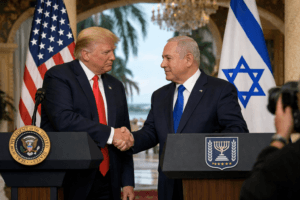
A Deep Dive into the Trump-Netanyahu Meeting: Grand Strategy, Political Survival, and Humanitarian Crisis
- Mar-a-Lago Meeting Dynamics: Trump’s unwavering support for Israeli actions and Netanyahu’s reciprocal awarding of Israel’s highest civilian honor to a foreign leader.
- Strategic and Humanitarian Disconnect: Official declarations of peace efforts starkly contrast with actions exacerbating Gaza’s humanitarian catastrophe.
- Wider Regional Ambitions: Discussions extended beyond Gaza to include threats against Iran, revealing a broader strategy to reshape the Middle East.
Introduction: A Meeting of Minds at Mar-a-Lago
In late December 2025, the meeting at President Donald Trump’s Mar-a-Lago estate between the American president and Israeli Prime Minister Benjamin Netanyahu presented a powerful spectacle of alliance. Trump offered sweeping support for Israel’s military stances toward Iran and Gaza, while Netanyahu announced that Trump would become the first non-Israeli to receive the Israel Prize, the nation’s highest civilian award. Beneath the surface of mutual praise, however, analysts detected a concerning reality: a partnership advancing a vision with profound consequences for Middle East stability and international humanitarian law. This meeting, as described by Palestinian American journalist Rami Khouri, appeared to be a continuation of a drive to reconfigure the region into a new colonial arrangement dominated by the U.S. and Israel.
Unpacking the Trump-Netanyahu Agenda: Strategy and Public Performance
The press conference following the meeting was long on bold declarations but notably short on substantive diplomatic detail. The two leaders projected an image of total alignment, but their performances served different, albeit complementary, goals.
Trump’s “Whatever Israel Wants” Stance
President Trump adopted a posture of maximal, unconditional support. He issued a stark warning to Iran, stating, “Now I hear that Iran is trying to build up again. And if they are, we’re going to have to knock them down. We’ll knock the hell out of them”. This bellicose language underscored a policy of aggressive deterrence favored by Netanyahu. On Gaza, Trump framed the stalled ceasefire agreement in simple terms, demanding Hamas disarm within a “very short period of time” or face severe consequences, while appointing his son-in-law Jared Kushner and Steve Witkoff to oversee the process. Israeli journalist Gideon Levy characterized Trump’s presentation as an “embarrassment,” noting the president presented himself as someone who promises the sky but has no demands from Israel whatsoever. This one-sided pressure, focusing solely on Hamas’s obligations while ignoring Israeli actions, revealed a fundamental asymmetry in the U.S.-brokered approach.
Netanyahu’s Domestic and Legal Calculations
For Netanyahu, the meeting was a crucial display of unwavering American backing, a asset he desperately needs. He is caught in what former aides call the “Bibi sandwich”—trapped between pressure from President Trump to advance a ceasefire and the demands of his far-right coalition partners, like Finance Minister Bezalel Smotrich, to resume the war in Gaza to eradicate Hamas. Netanyahu’s political survival depends on maintaining this coalition, and a misstep could cause it to collapse. Furthermore, Netanyahu is on trial for corruption charges in Israel. Trump’s very public call for Israeli President Isaac Herzog to grant Netanyahu a pardon—a claim Herzog’s office later denied—was a blatant intervention into another country’s sovereign legal process. It highlighted how Netanyahu’s personal political and legal vulnerabilities are now intertwined with high-stakes international diplomacy.
The Stark Contradiction: Rhetoric Versus Humanitarian Reality
Perhaps the most disturbing aspect of the Mar-a-Lago meeting was the vast chasm between the leaders’ statements and the actual conditions in Gaza. Trump claimed Israel was “abiding by the ceasefire,” a statement directly contradicted by facts on the ground.
Since the ceasefire agreement, hundreds of Palestinians have been killed. The humanitarian situation remains catastrophic. Khouri described Israel using a “new weapon… to freeze babies to death,” referencing reports of infants dying from exposure in makeshift shelters during winter. This crisis is systemic: over 77% of Gaza’s population faces high levels of food insecurity, and the majority of buildings, including hospitals and schools, have been damaged or destroyed.
In a move that experts warn will dramatically worsen this crisis, Israel announced it would suspend the operating licenses of more than two dozen major international humanitarian organizations in Gaza, effective January 1, 2026. The banned groups include Doctors Without Borders (MSF), Oxfam, CARE, and the Norwegian Refugee Council. Israel’s government claims the organizations failed to meet new transparency requirements, but aid groups argue the rules are arbitrary and could endanger their Palestinian staff.
Table: Contradictions Between Trump-Netanyahu Statements and Gaza Reality
| Official Statement/Claim | Documented Reality | Immediate Consequence |
| Israel is “abiding by the ceasefire” | Hundreds of Palestinians killed since truce; near-daily attacks | Erosion of trust, ceasefire at risk |
| Focus on Hamas disarmament as key to “Phase 2” | Catastrophic humanitarian crisis persists; 1 in 3 healthcare facilities at risk of closing if INGOs are banned | Civilian suffering decoupled from political process |
| Aid regulations ensure security & transparency | NGOs fear staff targeting; over 500 aid workers killed since war began | Backbone of aid response dismantled, winter deaths expected to rise |
Refugees International condemned the aid group suspensions, stating the action has no legitimate basis and “will cost the lives of Palestinians”. They emphasized that a ceasefire is not just a reduction in violence but a commitment to stabilize civilian life, a commitment this decision fundamentally undermines.
A Broader Colonial Vision and the Erosion of International Norms
Analysts like Rami Khouri interpret these actions as part of a longer-term project that extends far beyond Gaza. He describes a “continuation of the American-Israeli drive… to reconfigure the Middle East… into a new colonial arrangement”. In this view, the meeting at Mar-a-Lago was about reinforcing a system where the U.S. and Israel “dominate what goes on in the region, they give orders to everybody, and they set the rules”.
Several concurrent actions support this analysis:
- Expansion of Conflict: Discussions included active support for potential Israeli strikes against Iran, signaling a willingness to widen the regional conflict.
- Recognition of Somaliland: Israel’s controversial move to become the first country to recognize the breakaway region of Somaliland was interpreted by some, including Somalia’s UN ambassador, as a potential step toward relocating Palestinians from Gaza.
- Defiance of International Law: Netanyahu’s ability to fly through European airspace without arrest, despite an ICC warrant, exemplifies what Khouri calls the “shredding” of international law. The message, he argues, is that “these rules of law, rules of war… don’t apply to Israel”.
Conclusion: The High Stakes of Unconditional Alliance
The Mar-a-Lago meeting between Trump and Netanyahu was more than a diplomatic photo opportunity; it was a crystallization of a particular, hardline approach to the Middle East. It showcased a partnership where unconditional American support empowers an Israeli government pursuing maximalist security goals, often at the direct expense of Palestinian civilian life and international legal norms. The simultaneous discussion of confronting Iran and punishing Gaza reveals a vision of a region permanently reshaped by force and dominance.
The immediate and most heartbreaking cost is being paid in Gaza. As winter sets in, the suspension of lifesaving humanitarian organizations—decried by the international community—threatens to turn an already unimaginable catastrophe into one of historic proportions. The meeting’s legacy may ultimately be defined not by the prizes exchanged or the deals promised, but by the degree to which it accelerated the suffering of a civilian population and the destabilization of a volatile region. The path forward, as noted in the discussions, remains “complicated,” caught between geopolitical ambition, domestic political survival, and a devastating human toll.
You must be logged in to post a comment.