
A Day of Layered Crises: West Bank Attack, Hostage Testimony, and Regional Alarms Signal Unabating Tensions
The day’s events underscored the interconnected and escalating nature of the Israeli-Palestinian conflict, where a localized car-ramming that lightly wounded an Israeli soldier in the West Bank occurred amidst broader crises: the haunting testimony of a released hostage detailing sexual assault and abuse in Gaza captivity, a stark U.S. warning of an imminent Israeli offensive against Hezbollah in Lebanon, and high-stakes political maneuvers including an invitation for Netanyahu to the White House.
These simultaneous developments reveal a conflict with no clear off-ramp, characterized by persistent low-intensity violence, profound humanitarian and psychological trauma, the looming threat of regional war, and deep internal political divisions, all converging into a cycle of retaliation and entrenched hostility.
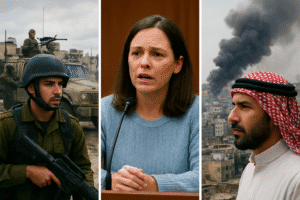
A Day of Layered Crises: West Bank Attack, Hostage Testimony, and Regional Alarms Signal Unabating Tensions
In a region where a single incident is often a tremor along a much larger fault line, a seemingly isolated car-ramming attack in the southern West Bank on Monday became a focal point in a day dense with ominous developments. The event, which left an Israeli soldier lightly wounded near Kiryat Arba, was just one entry in a ledger of violence, political maneuvering, and profound human suffering that continues to define the Israeli-Palestinian conflict and its widening regional ripple effects.
The attack itself followed a now-familiar pattern: a driver, identified by the Israeli military as a terrorist, struck a soldier before fleeing the scene, prompting an extensive IDF manhunt. While such incidents have occurred with grim regularity in the West Bank for years, their context is now indelibly shaped by the ongoing aftermath of the October 7 attacks and the war in Gaza. The IDF’s operations in the West Bank have intensified dramatically, a reality underscored just hours before the ramming when IDF Chief of Staff Eyal Zamir addressed a different, more troubling shooting. He stated that the killing of two surrendered Palestinians by Border Police officers days earlier “require[d] a thorough clarification.” This juxtaposition—a search for a fleeing assailant alongside an investigation into potential excessive force—highlights the tense and volatile atmosphere in which both Palestinians and Israeli soldiers operate, where threat perception is at a peak and accountability is fiercely debated.
The Unending Trauma of Captivity
Beyond the immediate violence of the ramming, a deeper, more intimate horror was revealed. In a televised interview, former hostage Alon Ohel, released from Gaza in October, provided chilling testimony of his captivity. He described not only starvation and medical neglect but also sexual assault by a captor during forced showers. “He’d start soaping you up in the shower… [He’d] touch you, it’s unpleasant,” Ohel recounted. His account, which included being forbidden from speaking for his first two weeks, adds a devastating layer to the understanding of hostage abuse. It shifts the narrative from one of mere physical detention to one of systematic dehumanization, reinforcing the complex trauma that survivors and a nation continue to grapple with. This personal testimony, emerging on the same day as the soldier was wounded, served as a stark reminder that the physical battles in the West Bank and Gaza are paralleled by profound psychological wars.
The Northern Shadow and Global Politics
Simultaneously, the specter of a second major front loomed larger. Reports confirmed that U.S. Special Envoy Tom Barrack had warned Iraq of an “imminent Israeli operation against Hezbollah in Lebanon,” stating it would continue until the group disarms. This aligns with months of escalating cross-border strikes and rhetoric, suggesting Israeli leadership may be nearing a decision point on whether to pursue a more expansive campaign to push Hezbollah back from the northern border. Such a conflict would be catastrophic for both Lebanon and Israel, drawing in regional players and potentially triggering a broader regional war.
Amidst these security warnings, high-stakes politics played out. Prime Minister Benjamin Netanyahu shared a phone call with U.S. President Donald Trump. According to Netanyahu’s office, Trump invited the Israeli leader to the White House and both “emphasized… the commitment to disarming Hamas and demilitarizing Gaza.” Notably, Trump also publicly urged Israel to “maintain a strong and true dialogue” with Syria as a path to normalization—a foreign policy suggestion that aligns with his administration’s prior approach but stands at odds with the current regional alignments and Syria’s entrenched alliance with Iran.
Meanwhile, on the Israeli domestic front, National Security Minister Itamar Ben-Gvir escalated his rhetoric against state institutions, labeling the Justice Ministry unit investigating police misconduct as part of the “Deep State” that “persecutes the right.” His concurrent call to pardon Netanyahu, who is facing corruption charges, further illustrates the intense internal political battles that run parallel to military ones, shaping governance and policy from within.
The Gaza Grind: Death, Destruction, and a ‘Yellow Line’
In Gaza, the war of attrition persisted. The Gaza Health Ministry reported the recovery of nine more bodies from the rubble over 24 hours, a daily toll that has become a macabre routine. The IDF announced it had killed “two terrorists” who crossed the unilaterally declared “Yellow Line” in northern Gaza, a boundary it says poses an immediate threat to troops. This procedural military statement, a fragment in the day’s news, encapsulates the grim reality of the ongoing Israeli presence in parts of Gaza: a tightly controlled, lethal landscape where any movement is fraught with extreme danger.
A Tapestry of Unresolved Conflict
The day’s events, taken together, form a mosaic of a conflict with no off-ramp. From the West Bank roadside to the hostage’s memory of a Gaza shower, from diplomatic offices in Washington to the rubble of Khan Younis, the crisis manifests in relentlessly diverse forms.
The lightly wounded soldier near Kiryat Arba is more than a statistic; he is a symptom of an occupation deepened by mutual fear and retaliatory violence. Alon Ohel’s testimony is more than an interview; it is a fragment of a national trauma that fuels resolve and rage in equal measure. The U.S. warning on Hezbollah is more than a rumor; it is a potential preamble to a war that could dwarf the current destruction.
This is the essence of the current moment: there is no singular “Israel-Gaza war.” There is, instead, a multi-arena struggle encompassing guerrilla attacks in the West Bank, high-intensity urban warfare in Gaza, shadow warfare with Iran’ proxies, a bitter internal Israeli political divide, and a global battle for diplomatic and public opinion. Each car-ramming, each hostage testimony, each bomb threat to a U.S. senator’s office (as also reported that day targeting Chuck Schumer), and each diplomatic maneuver is a thread in the same tangled, tightening knot. Until there is a political vision capable of addressing the core drivers of this spiral—the occupation, Palestinian statelessness, Israeli security fears, and the role of militant actors—the days will continue to be measured in wounded soldiers, bodies pulled from rubble, and the slow, painful unfolding of truths no one wanted to hear.
You must be logged in to post a comment.