
A Cycle of Violence: When Retribution Replaces Resolution in the Israeli-Palestinian Conflict
The stabbing and car-ramming attack in northern Israel, which killed two Israelis and was allegedly carried out by a Palestinian from the West Bank town of Qabatiya, triggered an immediate cycle of violence and retaliation that encapsulates the entrenched Israeli-Palestinian conflict. In response, the Israeli defense minister ordered a forceful military operation in the attacker’s hometown, a common practice Israel defends as a security necessity but which critics condemn as collective punishment; this starkly contrasted with the treatment of an Israeli soldier who rammed a Palestinian, who was individually disciplined. The incident underscores a devastating pattern where asymmetric violence—reflected in UN figures showing over 1,000 Palestinians killed in the West Bank versus 57 Israelis in a similar period—fuels a self-perpetuating cycle of trauma, retaliation, and despair, highlighting the urgent need to move beyond security-centric responses and address the underlying political stagnation and injustices of the occupation that erode hope for both peoples.
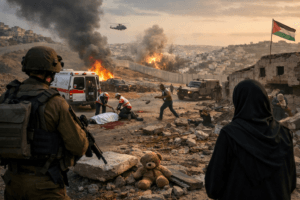
A Cycle of Violence: When Retribution Replaces Resolution in the Israeli-Palestinian Conflict
The news from northern Israel on a December Friday was tragically familiar in its outline, yet uniquely shattering in its details. A Palestinian man from the West Bank town of Qabatiya allegedly carried out a combined car-ramming and stabbing attack, killing an Israeli man and woman before being shot and wounded by a civilian. Within hours, Israeli Defense Minister Israel Katz announced instructions for the military to “respond with force” in Qabatiya, a town already scarred by previous raids. This instantaneous pivot from tragedy to promised reprisal lays bare a devastating pattern that has calcified into a grim status quo, one where human loss is not a catalyst for breaking cycles, but a pretext for perpetuating them.
The Immediate Aftermath: Grief and the Machinery of Response
The attack itself, described by police as a “rolling terror attack,” represents the ultimate nightmare for any community—a sudden, violent incursion that shatters the mundane. The victims, whose names and stories were yet to fully emerge in initial reports, become more than statistics; they are neighbors, parents, friends, whose futures are erased in an act of political violence. The teenage bystander reportedly injured adds another layer of trauma, a young life irrevocably altered.
Yet, even as medics worked at the scene, the political and military machinery was engaging not just in investigation, but in preparation for a response. The declaration from Defense Minister Katz was swift and unequivocal: a forceful military operation in the attacker’s hometown. This practice, as noted in the report, is common. Israel justifies these raids as necessary to dismantle militant networks and create a deterrent, arguing they prevent future attacks by targeting the infrastructure that supports them. For the residents of towns like Qabatiya, however, these operations are not surgical strikes against guilty individuals. They are experienced as collective punishment—a disruptive, often terrifying incursion by armed forces that affects everyone, guilty and innocent alike.
The Dissonant Contrast: A Tale of Two Incidents
Perhaps the most profound insight into the corrosive nature of this conflict lies in the stark juxtaposition presented within a single news cycle. Alongside the report of the Palestinian attacker, we learn of an Israeli reservist soldier who, the day prior, rammed his vehicle into a Palestinian man praying on a roadside in the West Bank. The military’s response here is telling: the soldier’s service was terminated, his weapon confiscated, and he was placed under house arrest for a “severe violation of his authority.” The Palestinian victim, thankfully, was unhurt.
This incident is framed correctly as a criminal act by an individual, an aberration from military protocol. The system moves to isolate the perpetrator and affirm a standard of conduct. Yet, when the perpetrator is Palestinian, the response is frequently not individualized. It is collective and geographic, targeting a family’s home or an entire town. This dissonance feeds a pervasive sense of injustice and inequality under the law—or under force. Palestinians see one standard for their actions and another for actions against them, a perception that fuels resentment and undermines any faith in a system that might deliver justice or security.
The Human Calculus of a Long Occupation
The United Nations figures cited in the report offer the chilling macro-context: over 1,000 Palestinians killed in the West Bank in just over two years, compared to 57 Israelis. This staggering disparity is not just a number; it is a testament to the profoundly asymmetric nature of the conflict. For Palestinians in the West Bank, life under military occupation is a daily negotiation with checkpoints, restrictions, settlements expanding on hilltops, and the constant potential for lethal violence during army raids or settler confrontations.
This environment does not excuse acts of terror against Israeli civilians, which are morally reprehensible and inflict deep, lasting trauma. But to understand is not to excuse. It is to recognize that endless occupation, devoid of a political horizon for freedom or statehood, creates a pressure cooker of despair, humiliation, and rage. For some, this boils over into nihilistic violence. The attacker from Qabatiya did not emerge from a vacuum. He came from a territory under Israeli military control for over half a century, where hope is a scarce commodity.
Similarly, the Israeli public, subjected to horrific attacks like the one reported, experiences a genuine and justified fear. This fear often translates into political support for the very harsh security measures—like punitive house demolitions and large-scale raids—that, in turn, deepen Palestinian despair. It is a vicious, self-perpetuating cycle where each act of violence strengthens the hardliners on both sides, drowning out the voices for dialogue and compromise.
Beyond the Headlines: The Search for a Different Path
The Guardian’s plea for support, embedded in the report, underscores a critical point: “Now is not the time to look away.” Indeed, it is precisely when the news is this grim that focused attention is most crucial. But looking must go beyond merely witnessing the latest explosion in the cycle. It must involve examining the fuel that powers it.
The well-trodden path of attack-retribution-counter-retribution leads only to more graves. The military response in Qabatiya may temporarily satisfy a public demand for action, but history suggests it will also sow the seeds for future anger. Deterrence built solely on fear and punishment has a limited shelf life, especially when the fundamental aspirations of a people for dignity and self-determination are continuously denied.
A different path—infinitely more difficult, politically risky, and humanly complex—would involve a radical recentering on individualized justice and a simultaneous, relentless pursuit of political diplomacy. This means:
- Consistently applying the rule of law, as seen with the reservist, to all actors, ensuring violent acts are treated as crimes by individuals, not pretexts for collective penalties.
- Addressing the core drivers of violence: the expansion of settlements, the daily indignities of occupation, and the political stagnation that leaves young Palestinians with no vision for a peaceful future.
- Empowering the voices on both sides who still advocate for co-existence, who are too often marginalized by the dynamics of mutual trauma.
The two lives lost in northern Israel are a profound tragedy. The potential for more lives to be upended in a military operation in Qabatiya is a pending one. Between these two poles lies the immense, aching space of this conflict—filled with grief, fear, historical wounds, and competing claims to justice and security.
Breaking the cycle requires more than stronger retaliation. It requires the courage to interrupt the predictable script, to offer a different response to violence—one that isolates perpetrators without punishing communities, that addresses legitimate security needs without perpetuating profound injustice, and that ultimately recognizes that neither Palestinians nor Israelis are going away. Their futures, however bloody the present, remain inextricably linked. The only true security will be found not in the rubble of demolished homes, but in the fragile, yet-to-be-built architecture of a just peace.
You must be logged in to post a comment.