
A Cycle of Violence in the Holy Land: The Human Stories Behind the Headlines of a “Rolling Terror Attack”
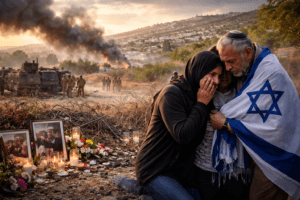
A Cycle of Violence in the Holy Land: The Human Stories Behind the Headlines of a “Rolling Terror Attack”
Introduction: A Fractured Landscape
Northern Israel’s Jezreel Valley, a region steeped in biblical history and agricultural abundance, became the stage for a modern-day tragedy this week. The sequence of events—a vehicular ramming, a pursuit, a stabbing miles away—was described by authorities in the sterile, tactical language of our times: a “rolling terror attack.” But behind this phrase lie shattered families, a community on edge, and the heavy, familiar shadow of an intractable conflict reignited. This incident is not an isolated bolt from the blue; it is a painful link in a long chain of action and reaction, a moment that encapsulates the despair, fear, and entrenched narratives that define life for Israelis and Palestinians today.
The Attack: Minutes of Terror, Lifetimes of Grief
On Friday, the ordinary rhythm of life in Beit Shean was shattered. Shimshon Mordechai, 68, was killed, and a 16-year-old boy injured, when a driver deliberately struck them. The attacker didn’t stop. Fleeing westward, he abandoned the vehicle and, near the kibbutz of Ein Harod, stabbed and killed Aviv Maor, an 18-year-old woman. The violence only ceased when a civilian, in a moment of terrifying confrontation, shot and wounded the assailant outside Afula.
The victims were not soldiers or politicians; they were individuals going about their day. Shimshon Mordechai, at 68, represented a generation that has lived through multiple cycles of this conflict. Aviv Maor, at 18, embodied the future, a life brutally cut short before it truly began. The “rolling” nature of the attack spread terror across multiple communities, a tactic designed to maximize psychological impact, making everyone feel nowhere is safe.
The Perpetrator: A Profile in Despair?
Israeli officials quickly identified the suspect as a 37-year-old man from Qabatiya, a village in the northern occupied West Bank. Reports indicate he had been working illegally in Israel, using his employer’s vehicle. This detail opens a window into a grim paradox of the conflict: economic interdependence amidst deep-seated hostility. For years, tens of thousands of West Bank Palestinians have crossed into Israel for work, often through the same gaps in security they are accused of exploiting. It’s a daily reality born of necessity, where the Israeli economy relies on this labor, and Palestinian families rely on the wages.
This context doesn’t justify violence; it complicates it. It suggests an attacker who was familiar with Israeli society not just as an abstract enemy, but as a workplace. What catalyzed the shift from laborer to attacker? Was it a personal grievance, ideological fervor, or the boiling-over of a pervasive sense of humiliation and hopelessness? These are the unanswerable questions that haunt such events.
The Immediate Aftermath: Condolences and Consequences
Prime Minister Benjamin Netanyahu offered condolences and praised the civilian who intervened—a narrative of communal resilience. Simultaneously, Defense Minister Israel Katz ordered the military to act “forcefully and immediately” in the Qabatiya area, a promise of swift retaliation. The IDF announced preparations for an operation, a move likely involving arrests, home demolitions (a controversial tactic Israel says deters attacks, but critics call collective punishment), and heightened closures.
This is the familiar script: a Palestinian attack triggers Israeli military action in the West Bank, which fuels further resentment and potentially inspires more violence. It is a feedback loop of trauma.
A Mirror Image: The Quad Bike Ramming
Crucially, this attack did not occur in a vacuum. Just one day prior, a video circulated showing an Israeli army reservist, in civilian clothes but armed, deliberately driving a quad bike into a Palestinian man who was praying by a roadside in the West Bank. The military fired the reservist and confiscated his weapon, calling his actions “serious and inconsistent with the values of the IDF.”
The two incidents, side-by-side, present a disturbing symmetry. Both involved using a vehicle as a weapon against an unarmed civilian. Both perpetrators acted from a place of perceived supremacy and deep-seated animus. The UN notes a dramatic surge in settler violence against Palestinians since the October 7th attacks, with over a thousand Palestinians killed in the West Bank in the subsequent war context. This violence, often with limited accountability, creates a powder-keg atmosphere where extremist actions on one side are used to justify extremist actions on the other.
The Broader Canvas: A Region Engulfed
These events unfold against a backdrop of catastrophic suffering in Gaza, where the Hamas-run health ministry reports over 70,600 killed since the war began, and profound insecurity in Israel, where the trauma of October 7th remains raw. The war’s ripple effects are destabilizing the West Bank, where Israeli settlement expansion continues (19 new settlements were just approved), and Palestinian Authority control is weak.
This creates a perilous ecosystem for violence. For some Palestinians, the sheer scale of destruction in Gaza and the daily frustrations of occupation ferment a nihilistic rage. For some Israelis, particularly in border areas, the October 7th attacks solidified a belief that separation and overwhelming force are the only guarantors of safety. Civilians on both sides become both targets and symbols.
Human Insight: Beyond the Binary
The true value in examining such a tragic event lies in resisting the simple binary of “us vs. them.” It requires holding two devastating truths simultaneously:
- For Israeli families in towns like Beit Shean, this attack is a terrifying reminder of their vulnerability. It reinforces a worldview where danger is relentless and concessions are seen as fatal weaknesses. The hero is the armed civilian who stops the threat.
- For Palestinians in villages like Qabatiya, the impending IDF raid will mean nights of fear, the arrest of relatives, and the reinforcement of a reality where they have no control over their security or future. Their “heroes” are often those who strike back, however brutally.
The real tragedy is that both these perspectives are emotionally valid while being politically irreconcilable. The civilian on both sides is trapped in a geopolitical conflict they did not create, paying the highest price.
Conclusion: Breaking the Chain?
The “rolling terror attack” is a stark data point in a long history of bloodshed. It will be claimed as justification for further hardening of positions, for tighter security, for more aggressive military posture. And in that response, the cycle will turn another rotation.
Adding genuine value to this news report means looking past the immediate chronology to ask the harder questions: What breaks this cycle? Where is the space for a different story? It likely isn’t found in the rhetoric of leaders or the military plans drawn up in aftermaths. It may be found, faintly, in the voices of those on both sides who refuse to dehumanize the other, who recognize that the mother’s grief in Qabatiya is the same as the mother’s grief in Beit Shean. It is found in the courage to condemn violence from one’s own side as fiercely as from the other.
Until that empathy can find a political expression, the landscape of the Holy Land will continue to be scarred by rolling attacks, rolling retaliations, and a rolling river of tears that respects no border or barrier. The names change—Shimshon, Aviv, and the unnamed praying man—but the story remains tragically, devastatingly the same.
You must be logged in to post a comment.