
A Constitutional Confrontation: Why Ambedkarites Are Taking the Fight Directly to the RSS’s Doorstep
In a historic and symbolically charged confrontation, Ambedkarites led by the Vanchit Bahujan Aghadi (VBA) protested outside the RSS headquarters in Aurangabad, Maharashtra, to directly challenge the organization’s ideological stance and legal status. The immediate trigger was an RSS recruitment drive on a college campus and the subsequent booking of Ambedkarite students who questioned it.
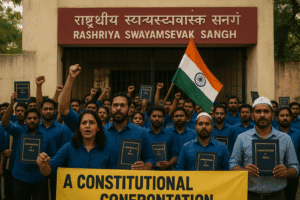
The protestors staged a peaceful assertion of constitutional values, arriving with three symbolic gifts: a copy of the Indian Constitution to demand the RSS operate within its framework, the national flag to critique its historical ambivalence towards Independence Day, and the Maharashtra Public Trust Act to highlight its status as an unregistered body.
This action escalates a long-standing ideological war, pitting Ambedkar’s vision of a casteless, secular, and egalitarian India governed by the Constitution against the RSS’s vision of a Hindu Rashtra, and marks a strategic move by Bahujan forces to reclaim the narrative of Indian democracy on constitutional grounds
A Constitutional Confrontation: Why Ambedkarites Are Taking the Fight Directly to the RSS’s Doorstep
In the heart of Maharashtra, a political tremor has been felt, one that signals a profound shift in India’s ideological landscape. The image of thousands of Ambedkarite protesters, brandishing the Indian Constitution and the tricolour, standing before the shuttered gates of the Rashtriya Swayamsevak Sangh (RSS) headquarters in Aurangabad is more than just a dramatic photo-op. It is a historic, symbolic, and strategic escalation in a decades-old cold war that has now turned decidedly hot.
This isn’t merely a protest; it is a direct, constitutional challenge to one of the most powerful socio-political organizations in the country. To understand why Ambedkarites, led by the Vanchit Bahujan Aghadi (VBA), have chosen this moment for such a bold confrontation, we must look beyond the immediate provocation and delve into the deep-seated ideological schism between the worldviews of B.R. Ambedkar and the RSS.
The Immediate Spark: A Campus Campaign and a Police Response
The catalyst for the Aurangabad march was an event that has become commonplace yet remains deeply contentious: a “Join RSS” campaign inside a government college campus. For Ambedkarite students, educational institutions are not neutral grounds but arenas for ideological struggle. They are the very spaces where Dr. Ambedkar believed the marginalized could empower themselves, breaking free from centuries of caste oppression.
When the RSS set up its recruitment drive at the Polytechnic College in Aurangabad, it was perceived not as an invitation, but as an intrusion. Student activists from the VBA’s student wing, Samyak Vidhyarthi, attempted to question the campaigners democratically. Their reward? Being booked under non-bailable sections by the Aurangabad police.
This disproportionate response was the final straw. For the VBA, it underscored a painful reality: an organization they view as antithetical to the Constitution was being afforded state protection, while those upholding constitutional values of questioning and dissent were being criminalized. The protest, therefore, was framed not as an act of aggression, but as a “peaceful assertion” of constitutional morality.
The Three Symbolic Gifts: A Masterstroke of Political Theatre
The genius of the VBA’s action lay in its symbolism. By arriving with three specific gifts, they meticulously constructed a narrative that placed the RSS on the defensive, forcing it to answer uncomfortable questions about its own legitimacy.
- The Indian Constitution: This was the central prop. Presenting the Constitution to the RSS was a powerful act of reclamation. It declared, “This is our rulebook, the one drafted by our icon, and you must operate within its framework.” It directly challenged the RSS’s historical ambivalence, and at times opposition, to the document. The message was clear: you cannot claim patriotism while disregarding its foundational legal text.
- The National Flag: The gift of the tricolour was a pointed reminder of the RSS’s complicated history with the Indian flag. The protester’s accusation—that the RSS has historically observed Independence Day as a “day of mourning”—struck at the very heart of its nationalist credentials. By demanding the RSS “hoist it proudly,” the VBA was publicly questioning the organization’s commitment to the symbols of the modern Indian nation-state, which it associates with Partition and what it sees as a flawed secularism.
- The Maharashtra Public Trust Act: This was the tactical masterstroke. By bringing a copy of the Act and offering to help the RSS “finally register itself,” the protesters highlighted a long-standing legal ambiguity. The RSS, despite its immense influence, remains an unregistered body. This move framed the organization not just as an ideological opponent, but as an entity operating outside the very law it seeks to influence. It transformed a philosophical debate into a question of legal compliance.
The Deeper Fault Line: Ambedkar’s Constitution vs. Savarkar’s Hindutva
The Aurangabad protest is merely the latest battle in a war of ideas that dates back to the pre-Independence era. The conflict is fundamentally between two visions of India:
- The Ambedkarite Vision: For Dr. B.R. Ambedkar, the Constitution was a revolutionary tool for social transformation. It was designed to dismantle the hierarchical caste system and build a nation based on liberty, equality, fraternity, and justice. Its core principles are individual rights, social justice, and secularism—a state that does not privilege any religion.
- The RSS/Hindutva Vision: Rooted in the writings of V.D. Savarkar and M.S. Golwalkar, this worldview envisions India as a Hindu Rashtra (Hindu Nation). It emphasizes cultural nationalism, where Indian identity is inextricably linked to Hindu identity. This vision often views caste as a unifying social structure rather than a oppressive hierarchy and is skeptical of Western-style individualism and constitutional secularism, which it sees as a form of pseudo-secularism that appeases minorities.
When Sujat Ambedkar states, “The Constitution belongs to the people, not to Nagpur,” he is drawing this battle line in the sand. The protest is an assertion that the future of India will be decided by the values of the Constitution, not by the ideology emanating from the RSS headquarters in Nagpur.
Why Now? The Political Calculus in Maharashtra
The timing of this bold move is not accidental. Maharashtra is a key political battleground, and the VBA, led by Prakash Ambedkar, has been working to consolidate the vast Bahujan (OBC, SC, ST, Buddhist) vote bank. By directly confronting the RSS, the VBA accomplishes several strategic goals:
- Reclaims Ambedkar’s Legacy: It positions itself as the true, fearless inheritor of Ambedkar’s legacy, contrasting with other Dalit and OBC parties that have, at times, allied with the BJP.
- Moral High Ground: The peaceful, constitution-centric approach gives them an undeniable moral high ground, painting the RSS as an organization that flees from the Constitution and the national flag.
- Galvanizes a Base: For decades, the Bahujan movement has often been fragmented. A direct, dramatic confrontation with a common ideological foe has the potential to unite these disparate groups under a single banner, creating a powerful political force.
The RSS’s Retreat: A Sign of Weakness or Strategy?
The RSS’s decision to vacate its office before the protesters arrived has been interpreted by the VBA as “cowardice” and proof of its “hatred toward the Constitution.” However, from a strategic standpoint, the RSS likely saw no winning move. Engaging directly would have legitimized the confrontation on the VBA’s terms. A confrontation could have led to violence, creating martyrs for the Ambedkarite cause. By leaving, they avoided a direct physical clash, but they ceded the symbolic ground entirely, allowing the VBA to dominate the narrative.
Conclusion: A Warning and a Watershed Moment
The Aurangabad protest is a watershed moment. It marks the maturation of a political strategy that moves beyond demanding reservations or protesting specific instances of caste violence. It is a frontal assault on the ideological underpinnings of Hindutva politics, fought on the terrain of the Constitution.
Sujat Ambedkar’s words—”This is not just a protest, it’s a warning”—should be taken seriously. The Ambedkarite movement is asserting that the defense of the Constitution is no longer a passive exercise; it is an active, on-the-ground struggle. They are forcing a national conversation: Can an organization that has had an ambivalent relationship with the founding document of the republic claim to be its ultimate guardian?
The shuttered gates in Aurangabad are a powerful metaphor. The question now is whether the RSS will continue to retreat from this constitutional challenge, or whether it will finally step out and engage in the open, democratic debate that the Ambedkarites have so boldly initiated. The future of India’s political discourse may well depend on the answer.
You must be logged in to post a comment.