
A Confluence of Titans: When Laurencin Met Rao—A Meeting That Bridges Science, Legacy, and Humanity
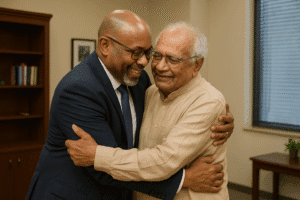
The warm embrace shared between Professor Sir Cato T. Laurencin and Professor C.N.R. Rao in Bangalore transcends a mere social meeting, representing a profound confluence of scientific legacy and interdisciplinary inspiration.
Their encounter bridges the foundational world of materials chemistry, embodied by Rao’s groundbreaking work on the electronic and structural properties of solids which earned him India’s highest civilian honor, the Bharat Ratna, and the applied, convergent realm of regenerative engineering, pioneered by Laurencin, who has harnessed such fundamental knowledge to forge new paths in healing tissues and organs, earning him the U.S. National Medal of Technology and Innovation. This moment highlights the essential dialogue between curiosity-driven science and translational innovation, where Rao’s deep understanding of matter at its core provides the essential language for Laurencin’s revolutionary biomaterial designs.
More than a meeting of two internationally decorated scientists—both Fellows of the Indian Academy of Sciences—it is a powerful testament to the enduring impact of mentorship, the global citizenship of science, and the collaborative spirit that drives human progress, reminding us that the future of healing is built upon decades of dedicated inquiry into the very nature of the material world.
A Confluence of Titans: When Laurencin Met Rao—A Meeting That Bridges Science, Legacy, and Humanity
The image is both powerful and tender: two men, separated by a generation and geography, sharing a warm embrace in an office in Bangalore. This was not merely a polite exchange between academics. It was a moment of profound resonance—a convergence of two extraordinary scientific universes, embodied in Professor Sir Cato T. Laurencin, M.D., Ph.D., and Professor C.N.R. Rao, F.R.S. Their meeting at the Jawaharlal Nehru Centre for Advanced Scientific Research (JNCASR) in late 2025, on the sidelines of a global conference, tells a deeper story about the threads that connect true scientific legacy: mentorship, interdisciplinary courage, and the shared language of improving the human condition.
The Setting: More Than a Conference Drop-In
While Professor Laurencin was in India as the Plenary Speaker for the ACS Global Scientific Conference in Mumbai, his journey to Bangalore was a deliberate pilgrimage. In the scientific world, where calendars are fragmented into 15-minute meeting slots, taking the time to travel across the country to meet a 91-year-old colleague speaks volumes. It underscores a relationship that transcends professional courtesy. JNCASR, founded by Professor Rao himself, is a temple of fundamental scientific inquiry in India. For Laurencin, a Fellow of the Indian Academy of Sciences, this visit was a homecoming of sorts to a sphere of influence that had helped shape his global perspective.
Professor C.N.R. Rao: The Architect of Indian Materials Science
To understand the weight of this meeting, one must first appreciate the colossus that is Chintamani Nagesa Ramachandra Rao. His is not just a career; it is the bedrock upon which modern materials chemistry in India was built. With over 1,600 publications, his work deciphering the electronic, magnetic, and structural secrets of solids has been foundational. He didn’t just participate in science; he built its infrastructure—founding JNCASR and steering the Indian Institute of Science.
His accolades, including the Bharat Ratna (India’s highest civilian honor) and Fellowship in the Royal Society, are not mere decorations. They are testaments to a life dedicated to elevating an entire nation’s scientific standing on the world stage. Rao represents the power of fundamental inquiry—the pursuit of knowledge about why materials behave as they do, for its own intrinsic value and for the technological revolutions it inevitably sparks.
Professor Sir Cato T. Laurencin: The Convergent Pioneer
From this foundation of fundamental knowledge emerges a different, yet symbiotically linked, kind of pioneer. Laurencin’s legacy is defined by strategic convergence. He looked at the intricate puzzles of materials science, the nascent potential of stem cell biology, and the urgent needs of clinical medicine, and asked a revolutionary question: What if we deliberately merge these disciplines to regenerate what was lost?
Thus, Regenerative Engineering was born. Laurencin, rightly recognized as its father, moved beyond traditional tissue engineering. His work isn’t just about scaffolding; it’s about orchestrating a biological symphony at the nanoscale to rebuild complex tissues and organ systems. His honors mirror this transformative impact: the National Medal of Technology and Innovation (the USA’s highest tech honor), the Priestley Medal (the ACS’s pinnacle award), and a knighthood from St. Lucia. His leadership as CEO of an institute bearing his name and as Editor-in-Chief of a flagship journal shows a commitment to building an enduring field, not just a personal research portfolio.
The Intersection: Where the Fundamental Meets the Applied
This is the crux of the meeting’s significance. Rao’s world is the deep understanding of materials—their atomic dance, their magnetic whispers, their electronic pathways. Laurencin’s world is the intentional application of materials—designing polymers and ceramics that can converse with human cells, instructing stem cells, and healing limbs.
Their work intersects precisely in the realm of nanostructures and biomaterials. Rao’ fundamental research on the properties of materials at the smallest scales provides the essential language and toolkit. Laurencin’s regenerative engineering applies that language to write new medical solutions. One asks, “What are the extraordinary properties of this oxide?” The other asks, “How can we harness those properties to create a matrix that regenerates a knee ligament?”
Laurencin’s acknowledgment that Rao “significantly influenced” his career and “shared his wisdom so generously” hints at a mentorship that likely shaped not just specific ideas, but a philosophical approach to scientific leadership and global citizenship.
A Tapestry of Highest Honors and Shared Values
The parallel in their recognitions is striking and symbolic:
- Bharat Ratna (Rao) / National Medal of Tech & Innovation (Laurencin): Both represent the ultimate acknowledgment from their nations—India and the United States—for service through science.
- Fellowship of the Royal Society (Rao) / Election to U.S. National Academies (Laurencin): Recognition by the most esteemed scientific bodies for advancing “natural knowledge.”
- Fellowship in the Indian Academies (Both): A shared platform, demonstrating their mutual respect and embeddedness in India’s scientific fabric.
This tapestry of honors underscores that greatness in science, though expressed through different disciplines, is universally recognized by its impact and integrity.
The Human Insight: Legacy, Mentorship, and the Future
What genuine value does this story offer to readers beyond a simple news item? It provides a masterclass in the ecosystem of scientific progress.
- Fundamental Science is the Engine: Rao’s career is a powerful reminder that without deep, curiosity-driven research into the nature of matter, applied revolutions like regenerative engineering have no fuel. Today’s “obscure” material property is tomorrow’s miracle biomaterial.
- Convergence is the Catalyst: Laurencin’s journey demonstrates that the most intractable human challenges—like organ failure or major tissue loss—will not be solved within single disciplines. They require the fearless integration of fields, building new ones in the process.
- Mentorship is the Unseen Architecture: Laurencin’s pilgrimage to Bangalore is a profound act of acknowledging lineage. It reminds every young scientist that behind every giant is often another giant, offering wisdom and encouragement. Science is a human endeavor, passed person-to-person.
- Science as Global Citizenship: Both men have operated on a global stage, yet remain deeply connected to their roots—Rao to India’s scientific ascendancy, Laurencin to his St. Lucian heritage and his role in U.S. innovation. They embody how science transcends borders while honoring origins.
Conclusion: An Embrace That Symbolizes a Bridge
The warm embrace between Laurencin and Rao was more than personal. It was symbolic of a vital bridge being reaffirmed: the bridge between the fundamental and the applied, between curiosity and translation, between East and West, and between generations of scientific seekers.
For the aspiring student, this story says: Dig deep into fundamentals, but dare to converge. For the policymaker, it shouts: Invest in both pure science and applied engineering; they are inseparable. For the public, it reveals that the path to medical breakthroughs is long, built upon decades of quiet, dedicated work by giants like Rao, and brought to fruition by visionary synthesizers like Laurencin.
Their meeting in Bangalore was a quiet moment in a busy world. But within it echoed the very spirit of scientific progress—a spirit built on legacy, collaboration, and an unwavering belief that understanding the material world can ultimately heal the human one. The future of regeneration, it turns out, is deeply rooted in a fundamental love for the science of matter itself.
You must be logged in to post a comment.