
A Coffin’s Return: The End of an Israeli Hostage Era and the Unsettled Future of Gaza
The return of the remains of Israeli police sergeant Ran Gvili, the last of the 251 individuals captured during the October 7, 2023 attacks to be held in Gaza, marks a somber, symbolic closure to Israel’s hostage crisis, fulfilling a key condition of the Trump administration’s ceasefire plan and allowing the Israeli government to declare an end to this chapter. This development is poised to shift the contentious focus within Israel toward a demanding independent inquiry into the initial security failures and the war’s conduct, while internationally it theoretically opens the way for the ambitious second phase of the U.S. plan, which envisions a Palestinian-run Gaza. However, the path forward is fraught with immediate obstacles, including a stark divergence between U.S. plans for reconstruction and unified governance and Israeli Prime Minister Netanyahu’s insistence on Hamas’s disarmament first, a humanitarian crisis in Gaza that persists despite the ceasefire, and the unresolved, painful practice of both sides using human remains as political leverage, all signaling that this moment of closure is merely a pivot to a new, complex phase of political and humanitarian challenges.
A Coffin’s Return: The End of an Israeli Hostage Era and the Unsettled Future of Gaza
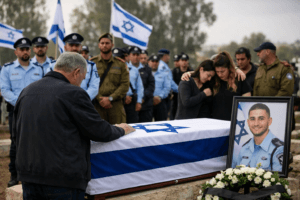
The father stood before the flag-draped coffin, his voice cutting through the heavy silence of a nation’s collective exhale. “All the people who brought you. All the police are here with you, the entire army is here with you, the entire nation is here with you.” In those words, spoken over the remains of 24-year-old police sergeant Ran Gvili, lay the poignant, painful closure of a chapter that has defined Israel for over two years. The last known Israeli held in Gaza since the Hamas-led attack of October 7, 2023, was home. But his return in a coffin, not on his feet, underscores a brutal truth: in this conflict, even resolutions are layered with tragedy and foreshadow further complexity.
The handover of Gvili’s body, discovered in a cemetery in Israeli-controlled northern Gaza, marks a significant, symbolic threshold. Militarily, it fulfills a key initial demand of the ceasefire plan advanced by the Trump administration. Politically, it allows the Israeli government to declare, as the military did, that “all hostages have been returned from the Gaza Strip.” Yet this moment of national relief is not a clean endpoint, but a pivot point—a transition from one set of agonies to another, from the urgent campaign for return to the intractable challenges of “the day after.”
The Volunteer and the Void
Ran Gvili’s story encapsulates the trauma of that October day. On medical leave for a dislocated shoulder, he chose to rush toward the crisis at Kibbutz Alumim when he could have stayed away. This narrative of voluntary sacrifice has been seared into Israel’s consciousness, a emblem of the blurred lines between soldier and citizen, duty and catastrophe. His return finally allows for traditional mourning, for the rituals of grief that have been suspended for so many families. As his sister Shira expressed, it is a relief laced with profound sadness: “I am so happy he’s coming back home.”
But this closure for Gvili’s family also extinguishes the last flicker of tangible hope for the Hostages and Missing Families Forum, a movement that reshaped Israeli civil society and politics. Their singular, powerful focus—”Bring Them Home Now”—forced the war to the center of every discussion and exposed deep fissures in Netanyahu’s coalition. With no one left officially in captivity, the movement’s energy is already shifting, as noted in the report, toward demanding an independent inquiry into the failures of October 7 and the conduct of the subsequent war. Many accuse the Prime Minister of having sabotaged earlier deals for political survival, a charge that will now resonate in a new, more accusatory key.
The “Catastrophic Success” Blueprint and Bitter Realities
The return was engineered as the linchpin for Phase Two of what Trump aides have grandly termed a plan for “catastrophic success.” The vision, articulated by Jared Kushner, is strikingly ambitious: a unified, Palestinian-run Gaza, explicitly rejecting the goals of Israeli extremists who advocated for depopulation and re-settlement. On paper, it represents a stark U.S. rebuke to factions within Netanyahu’s own government.
However, the chasm between blueprint and bedrock is cavernous. Immediately following the handover, Netanyahu stated the next step was not reconstruction but “the disarmament of Hamas and the demilitarisation of the Gaza Strip.” This divergence highlights the plan’s fundamental weak points. Who will disarm Hamas? The report notes potential contributors to an international force have already ruled out direct confrontation. What mechanism inside Gaza’s ruins can possibly oversee such a task? And how does reconstruction begin when Israel, as reported, only reopens the critical Rafah crossing to pedestrians, retaining full control and failing to address the massive shortages of food, medicine, and shelter aid?
The ceasefire, while reducing large-scale strikes, has not stopped the killing. Nearly 500 Palestinian deaths since its implementation, children dying of hypothermia, and persistent famine paint a picture of a grinding, protracted crisis. The “yellow line” behind which Gvili’s body was found is not just a military boundary but a metaphor for the divided, controlled, and suffocated entity Gaza remains.
The Unbalanced Equation of Remains
In a stark reminder of the conflict’s asymmetries and the grim economy of leverage, the article notes the negotiated exchange: Gvili’s body for the remains of 15 Palestinians held by Israel. Israel’s practice of retaining Palestinian bodies—including those of children and detainees who died without trial—as bargaining chips is a deeply contentious issue, one that human rights groups condemn as a violation of international law and dignity. This transaction, within Trump’s deal, formalizes a painful reality: even in death, individuals become political currency. For countless Palestinian families, the return of their loved ones’ remains is a similarly longed-for closure, a right to burial often denied. This parallel narrative of grief is rarely afforded equal space in the mainstream discourse, yet it is central to understanding the cyclical nature of resentment and retaliation.
An Unfinished Landscape of Pain
The return of the final hostage draws a line under a specific list, but the landscape of loss is far messier. As the report details, of the 166 people returned alive, most came via ceasefire deals, only eight through military rescue. Among the dead, the causes of death—killed before capture, by captors, by Israeli fire, or by circumstance in tunnels—create a mosaic of anguish where blame and fate are bitterly contested. This ambiguity will fuel historical and legal debates for decades.
Furthermore, the focus on those taken since October 7, 2023, inadvertently shadows older cases. President Herzog’s statement that “for the first time since 2014 there are no Israeli citizens held hostage” is technically precise but overlooks the fates of two Israeli soldiers, Oron Shaul and Hadar Goldin, whose remains have been held by Hamas since 2014, and two civilian captives, Avera Mengistu and Hisham al-Sayed, who are believed to be alive but mentally ill and detained under unclear circumstances. For their families, this moment is not an end but another painful reminder of their unresolved plight.
Looking Away Is Not an Option
The final section of the original text, an appeal for support, underscores a vital point: sustained, independent journalism is crucial precisely because the story is now entering a new, possibly more volatile phase. The intense global focus that accompanied the hostage crisis may wane, but the underlying dynamics are more dangerous than ever. A ceasefire in name only, a U.S. plan facing fierce Israeli obstruction, a radicalized Palestinian population living in ruins, and an Israeli public shifting from unified demand to recriminatory inquiry—this is the tinderbox that remains.
Ran Gvili is home. The nation that stood with him in spirit now must confront what his return has unlocked. It has paved the way not for peace, but for the next fraught negotiation; not for healing, but for a bitter domestic reckoning; not for Gaza’s recovery, but for a staggering test of political will. The coffin’s return closes a circle of immediate hope and immediate terror, only to open a wider, more uncertain ring where the real foundations of “catastrophic success” or catastrophic failure will be laid. The world may be tempted to look away, believing a marker has been reached. But as the dust settles over his grave, the harder work—and the greater risk—is just beginning.
You must be logged in to post a comment.