
A Breath of Fresh Air: The Science and Soul of Southern Tamil Nadu’s Weekend Rain
The India Meteorological Department has forecast light to moderate rainfall in the southern coastal districts of Tamil Nadu, including Kanyakumari, Tirunelveli, and Thoothukudi, until Sunday due to a persistent low-pressure system extending from the region to coastal Karnataka, which is drawing moisture inland and creating favorable conditions for scattered showers and cloudy skies. While this atmospheric disturbance offers welcome relief from dry weather for local farmers by supplementing irrigation for crops like paddy and coconuts, it also serves as a critical caution for fishing communities who must navigate potentially rougher seas and changing wind patterns. In contrast, Chennai will remain largely dry with partly cloudy skies and temperatures around 34°C, even as the state experiences a slight rise in night temperatures, underscoring the region’s diverse microclimates and the deep connection between weather patterns, livelihoods, and daily life along India’s southern coast.
A Breath of Fresh Air: The Science and Soul of Southern Tamil Nadu’s Weekend Rain
For the sun-baked coastal districts of southern Tamil Nadu, the India Meteorological Department’s (IMD) latest forecast is music to the ears. As the rest of the state braces for a slight uptick in night temperatures, the southern tip of India is set to play host to a different narrative—one of grey skies, scattered showers, and the unmistakable petrichor that signals a change in the atmosphere. The IMD has predicted light to moderate rainfall in districts like Kanyakumari, Tirunelveli, and Thoothukudi until Sunday, driven by a persistent low-pressure system stretching from the southern coast up to coastal Karnataka.
But beyond the technical bulletin lies a more profound story—a tale of geography, livelihood, and the delicate dance between the land and the sea. This weekend’s forecast is more than just a line in a newspaper; for the communities living on this edge of the subcontinent, it is a moment of respite, a call to caution, and a reminder of the rhythms that govern their lives.
Decoding the Dance of the Winds
To understand why these rains are significant, one must first look at the atmospheric ballet taking place overhead. According to meteorological officials, the current weather system is a “low-pressure area” that has established a firm influence over the regional climate. Unlike the dramatic, violent formation of a cyclone, this system is a more subtle but persistent feature. It acts as a giant sponge, drawing in moisture-laden winds from the warm Arabian Sea and the Gulf of Mannar.
The beauty of this particular system lies in its reach. It is not an isolated cell hovering over a single town but a trough—an elongated stretch of low pressure—that links the southern tip of India with the western coast. This geographical bridge allows for a continuous conveyor belt of humidity to feed into Tamil Nadu’s southern districts. As this moist air pushes inland, it encounters the local topography and atmospheric instability, forcing it to rise, cool, and condense into the fluffy, rain-bearing clouds that will blanket the region.
Meteorologists note that while the rainfall is expected to be “generally light,” the phrase “occasional moderate showers” is a crucial caveat. In tropical climates like that of Tamil Nadu, local conditions can amplify a light weather system. A slight variation in surface temperature or a sudden gust of wind can turn a persistent drizzle into a more substantial downpour. This unpredictability is what keeps the IMD’s monitoring teams vigilant and local communities adaptable.
The Land that Drinks the Rain
For the average urban dweller in a metropolis like Chennai, a forecast of rain might mean traffic jams and cancelled plans. But in the agrarian belts of Tirunelveli and the horticultural pockets of Kanyakumari, rain is a direct dialogue with sustenance.
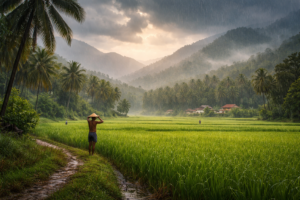
Take the paddy fields that stretch across the fertile plains of the Thamirabarani River in Tirunelveli. While the district relies heavily on the river system and monsoon patterns, the onset of these intermittent showers during an otherwise dry period acts as a critical supplement. Farmers often refer to these as “Mango Showers” or similar local names, depending on the crop cycle. A few days of cloud cover and light rain can reduce the need for manual irrigation, saving diesel costs for pumps and giving the young saplings a natural boost of nitrogen from the atmosphere.
In Kanyakumari, the landscape is a lush mosaic of rubber plantations, coconut groves, and banana farms. The district, being one of the highest rainfall recipients in the state during the traditional monsoons, has a culture deeply attuned to the sky. Here, the rain forecast until Sunday is a welcome mat for the crops. Coconut palms, in particular, thrive with the groundwater recharge that these spells provide. However, for the banana cultivators, the news is a double-edged sword. While the plants need water, strong winds accompanying the showers can lodge (flatten) the trees or damage the heavy bunches of fruit. This is why the IMD’s characterization of the rain as “light” offers a sigh of relief—it suggests nourishment without destruction.
The Fisherfolk’s Horizon
Perhaps the group with the most intimate and cautious relationship with this weather system is the fishing community along the Thoothukudi coast. For generations, the men and women of villages like Vembar and Pazhayakayal have read the sea and sky with an inherited wisdom. Today, that traditional knowledge is supplemented by the precise bulletins from the IMD.
The forecast of atmospheric instability is a critical piece of information for them. While a “low-pressure area” might not signify a complete ban on venturing out like a cyclone warning would, it does change the calculus of safety. The increased moisture inflow and changing wind patterns can make the sea rougher than usual, and the currents unpredictable.
For the fishermen who operate motorized catamarans, the next few days require a strategic shift. They might choose to fish closer to the shore rather than venturing far into the deep sea. The possibility of “squalls”—sudden, sharp increases in wind speed—means that the nets must be checked more frequently and the return journey timed with extra caution. The IMD’s advisory for coastal communities to stay updated is not bureaucratic boilerplate; it is a lifeline. It allows the community to balance their need for livelihood with the imperative of safety, turning modern meteorological science into a tool for daily survival.
The Great Contrast: Chennai vs. The South
The weather bulletin also highlights a fascinating dichotomy within the state itself. As the southern coastal districts prepare to welcome the clouds, the capital city of Chennai is looking at a different picture entirely. The sky will remain “partly cloudy,” a term that in Chennai often translates to hazy sunshine and urban humidity. The forecast of a maximum temperature hovering around 34 degrees Celsius reinforces the feeling of a typical, dry season.
This contrast underscores the vast microclimates within Tamil Nadu. Chennai, located on the eastern coast, has its weather heavily influenced by the Bay of Bengal and is a hotspot during the Northeast Monsoon (October to December). The current system, however, is drawing moisture from a different source and affecting the western and southern ghats and coastlines.
For the residents of Chennai, the news from the south is a reminder of the state’s geographical diversity. While they experience a marginal rise in night temperatures—forecast to increase by about 2 degrees Celsius—their counterparts 600 kilometers away are reaching for their umbrellas and wrapping themselves in the cooler evening air that follows a day of rain.
The Warm Nights of the Interior
The IMD’s note on rising night temperatures across Tamil Nadu and the Karaikal region is a subtle but significant piece of the forecast. A 2-degree Celsius rise in minimum temperatures might seem negligible on paper, but for those living without air conditioning, it is noticeable.
These warmer nights are a direct result of the atmospheric setup. The increased cloud cover over the southern parts acts like a thermal blanket, trapping the day’s heat and releasing it slowly overnight, preventing the usual nocturnal cooling. In the interior regions, where the skies remain clear, the lack of this cloud cover usually leads to cooler nights. However, the broader circulation patterns and changes in humidity can still prevent the mercury from dipping as low as the seasonal average.
For the elderly, infants, and those working outdoors, these warmer nights mean a disruption in the natural cooling cycle that the body craves for rest. It’s a subtle shift in comfort, a reminder that the climate is a connected system, and changes in one part of the state can ripple through to another.
More Than Just a Weather Report
As the weekend approaches, the residents of Kanyakumari, Tirunelveli, and Thoothukudi will go about their routines with one eye on the sky. The school child will pack a raincoat just in case. The tea stall vendor will roll out his tarpaulin sheet, ready to extend his awning. The housewife will bring the washed chilies and lentils in from the courtyard a little earlier.
This forecast is a thread in the cultural fabric of the region. In a land where ancient Tamil literature (Sangam poetry) classified landscapes based on their relationship with rain and seasons, a weather forecast is never just data. It is a continuation of a timeless dialogue.
It evokes a sense of relief from the relentless dry heat that can be particularly taxing in the coastal areas where the humidity adds a layer of discomfort. It is a reason for the young to look forward to a weekend that might offer a break from the monotony of sunshine. For the environment, it is a vital drink of water that will keep the rivers flowing a little longer and the vegetation lush.
Looking Ahead: Vigilance in the Time of Climate Change
The IMD’s commitment to “closely monitor” the system and communicate changes is a cornerstone of modern disaster preparedness. In an era of climate change, where weather patterns are becoming increasingly erratic, the ability to provide localized, accurate forecasts is more important than ever. The phrase “evolving weather system” is one that meteorologists use with increasing frequency, acknowledging that what starts as a light rain-bearing trough could, under the right (or wrong) conditions, intensify.
For the residents, this means a shift in mindset. The days of taking the weather for granted are over. There is a growing awareness that these intermittent rains, while welcome, are part of a larger, more complex climatic puzzle. The advisory for fishermen is heeded more seriously than ever before. The loss of lives at sea is no longer seen as just an act of God, but as a preventable tragedy if official warnings are respected.
Conclusion: The Smell of the Earth
Ultimately, the story of the rain in southern Tamil Nadu until Sunday is a story of hope and resilience. It is about the atmospheric low that brings a spiritual high. It is about the farmer in Tirunelveli who looks at the overcast sky and sees a future harvest. It is about the fisherman in Thoothukudi who respects the sea’s power but also depends on its bounty. It is about the families in Kanyakumari who will sit on their porches, sipping hot tea and watching the first drops of rain hit the dry earth, releasing that unique, life-affirming scent that no chemist can ever truly replicate.
As the IMD continues to track the system’s pulse, the people of the southern coast will engage with it in the most human way possible—by adapting, by celebrating, and by hoping that these few days of rain bring not just relief, but a reminder of the natural cycles that sustain life on this beautiful, weather-beaten peninsula.
You must be logged in to post a comment.