
A Boy, a Bullet, and a Final Hour: The Death of Jad Jadallah
A Boy, a Bullet, and a Final Hour: The Death of Jad Jadallah
The last hour of Jad Jadallah’s life unfolded in a narrow alley in al-Far’a refugee camp, where fourteen Israeli soldiers stood watching as the 14-year-old bled on the ground. He waved his arm toward them. He threw his hat in their direction. They kicked the hat back.
For forty-five minutes, according to video footage and multiple witnesses, no one moved to save him.
The Morning of November 27th
Al-Far’a refugee camp sits in a valley in the northern West Bank, surrounded by hills and military checkpoints. Home to roughly 10,000 Palestinians, it is one of several camps in the territory that trace their origins to 1948, when families fled or were expelled from their villages during the war that established Israel.
For generations, the camp has known poverty and confinement. Its narrow streets fill with children after school. Its walls bear layers of political graffiti and memorial posters for those killed over decades of conflict.
On the morning of November 27, 2024, Jad left his family’s home wearing a light-colored t-shirt and jeans. His mother, Safa, watched him go. He was going to check on his friends, she later said. Like most teenagers in the camp, he had grown accustomed to the rhythm of Israeli military raids—the sudden incursions, the curfews, the sound of jeeps moving through narrow streets.
A messaging group for camp residents had circulated word that the Israeli units were pulling back toward the exit. Jad and two friends stepped out to look.
The Alley
The CCTV footage obtained and verified by the BBC shows three boys at the corner of an alley. They peer to their right, where military vehicles had recently passed. What they could not see was that four soldiers had remained behind, positioned to their left, tucked against a wall just meters away.
Jad’s friends spotted the soldiers first. They turned and ran up the alley. Jad either did not see them or realized too late.
The lead soldier steps into the frame, less than three meters from the boy. His rifle rises. He fires.
Bullet holes found later in the alley wall confirm what the footage suggests: the shots came from close range, raking across the stone where Jad had been standing.
Wounded, Jad runs. The soldier tracks him, firing again. Dust kicks up ahead of the boy as bullets strike the ground around him. He collapses after a few meters, disappearing from the camera’s view.
What the Bystander Footage Shows
A camp resident began filming discreetly from another direction. The footage, now verified by multiple news organizations, captures what followed.
Jad lies on the ground. He appears conscious. He moves his arm, trying to get the attention of the soldiers who now stand around him. He throws his hat toward them. One of the soldiers kicks it back.
The soldiers form a cordon around the boy. Fourteen of them, according to witnesses and video analysis, stand in the alley or nearby positions. Some hold their rifles at ready. Others appear to be talking among themselves. Minutes pass. Then more minutes.
All Israeli soldiers receive basic trauma training. Combat units include medics specifically trained to treat battlefield injuries. None of the soldiers in the alley appear to provide any medical aid to the boy who lies bleeding a few meters away.
The Ambulances That Couldn’t Reach Him
Hassan Fouqha, a lead paramedic with the Palestinian Red Crescent, received the emergency call at 10:48 a.m. His ambulance arrived at the scene eight minutes later. The soldiers stopped him at gunpoint.
“We could see him,” Fouqha told the BBC. “He was maybe a hundred yards away. In our sight. We could have reached him and provided medical aid, but we were completely blocked.”
Fouqha’s team tried to advance several times, signaling to the soldiers that they needed to reach the injured child. Each time, they were turned back. Fouqha called for a second ambulance to approach from a different direction. It was also stopped.
For at least thirty-five minutes, Fouqha and his crew watched from a distance as Jad lay on the ground. The paramedic said he could see the boy moving, occasionally lifting his arm. The soldiers stood between them, preventing any attempt to help.
“The purpose of this, we do not know,” Fouqha said. “But this is what happened.”
The Question of Medical Care
The Israel Defense Forces told the BBC that soldiers provided “initial medical treatment” to Jad after first verifying that he was not wearing a hidden explosive device. The IDF declined to provide any details about what that treatment consisted of, when it was administered, or what injuries Jad had sustained.
Footage of Jad leaving his home moments before the shooting, as well as video from the alley afterward, shows he was wearing only a thin t-shirt and jeans—clothing that would make it impossible to conceal any significant device.
When asked directly what wounds Jad suffered and what medical care was provided, the IDF declined to answer.
The Rock
Among the most disturbing elements of the video footage is a sequence that shows one of the soldiers stepping into the frame from out of shot, carrying an object. The soldier places the object on the ground next to Jad’s hand, then takes a photograph of it with what appears to be a personal phone or military camera.
To Jad’s family and to human rights observers, the action appears to be an attempt to place a rock next to the boy—creating evidence that he had been throwing stones at the soldiers before being shot.
“They dropped a stone next to him so they could frame him,” Safa, Jad’s mother, said. “Anyone who watches the video will see.”
The IDF has said Jad threw a rock and was a “terrorist” who “attempted to attack the force.” Under Israeli military rules of engagement in the West Bank, throwing stones can, under certain interpretations, be met with lethal force—though human rights groups have long argued that the rules are applied far too permissively, resulting in the deaths of children who pose no immediate threat.
When asked specifically about the allegation that a soldier planted a rock next to Jad after the shooting, the IDF ignored the question.
Shai Parnes, from the Israeli human rights group B’Tselem, said the footage appeared to show exactly that.
“It is hard to determine for certain what we’re seeing—whether it’s a rock and whether they are trying to frame him with it,” Parnes said. “But I think anyone who watches it with an open mind will probably come to that conclusion.”
Parnes noted that his organization has documented other cases where Israeli forces appeared to manipulate scenes after shootings.
“It would not be the first time we’ve seen that on camera,” he said.
The Final Moments
At some point, the soldiers loaded Jad into the back of an Israeli military vehicle. By then, he was either dead or dying. The IDF has refused to say when or where he died, how many times he was shot, or what wounds he sustained.
The body has not been returned to his family.
Israeli authorities are currently withholding the remains of 776 Palestinians and others killed in the conflict, according to human rights organizations. In many cases, the bodies are held as bargaining chips or punitive measures. Families are left waiting months or years, not knowing when—or if—they will be able to bury their loved ones.
The Family’s Vigil
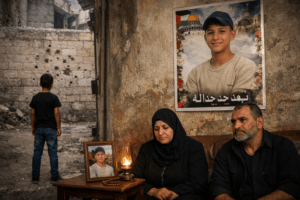
In the family home in al-Far’a, a large poster of Jad hangs from the ceiling. His father stands next to a smaller memorial taped to the carved wooden front door—a photograph of his son, surrounded by well-wishes and verses from the Quran.
“He did not pose a threat to those soldiers,” his father said.
Safa sits in the living room, a framed picture of Jad on the table behind her. Her face carries the exhaustion of months without answers, without her son’s body, without any acknowledgment from the military that took him.
“Maybe they are only trying to provoke our nerves, to exhaust us, to kill our patience,” she said. “But we are patient, and we have hope, and we will keep waiting. Today, tomorrow, or after a hundred years, we will get him back. God willing, we will get him back.”
The Numbers Behind One Death
Jad’s death, while uniquely documented, follows a pattern that has accelerated since October 7, 2023. According to the United Nations, 55 children were killed by Israeli forces in the West Bank last year—a sharp increase from previous years. Since the Hamas attack on Israel that triggered the current war in Gaza, 227 children have been killed in the West Bank.
The vast majority of these deaths receive little international attention. No major investigations are launched. No soldiers are held accountable. The bodies are often withheld. The families wait.
What Remains Unanswered
More than four months after Jad was shot, basic facts about his death remain unknown.
How many times was he hit?
Where on his body were the wounds?
Did he die in the alley, or in the military vehicle?
What medical treatment, if any, did he receive?
Why have fourteen soldiers—some of whom stood within meters of a bleeding child for forty-five minutes—faced no apparent consequences?
The IDF has declined to answer these questions. The body remains in Israeli custody. The family waits.
The Broader Context
Al-Far’a camp, like other refugee camps in the West Bank, exists in a state of perpetual military oversight. Israeli raids occur frequently, justified by the military as necessary to counter armed groups. Residents describe a life of constant disruption—sudden curfews, overnight incursions, the sound of jeeps and loudspeakers at all hours.
For the children of these camps, this is the only reality they have known. Jad was born here. He grew up here. He died here, in an alley, while soldiers stood watching.
His friends, the two boys who ran when they spotted the soldiers, now carry whatever weight survivors carry. They saw him shot. They saw him fall. They saw the soldiers standing around him, doing nothing, for nearly an hour.
The Photograph
A final image from the aftermath shows a young boy from al-Far’a standing in front of the bullet-scarred wall where Jad was shot. The holes rake across the stone at roughly chest height—the height of a 14-year-old boy standing, or running, or falling.
The boy in the photograph looks at the camera, then looks away. Behind him, the wall holds its evidence. The soldiers have gone. The alley is empty again, except for the marks they left behind.
Jad Jadallah was 14 years old. He liked soccer, his family says. He had friends. He lived in a refugee camp in a valley in the West Bank, surrounded by hills and checkpoints and soldiers who came and went as they pleased.
On a November morning, he stepped out to look for his friends. Fourteen soldiers stood around him while he bled. Two ambulances were blocked from reaching him. His body has not been returned.
His mother waits. The wall still bears the bullet holes. The video continues to circulate—a record of something that happened, and a record of what happens when no one intervenes.
You must be logged in to post a comment.