
9.6 Million Lives in the Crossfire: A Survival Guide for Indians in the Middle East
Amid escalating Iran-US-Israel tensions, approximately 9.6 million Indian nationals across the Middle East find themselves in a precarious position, prompting the Indian government to release a comprehensive list of emergency contacts for its embassies in conflict-affected countries including Iran, Israel, Palestine, and the Gulf nations. Beyond the raw numbers, this diverse diaspora—ranging from blue-collar workers in the Gulf to professionals and students in active conflict zones—faces layered threats to physical safety, economic stability, and mental well-being, making the emergency helplines a literal lifeline for reporting dangers, seeking medical aid, or coordinating potential evacuations. The situation demands that every Indian in the region adopt a “crisis mindset”: save all official embassy contacts, register on the MADAD portal, prepare a “go-bag” with essentials, and stay connected with local community networks, while trusting that the Indian government stands ready to activate evacuation protocols similar to past operations in Yemen and Ukraine.
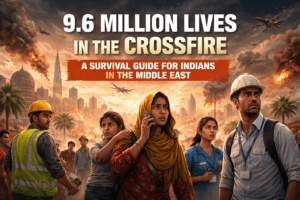
9.6 Million Lives in the Crossfire: A Survival Guide for Indians in the Middle East
The date is March 2, 2026. The headlines scream of escalation, of strikes and counter-strikes, of a region teetering on the edge of a wider conflagration. For most of the world, the escalating conflict between Iran, the US, and Israel is a geopolitical crisis to be watched from a safe distance. But for nearly 10 million Indian men, women, and children, this isn’t just news. It’s the sound of sirens in their neighbourhood, the anxious lump in their throat as they send their children to school, and the frantic refresh of the Ministry of External Affairs (MEA) website, hoping for guidance.
The figure is staggering: an estimated 9.6 million Indian nationals are currently residing across the Middle East. They are the silent backbone of the region’s economy—the engineers in Qatar’s stadiums, the nurses in Saudi Arabia’s hospitals, the construction workers building the skyscrapers of Dubai, the entrepreneurs in Bahrain, and the doctors and tech professionals in Israel. They are also the families, the children growing up in a land that is not their own, and the students chasing academic dreams far from home.
As the Iran-US-Israel conflict escalates into a dangerous new phase, these 9.6 million people are suddenly stranded in the eye of the storm. The recent release of emergency contact numbers by the Indian government is more than a list of phone numbers; it is a lifeline. This article serves as a comprehensive guide to navigating this crisis, offering not just the official contacts, but the context, the human perspective, and the actionable steps every Indian national in the region needs right now.
The Human Landscape: Who Are the 9.6 Million?
To understand the scale of the challenge, one must first understand the Indian diaspora in the Middle East. They are not a monolith; they are a vibrant mosaic of communities with vastly different experiences.
- The Gulf Region (UAE, Saudi Arabia, Kuwait, Qatar, Oman, Bahrain): This is the heartland of the Indian diaspora, home to over 8.5 million people. They are the “blue-collar” workers—labourers, drivers, domestic helps—who power the region’s infrastructure, and the “white-collar” professionals—engineers, bankers, IT specialists, and merchants—who drive its knowledge economy. For them, the Gulf has been a land of opportunity, a place to build a better life and send remittances home. A conflict here threatens not just their safety but their very livelihood.
- The Conflict Zone (Iran, Israel, Iraq): While smaller in number, the Indian community here is uniquely vulnerable. In Israel, thousands of Indian caregivers and diamond traders have made a life. The recent arrival of Indian construction workers, part of a bilateral agreement, now places them directly in the path of rocket attacks. In Iran, a small but significant community of students and professionals finds itself in the heart of the adversary’s territory. In Iraq, the community is even smaller, but the risk of being caught in the crossfire is immense.
- Palestine: The smallest and most vulnerable group, the Indians in Palestine—often associated with diplomatic missions or international organisations—face the grim reality of being in a territory that is itself a flashpoint.
The recent escalations, described by some as strikes wiping out top leadership, have fundamentally altered the risk profile for everyone. The fear is no longer abstract; it is a daily reality.
Beyond the Headlines: What This Escalation Means for Ordinary People
Geopolitical analysis often focuses on strategy, retaliation, and deterrence. But for an Indian mother in Tel Aviv, the news of “pre-emptive strikes” translates to a frantic rush to find a bomb shelter. For a Malayali nurse in a Tehran hospital, it means worrying if her colleagues will treat her differently as tensions rise.
The fear is multi-layered:
- Physical Safety: The most immediate threat is from direct violence—airstrikes, rockets, and terrorist attacks. The emergency numbers are the first line of defence for reporting such threats and seeking evacuation.
- Economic Disruption: Even for those far from the frontlines, the economic fallout is swift. Businesses shut down, flights are cancelled, and supply chains are disrupted. The daily wage earner in Dubai or Doha suddenly faces the terrifying prospect of no work and no income.
- Social and Racial Tensions: In times of conflict, expatriate communities can become targets of local anger or suspicion. Indian nationals, especially those with brown skin, can be mistaken for other nationalities, making them vulnerable.
- Mental Health Crisis: The constant anxiety, the uncertainty about the future, and the isolation from extended family back home can take a severe toll on mental well-being. The need for psychological first aid is as critical as the need for food and shelter.
Your Lifeline: The Complete Guide to Indian Emergency Contacts
In a crisis, information is the most valuable currency. The Indian government has activated its diplomatic machinery, and these contact details are your direct line to help. Save them now. Share them with every Indian you know in the region.
| Country | Emergency Contacts (Phone / WhatsApp) | Email Addresses | Key Mission Location |
| Palestine | +970592916418 | repoffice@mea.gov.in, cons.ramallah@mea.gov.in | Ramallah |
| Qatar | +974-55647502 | cons.doha@mea.gov.in | Doha |
| Saudi Arabia | +966-11-4884697, WhatsApp: +966-542126748, Toll-Free: 800 247 1234 | (Contact via phone/website) | Riyadh |
| Israel | +972-54-7520711, +972-54-2428378 | cons1.telaviv@mea.gov.in | Tel Aviv |
| Iran | (Check latest MEA advisory for updated numbers) | (Check latest MEA advisory for updated emails) | Tehran |
| UAE (Abu Dhabi) | +971-2-4492700 (24×7) | cons1.abudhabi@mea.gov.in | Abu Dhabi |
| UAE (Dubai) | +971-4-397-1222 | cons1.dubai@mea.gov.in | Dubai |
| Kuwait | +965-22574562 | hoc@indembkwt.org | Kuwait City |
| Bahrain | +973-1771-2785 | cons.bahrain@mea.gov.in | Manama |
| Oman | +968-2469-0200 | cons.muscat@mea.gov.in | Muscat |
| Jordan | +962-6-462-2098 | cons.amman@mea.gov.in | Amman |
| Iraq (Baghdad) | +964-770-000-4770 | cons.baghdad@mea.gov.in | Baghdad |
Important Note: For Iran and other highly volatile zones, contact numbers can change rapidly. Always cross-reference these with the latest advisories on the official MEA website (www.mea.gov.in) and the respective Indian embassy’s social media handles (especially X, formerly Twitter).
Decoding the Crisis: What to Do and When to Do It
Having the numbers is the first step. Knowing how to use them effectively is the next. Here’s a practical guide on how to navigate this situation.
- When to Call an Emergency Number:
- Immediate Threat: If you are in the vicinity of an explosion, gunfire, or a security operation.
- Medical Emergency: If you or someone near you has a serious injury or medical condition and local services are overwhelmed or inaccessible.
- Evacuation Need: If your area is being evacuated by authorities or if you are in a location that has become untenable and you need assistance relocating.
- Loss of Contact: If you have lost contact with a family member in the region and have reason to believe they are in danger.
- Before You Call: Be Prepared
- Your Details: Have your full name, passport number, and current location (with GPS coordinates if possible) ready.
- Nature of Emergency: Be ready to clearly and calmly describe the problem.
- Local Context: Inform them of any local developments (e.g., “The building next to us was just hit,” or “There is a curfew in place”).
- The “Evacuation-Ready” MindsetThe Indian government will coordinate evacuations if the situation demands it, much like the successful “Operation Raahat” from Yemen in 2015 or “Operation Ganga” from Ukraine in 2022.
- Register with the Embassy: If you haven’t already, register yourself and your family on the MADAD portal (madad.gov.in). This is the primary tool the government uses to track and assist its citizens.
- Prepare a “Go-Bag”: Have a small bag ready with essentials: passports, visas, cash (USD is best), a power bank, essential medications, a change of clothes, and copies of important documents.
- Stay Mobile: Keep your phone charged and have a local SIM card with a data plan. Keep a list of emergency contacts written down on paper in case your phone dies.
- Community is Key: Connect with other Indian nationals in your area. Form WhatsApp groups to share real-time information and support each other. The embassy can’t be everywhere at once, but a community can.
The Indian Government’s Role: From Stranded to Safe
The release of these emergency numbers is the most visible sign of the government’s “Vasudhaiva Kutumbakam” (World is One Family) approach to citizen protection. The Ministry of External Affairs (MEA) will be working 24/7, coordinating with host governments, arranging safe corridors, and potentially chartering flights and ships for mass evacuations.
The Indian missions are not just buildings; they are sanctuaries. In the worst-case scenario, they can become collection points for citizens, offering food, water, and shelter. The ambassadors and consular staff are your first responders on the diplomatic front, negotiating with local authorities to ensure your safety.
A Message of Resilience and Hope
As the world watches the Middle East hold its breath, the 9.6 million Indians there are displaying the remarkable resilience that defines the community. They are the human bridge between two ancient civilizations. This crisis will test them, but history has shown that the Indian diaspora, with the unwavering support of its government, weathers these storms.
Stay safe. Stay informed. Stay connected. Save these numbers. Your embassy is your home away from home, and they are working tirelessly to ensure that every single Indian national makes it through this crisis.
You must be logged in to post a comment.