
50 Years of Resistance: How Land Day Became the Unbroken Thread of Palestinian Identity
On March 30, 1976, six unarmed Palestinian citizens of Israel were killed and over 100 injured by Israeli forces during protests against the confiscation of 2,000 hectares of land in the Galilee—an event that became known as Land Day (Yom al-Ard), uniting Palestinians across geographic and political divides. Fifty years later, the struggle over land has intensified dramatically: in 2025 alone, Israel approved a record 27,941 settlement housing units in the occupied West Bank, while settler attacks reached an average of five per day, and recent legal measures have been condemned as de facto annexation. Land Day is now commemorated not only as a historical milestone but as a symbol of continuous resistance, marked by olive tree plantings, protests, and a reaffirmation of Palestinian connection to the land despite ongoing displacement and conflict.
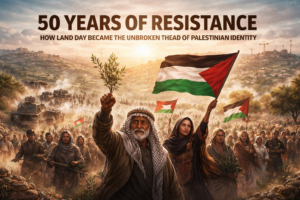
50 Years of Resistance: How Land Day Became the Unbroken Thread of Palestinian Identity
On a quiet morning in the Galilee region fifty years ago, the olive groves that had defined the landscape for centuries became the front line of a struggle that would come to define a people. On March 30, 1976, the Israeli government’s bulldozers were poised to move on 2,000 hectares (nearly 5,000 acres) of land—land that had been worked by Palestinian families for generations. But when the machinery arrived, they were met not by the empty fields they expected, but by a mass movement of unarmed citizens.
What followed was a turning point. Six Palestinians were killed, over a hundred were wounded, and the concept of “Land Day” (Yom al-Ard) was seared into the collective memory of Palestinians everywhere.
Fifty years later, the numbers tell a story of escalating crisis. In 2025 alone, Israel approved a record 27,941 settlement housing units in the occupied West Bank—more than double the number approved just two years prior. As the world marks the golden anniversary of Land Day in 2026, the question looms: is the event a historical memory or a daily reality?
The Roots of the Uprising: A Land Under Threat
To understand Land Day is to understand the legal architecture of displacement. The events of 1976 did not occur in a vacuum. They were the culmination of a policy known as the “Judaization of the Galilee.” Following the establishment of the State of Israel in 1948, the new government viewed the demographic reality of the Galilee—a region with a dense Palestinian population—as a threat to the state’s Jewish identity.
The plan in 1976 was sweeping. The government declared the confiscation of vast tracts of land owned by Palestinian citizens of Israel, ostensibly for “state purposes” and settlement expansion. For the Palestinian community, which had survived the Nakba (or “catastrophe”) of 1948—where over 700,000 Palestinians were displaced or fled—the land confiscations were not merely about acreage. They were an existential threat.
The confiscated area was immense; roughly the size of 3,000 football pitches. For context, it covered an area equivalent to the distance from the southern tip of Manhattan to the start of Central Park in New York City. For the residents of Sakhnin, Arrabeh, and Deir Hanna—the epicenters of the protests—it represented the erasure of their history and the suffocation of their future.
Unlike the protests that would erupt decades later in the West Bank and Gaza, the 1976 protesters were Palestinian citizens of Israel. They were protesting not as an occupied people in the international legal sense, but as citizens facing internal colonization. Their defiance broke a long-standing fear; it was the first time since 1948 that Palestinians inside the Green Line had organized a coordinated, national political strike against Israeli policy.
The Fires of Sakhnin
The protests began as a general strike. Schools closed, shops shuttered, and the normally bustling streets of the Galilee towns fell silent. But silence soon gave way to marches. As thousands took to the hills to physically stand between the bulldozers and their orchards, the Israeli military responded with live ammunition.
The images of that day—young men and women facing tanks with nothing but their bodies—became iconic. When the dust settled, the land was still confiscated, but something fundamental had shifted. Land Day transformed the Palestinian national movement. It unified Palestinians across geographic and political divides: those in the diaspora, those under occupation in the West Bank and Gaza, and those who remained as citizens inside Israel.
As one elderly resident of Sakhnin recalled in oral histories collected by local universities, “We didn’t just lose land that day; we gained a voice. We proved that our connection to this soil was stronger than their laws.”
From Historical Day to Contemporary Reality: The West Bank Eruption
While Land Day is a historical milestone, the mechanisms of land seizure have not only continued but have accelerated exponentially over the past decade.
In the occupied West Bank, where the majority of Palestinians live, the situation is now direr than at any point since the 1967 war. The recent statistics are staggering. According to data from the Israeli anti-settlement group Peace Now, the annual approval of settlement housing units has skyrocketed. In 2023, the government approved 12,349 units. In 2024, that number fell slightly to 9,884. But in 2025, the floodgates opened: a record-breaking 27,941 housing units were approved.
This is not organic growth; it is a calculated strategy. In December of 2025, Israel’s security cabinet approved a plan to formalize 19 illegal outposts across the West Bank. These are not isolated settlements on hilltops far from Palestinian cities; many are being established in the heart of densely populated Palestinian areas, a strategy designed to fracture the territorial contiguity of any future Palestinian state.
The violence accompanying this land grab has reached epidemic levels. Data shows that settler attacks—ranging from vandalism of olive trees to armed assaults on families—have risen steadily: 852 in 2022, 1,291 in 2023, 1,449 in 2024, and 1,828 in 2025. That averages out to five attacks per day. These attacks are often carried out with impunity, backed by military protection, creating an environment of terror that pushes Palestinians off their land without the need for formal eviction orders.
The Olive Tree: A Symbol of Silent Resistance
In the occupied territories and inside Israel, the commemoration of Land Day has taken on a ritualistic form: the planting of olive trees. The olive tree is a potent symbol in Palestinian culture—it represents resilience, deep roots, and economic independence. When Israel uproots olive trees (a common punitive measure or precursor to settlement expansion), Palestinians respond by planting more.
On Land Day, families gather on contested lands, often carrying saplings and water jugs past military checkpoints. It is a non-violent act of defiance that speaks louder than any political speech. For the international community, these plantings are often photographed as quaint traditions. For the Palestinians, they are acts of war against erasure.
A farmer from the Masafer Yatta region in the southern West Bank, an area that has been under threat of forced transfer for years, explained the ritual succinctly: “They have the guns, the laws, and the international backing. We have the trees. But the trees outlive the empires.”
A Shifting Legal Landscape: The 2026 Frontier
As the 50th anniversary arrives, the legal framework governing the West Bank is undergoing a radical transformation. On February 8, 2026, Israel’s security cabinet approved a series of measures that rights groups have condemned as “de facto annexation.”
These measures include easing the sale of Palestinian land to Israeli settlers—removing bureaucratic hurdles that previously offered some protection to Palestinian property rights—and expanding the powers of Israeli authorities in Areas of the West Bank that were ostensibly under Palestinian civil control under the Oslo Accords.
This is not merely settlement expansion; it is the dismantling of the structural framework of the Oslo Accords. By allowing settlers to purchase land deep in Palestinian cities and by extending Israeli administrative law over those areas, the government is creating facts on the ground that make the two-state solution geographically impossible.
The Toll of Silence: Gaza and the Global Response
While Land Day commemorates the death of six protesters in 1976, the context of 2026 is dominated by the staggering human toll of the ongoing conflict. In the Gaza Strip, which has been under a crippling blockade for nearly two decades, the death toll has exceeded 75,000 since October 2023, according to independent data verification. For the Palestinians marking Land Day in Gaza, there is no land left to march on—much of the territory has been reduced to rubble.
The international community’s response has been a mix of condemnation and paralysis. In recent months, while the United States has issued statements urging restraint, the “Board of Peace” updates remain contradictory, with reports indicating that despite declarations that the war in Gaza is “over,” Israeli attacks continue. This dissonance fuels the Palestinian narrative that Land Day is not just a memory, but a mirror reflecting the international community’s failure to enforce international law regarding land confiscation and occupation.
Why Land Day Matters Today
Fifty years later, Land Day endures not just as a commemoration of loss, but as a demonstration of continuity. For the Palestinian diaspora, it is a reminder of the land they have never seen. For the residents of the West Bank, it is the banner under which they resist daily home demolitions. For the 1.9 million Palestinian citizens of Israel, it is a reminder that their struggle for equality is intrinsically tied to the struggle for the land.
As the sun sets on March 30, 2026, the protests will look different from those in 1976. They will involve digital activism, drone footage of settlements, and global solidarity marches from New York to London. But the core remains the same.
The land is still being confiscated. The trees are still being uprooted. And the people are still marching.
One can look at the numbers—27,941 settlement units, 1,828 attacks, 75,000 dead—and see only statistics. But for the Palestinians who mark this day, these numbers are the story of a slow-motion displacement that began long before 1948 and accelerated in 1976. They see Land Day not as a historical event, but as a continuous state of being.
In the words of the poets who emerged from the 1976 protests, “We will not forget the names of our martyrs, and we will not abandon the land.” Fifty years on, as the bulldozers continue to move across the hills of the Galilee and the West Bank, that promise remains unbroken.
You must be logged in to post a comment.